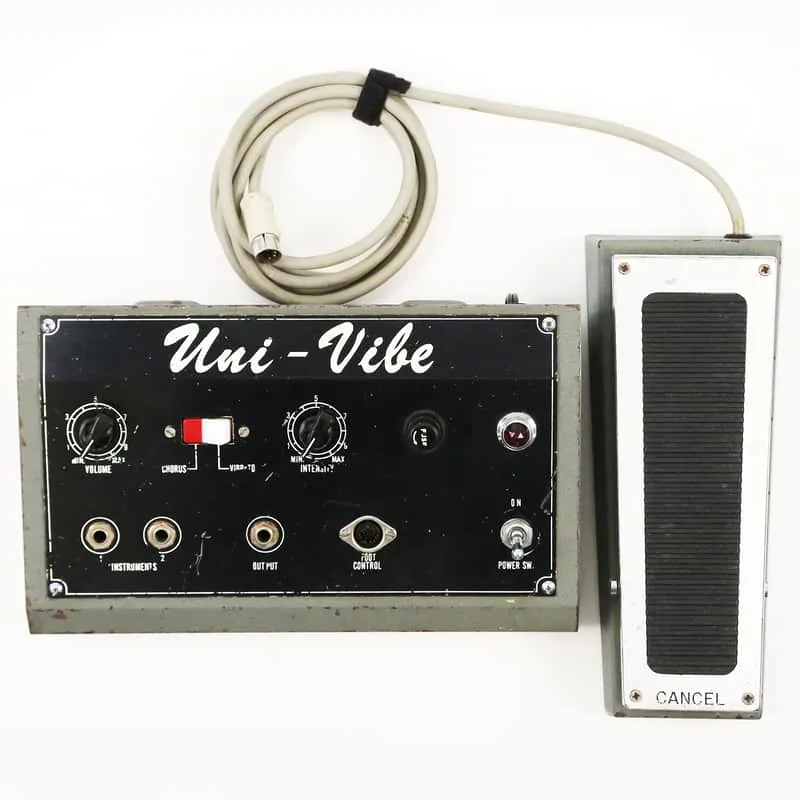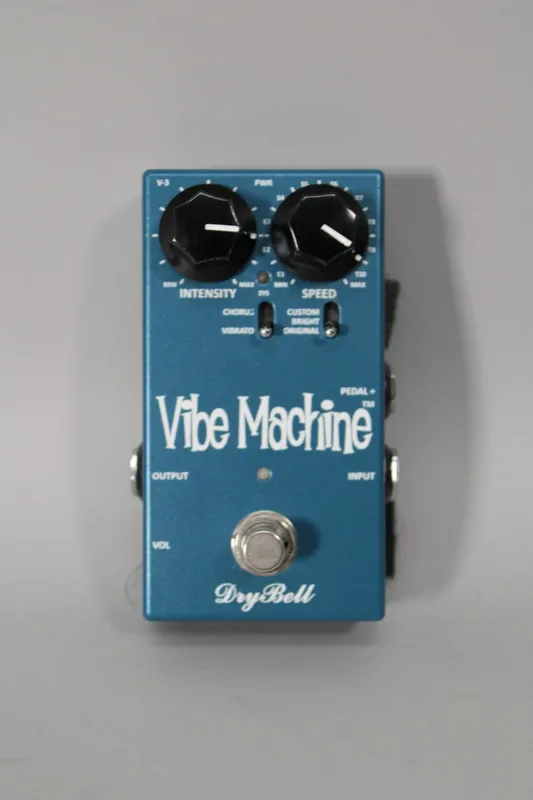


The DryBell Vibe Machine V-2 is a compact analog chorus/vibrato pedal that reproduces the sound of the classic Shin-ei/Univox Uni-Vibe using the same photocell approach as the original: a lamp and light-dependent cells create the modulation. DryBell announced it in January 2017 at $298.75, as the second version of the company's flagship pedal, adding features for extra tonal control and functionality based on feedback from users of the original123.
The V-2 is currently out of production; the line continues with the Vibe Machine V-3, which retains the layout and functions of the V-245. Like every Vibe Machine, it is handmade in Croatia by builders Zvonch and Kruno6.
What it does to your sound
The V-2 produces what DryBell's announcement called "classic, analog Uni-vibe sounds"1, with a Chorus mode and a Vibrato mode that each emulate the original Uni-Vibe but have, in Pedal of the Day's words, "a significantly different sound a feel to them"2. MusicRadar's reviewer Trevor Curwen described the pedal as using "analogue circuitry that uses the photocell methodology," the same optical system as the V-1389. Even in its small box it retains all the features of the classic Uni-Vibe, including the Cancel function, a warm and darker sounding preamp available using an expression pedal, just as on an original Uni-Vibe95.
DryBell says the controls help you achieve "that classic deep throbbing pulsating sound which can be adapted to any type" of gear1.
The controls: Intensity, Speed and two toggles
The front panel keeps things simple with two large knobs, while deeper shaping lives on side trimmers and toggles2109.
| Control | What it does |
|---|---|
| Intensity | Acts as the Depth/Character control for the effect2 |
| Speed | Acts as the Rate control for the effect2 |
| Chorus/Vibrato toggle | Chooses between Chorus and Vibrato modes; directly connected to the Intensity knob, giving each mode a different flavor2 |
| Original/Bright/Custom toggle | Selects the input impedance setting2 |
The three impedance settings each change how the pedal interacts with your guitar. Original keeps the vintage character, while, in Pedal of the Day's description, "The Bright mode gives you a brighter tone, as expected, adding a little life and sparkle to the pedal's output sound." Custom "gives you an impedance that falls somewhere between these two, and can be adjusted using the CUSTOM side" trimmer2. MusicRadar's reviewer noted the same idea: "A third Custom setting lets you set impedance somewhere between the two via a trimmer"3. The input impedance control exists so the pedal can be matched to different guitars10.
Around the sides are trimmers for internal tweaking. The V-2 carries a Volume trimmer that "sets the overall output of the pedal"2, a Chorus trimmer that "adjusts the 'chewiness' and depth of vibe modulation"1, and a set of side controls for depth of modulation, tone and output volume, with six side trimmers in total across the series for tailoring parameters related to tone and functions10.
Power and the Pedal+ jack
The Vibe Machine V-2 requires a standard 9V power supply drawing 170mA1. That current draw is on the high side for a compact analog pedal, so it is worth checking that your power supply can deliver it.
The Pedal+ jack is the V-2's expansion point, and it accepts two kinds of controller27:
- An expression pedal, to control the Speed of the effect "without having to bend down or interrupt your playing"2
- The optional F-1L Footswitch, designed for multiple purposes specifically for the V-2: Tap Tempo, Leslie FAST/SLOW mode, Two Speed mode, or engaging the Cancel function2
Players who use the external footswitch get access to the ramp feature as well; Steve Miller Band guitarist Jacob Petersen called "the ramp feature with the external foot switch... just icing on the cake"11.
History: from the V-1 to the V-3
DryBell's first Vibe Machine launched in 2010, claiming to be the smallest Uni-Vibe version in the world3. Builders Zvonch and Kruno spent four years of intense work developing the V-16, which Premier Guitar reviewed as a chorus/vibrato pedal with four photocells like the original Shin-ei/Univox Uni-Vibe, though in a smaller enclosure, at $295 direct12.
"Gorgeously authentic vintage Uni-Vibe tones."
The V-2 arrived in January 2017 as the second version of the flagship, keeping the same optical system as the V-1 while adding the impedance switch, side controls and the Pedal+ jack functions9. Pedal of the Day's overall impression of the V-2:
"this is one tiny machine that holds oodles of sonic power and tonal perfection"
At the LA Stompbox Exhibit 2021, DryBell unveiled the V-3, a 10th-year anniversary edition that retains the layout and functions of the V-25. The V-3 keeps the same tone but, in Delicious Audio's words, "delivers a modulation with deeper depth and character"10, and it adds:
- A redesigned Intensity control offering full usability across its entire range, improved over earlier models13
- An updated EQ function, so the pedal modulates without changing EQ, sounding roomier with more depth6
- A three-way ORIGINAL/BRIGHT/CUSTOM switch5
- A Sym/Range trimmer for the Character/Response of the vibe movement and lamp bias13
Delicious Audio's Paolo De Gregorio wrote that the "V-3 has its own colorful magic going on"5. The V-3 remains in stock, while the V-2 is out of production48.
Where it sits among vibe pedals
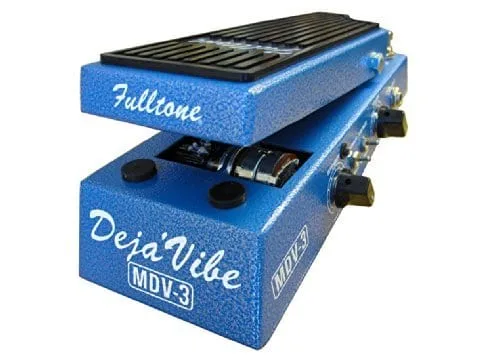
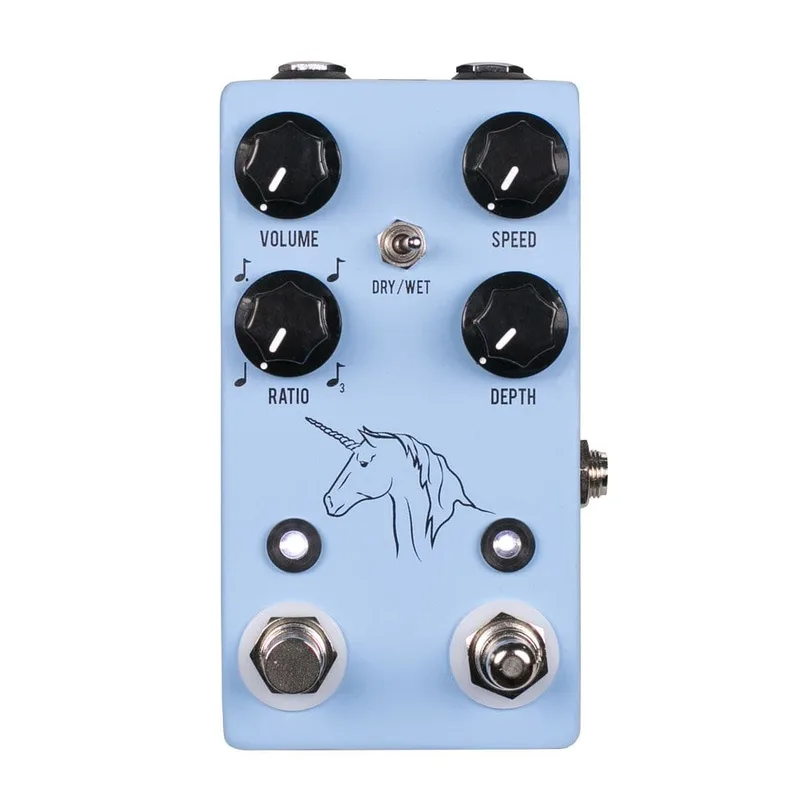
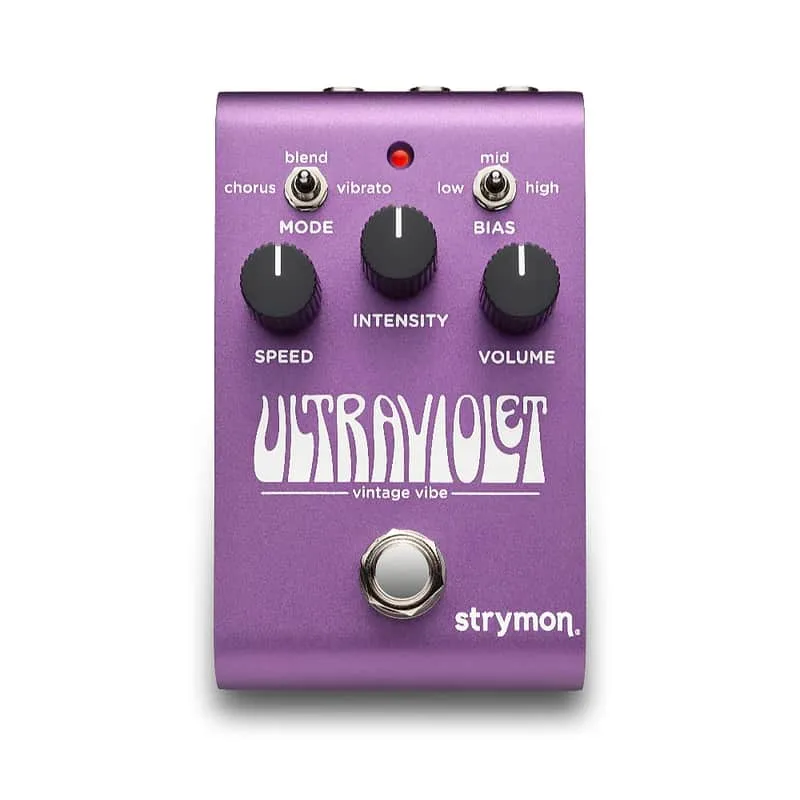
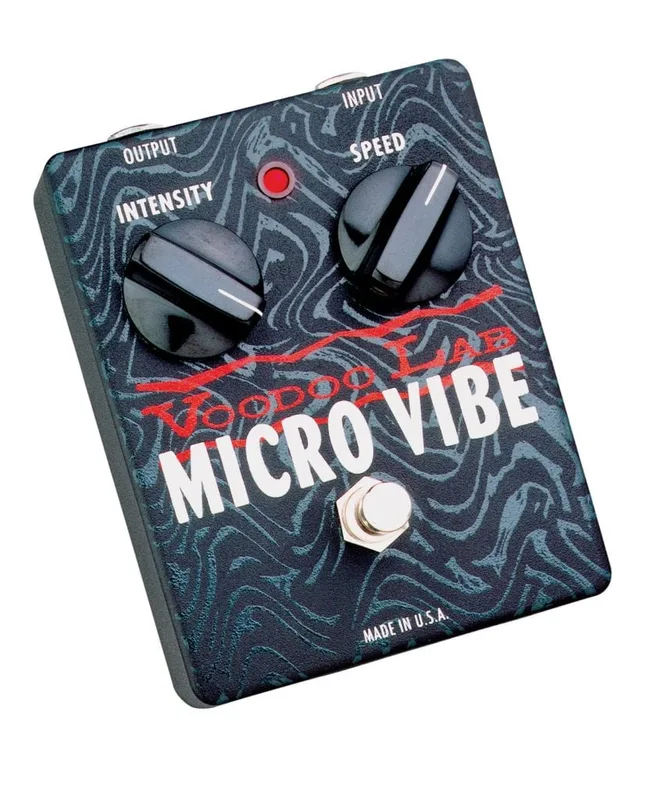
The Vibe Machine line is one of many modern pedals built on the Uni-Vibe's photocell circuit, alongside options like the Fulltone MDV3, JHS Pedals Unicorn V2, Strymon UltraViolet Vintage Vibe and Voodoo Lab Micro Vibe. Its distinguishing traits are its small enclosure, the input impedance switching for matching different guitars, and the Pedal+ jack's footswitch and expression functions. Players comparing pure vibrato pedals rather than Uni-Vibe-style chorus/vibrato can also look at the vibrato pedals category319.
Videos
ProGuitarShopDemos
Pete Thorn
DryBell Guitar Effects
Questions
Is the DryBell Vibe Machine V-2 still made?
No. DryBell lists the Vibe Machine V-2 as currently out of production. The line continues with the Vibe Machine V-3, which keeps the layout and functions of the V-2 and remains in stock, so a player wanting a new DryBell vibe pedal is looking at the V-3.
How much current does the Vibe Machine V-2 draw?
The Vibe Machine V-2 requires a standard 9V power supply drawing 170mA, as stated in the 2017 announcement. That is more than a typical small analog pedal, so it needs a power supply with adequate current rather than a low-output adapter.
What does the F-1L footswitch do on the Vibe Machine V-2?
The optional F-1L Footswitch plugs into the Pedal+ jack and serves several purposes designed specifically for the V-2: Tap Tempo, Leslie FAST/SLOW mode, Two Speed mode, or engaging the Cancel function. The same jack also accepts an expression pedal to control Speed while playing.
What is the difference between the Vibe Machine V-2 and V-3?
The V-3, a 10th-year anniversary edition, keeps the same tone but delivers modulation with deeper depth and character. It has a redesigned Intensity control with full usability across its range, an updated EQ function so it modulates without changing EQ, and a three-way ORIGINAL/BRIGHT/CUSTOM switch.
Where is the DryBell Vibe Machine made?
DryBell builds the Vibe Machine in Croatia. The company's builders, Zvonch and Kruno, spent four years developing the original V-1 before its launch, and the pedal is handmade in Croatia.
Is the DryBell V-1 Vibe Machine based on the Uni-Vibe?
Yes. Like the original Shin-ei/Univox Uni-Vibe, the V-1 features four photocells, though its enclosure is smaller. DryBell's first Vibe Machine launched in 2010 claiming to be the smallest Uni-Vibe version in the world.
Sources (13)
- DryBell Announces the Vibe Machine V-2, Premier Guitar, 2017-01-12
- DryBell Vibe Machine™ V-2 Chorus Vibrato, Pedal of the Day, 2020-01-11
- DryBell Vibe Machine V2 review, MusicRadar, 2018-07-11
- Manuals & FAQ, DryBell Guitar Effects, 2026-06-29
- DryBell Vibe Machine V3, Delicious Audio, 2026-01-07
- DryBell Vibe Machine: Awards, Press Reviews & Artist Picks, DryBell (drybell.com), 2024-03-21
- Best guitar effects pedals: The best FX pedals, MusicRadar, 2022-04-05
- Steve Stevens (Billy Idol) Reviews DryBell Pedals, drybell.com, 2026-09-29
- Dry Bell Vibe Machine, Delicious Audio, 2018-06-07
- The 9 Best Uni-Vibe Pedals In 2024: A Guide To UniVibe Clones, Delicious Audio (delicious-audio.com), 2024-02-16
- Jacob Petersen: Steve Miller Band Member & DryBell Enthusiast, DryBell, 2025-06-30
- Quick Hit: DryBell Vibe Machine Review, Premier Guitar, 2016-01-18
- DryBell Vibe Machine V-3: Classic Uni-Vibe Tones, DryBell Guitar Effects, 2026-09-24
 Joe Perry