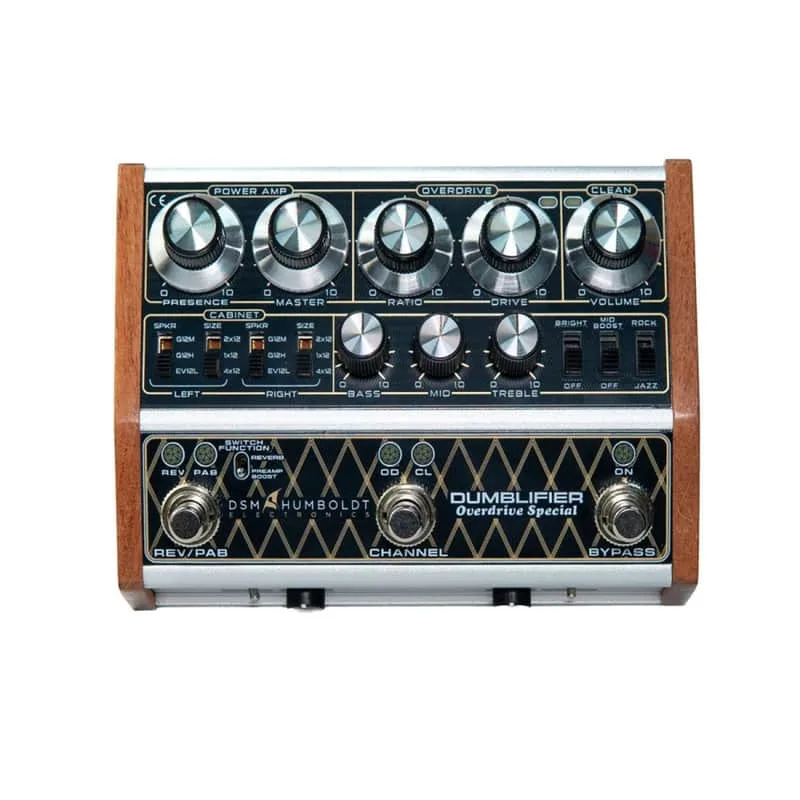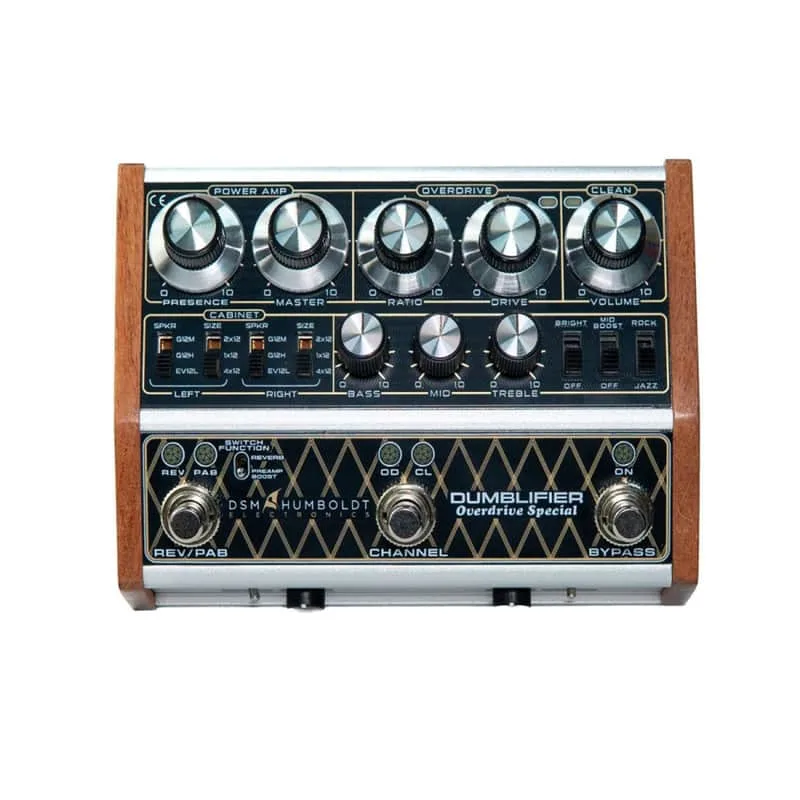


The DSM & Humboldt Dumblifier is an analog overdrive pedal that recreates Howard Dumble's Overdrive Special, the rare and expensive amp that, as the maker puts it, "guitarists around the world have dreamed of capturing the magic of"1. DSM & Humboldt says the design was fine-tuned after spending time with a genuine 1970s Dumble ODS in Tokyo, Japan, and that its analog amplifier modeling technology recreates not only the tone but also the compression behavior of the original2.
It works two ways. As a complete analog amp replacement, it runs with cab sim, stereo reverb and DI outputs straight to a desk, headphones or a recording interface. Or you can use it as a two-channel overdrive pedal in front of any rig13. Premier Guitar described it as "delivering the experience of playing a D-Style amp as it really feels," with "the unmistakable 'punchy compression' and smooth sustain that Dumbles are known for"3.
An Overdrive Special amp in a pedal
The Dumblifier packs a Dumble-style preamp and power amp into a pedal enclosure, with a Clean channel and an Overdrive channel sharing a 3-band EQ15. The maker positions it as an alternative to owning a real Overdrive Special, offering "all the features gigging and recording musicians demand, without the cost or fragility" of the amp itself1.
The two channels interact the way an amp's do. Gearnews reported that turning the clean channel's volume knob pushes the overdrive channel into a rich, saturated tone, and that the ratio and drive controls let you set the gain's intensity while balancing volume between the two channels4. That clean/overdrive blend is what the Ratio control does, a signature Dumble-style feature according to Delicious Audio's review5.
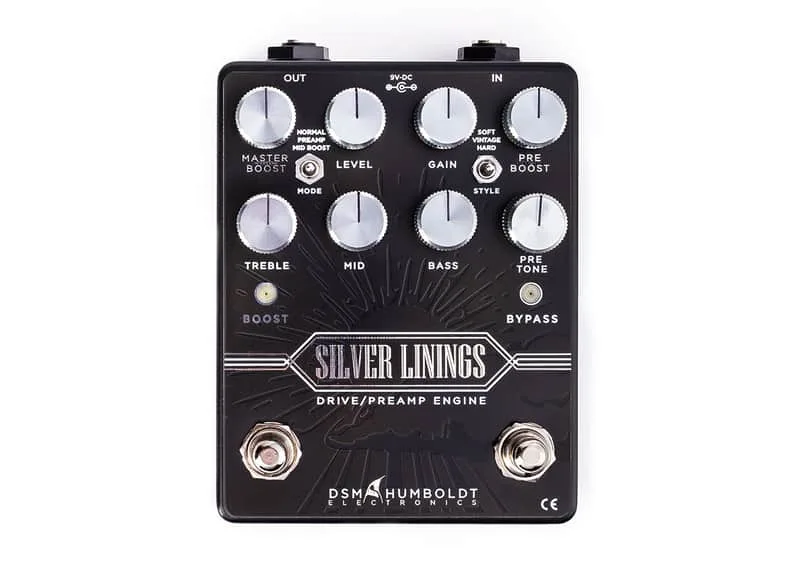
DSM & Humboldt is not new to amp-in-a-pedal designs; the Dumblifier follows earlier work such as the DSM Humboldt Silver Linings overdrive5.
The controls and footswitches
There are three footswitches: Reverb / PreAmp Boost, Channel (OD / CL) and Bypass6. The Reverb / PreAmp Boost switch does double duty: with the footswitch function switch set to "REV" it turns the reverb on and off, and the reverb amount is set by the REVERB knob on the front of the pedal1.
| Control | What it does |
|---|---|
| Ratio | Balances the clean/overdrive blend5 |
| Drive | Sets gain intensity45 |
| Master | Overall volume5 |
| 3-band EQ | Shared by both channels5 |
| Presence | Adjustes the power amp section's mid-high and high frequencies6 |
| REVERB knob | Sets reverb amount1 |
| Bright toggle | Bright voicing4 |
| Mid Boost toggle | Mid boost voicing4 |
| Rock/Jazz toggle | Voicing choice4 |
The toggles give quick voicing changes, in the spirit of the switches found on real Dumble amps, and the Presence control works on the power amp section rather than the preamp, which is where a Dumble's top-end character lives64.
Cab sims and stereo reverb
The cab sim offers three cabinet choices: 1x12 Combo, 2x12 Open Back, or 4x12 Closed Back4. The TRS outputs have cab sim bypass, which Premier Guitar called "extraordinarily flexible," since you can run the simulated outputs to a desk or interface and the bypassed outputs to a real amp3.
The reverb is footswitchable and stereo, with three types: Room, Ethereal and Plate6. A stereo FX loop sits between the pedal's preamp and its outputs, which Guitar Pedal X said "facilitates lock-tight pedalboard integration," so time-based pedals such as delay can go where they would sit in a real amp's loop6.
Guitar Pedal X also described the sound of one cab combination in its coverage: "EV12L + 2x12: Clear and punchy, nice SRV strat tones, with defined attack, but with extra note weight"6.
"Its extensive features, like the professional effects loop and high-quality built-in reverb, make it a viable all-in-one solution for direct recording or stage use."
Power and connections
The maker specifies 9V DC regulated, center negative, at 200mA2. Guitar Pedal X lists 9-12V DC at 150mA6. The two sources disagree on both the acceptable voltage range and the current draw, so plan your power supply for the higher figure.
The maker specifies a regulated 9V DC power supply with center negative polarity for this pedal26. Check your power supply's output rating before connecting it, since the maker's specification is the safe guide here.
Connections on the rear panel6:
- 1/4" TS mono input
- 1/8" aux in
- 1/4" TS right and left outputs, each with cab sim bypass
- 1/8" headphones out
- DI right and left (DIN)
- 1/4" send with right and left (mono) returns for the FX loop
The enclosure is a heavy-duty anodized aluminum box with wood side panels, 135 x 115 x 65 mm and 420 g6.
Price and what reviewers said
Published prices vary by region. DSM & Humboldt's listed pricing for the Dumblifier is a MAP of $569 in the United States, with an RRP of €599 in the EU and £519 in the UK6.
On value, Guitar Pedal X's Stefan Karlsson wrote:
"Considering the beautiful construction of this pedal, the $569 / €599 / £519 price tag actually seems relatively reasonable."
Gearnews noted before receiving a unit that it expected a high-quality build, "as DSM & Humboldt are known for making great quality analog pedals"4. Delicious Audio's June 2026 review found the effects loop and built-in reverb made it a viable all-in-one solution for direct recording or stage use5. One gap at launch: Guitar Pedal X noted there was no manual as yet6.
Videos
Andertons Music Co
Premier Guitar
DSM / Humboldt
News
Questions
Is the Dumblifier analog or digital?
Analog. DSM & Humboldt says it uses its proven analog amplifier modeling technology to recreate both the tone and the feel of a Dumble Overdrive Special, and Bass Magazine called it the first true analog solution to capture both. The cab sim, boost and stereo reverb are built into the same analog pedal format.
Can I use the Dumblifier with headphones?
Yes. The pedal has a dedicated 1/8 inch headphones output, plus a 1/8 inch aux input, so you can plug in and play silently. The built-in cabinet simulation means the sound is voiced for direct listening as well as for an amp or a mixing desk.
How much does the DSM & Humboldt Dumblifier cost?
Published prices differ. Premier Guitar and Bass Magazine reported an MSRP of $599 with a $549 MAP in January 2026, while Guitar Pedal X listed a MAP of $569 the same month, and Gearnews reported a Thomann listing of $585, with a launch listing of $555. Treat $549 to $599 as the published range.
Can I bypass the cab sim on the Dumblifier?
Yes. The two 1/4 inch TS outputs, left and right, each have a cab sim bypass, so you can run the pedal into a real guitar amp with the speaker simulation switched off, or use the simulated outputs for direct recording, headphones or the desk.
Is there a manual for the Dumblifier?
As of Guitar Pedal X's January 2026 review there was no manual yet. The maker's product pages describe the controls, the reverb switching and the power requirements, but a full printed or downloadable manual had not been published at that point.
Sources (6)
- THE DUMBLIFIER, DSM/HUMBOLDT, 2026
- SIMPLIFIER CLASSIC, DSM/HUMBOLDT, 2026
- DSM/Humboldt Introduces Dumblifier Overdrive Special, Premier Guitar, 2026-01-12
- DSM & Humboldt Dumblifier: Overdrive Special in a Pedal!, gearnews.com, 2026-01-09
- DSM Humboldt Dumblifier Overdrive Special, Delicious Audio, 2026-06-02
- Guitar Pedal X, Guitar Pedal X, 2026-01-13