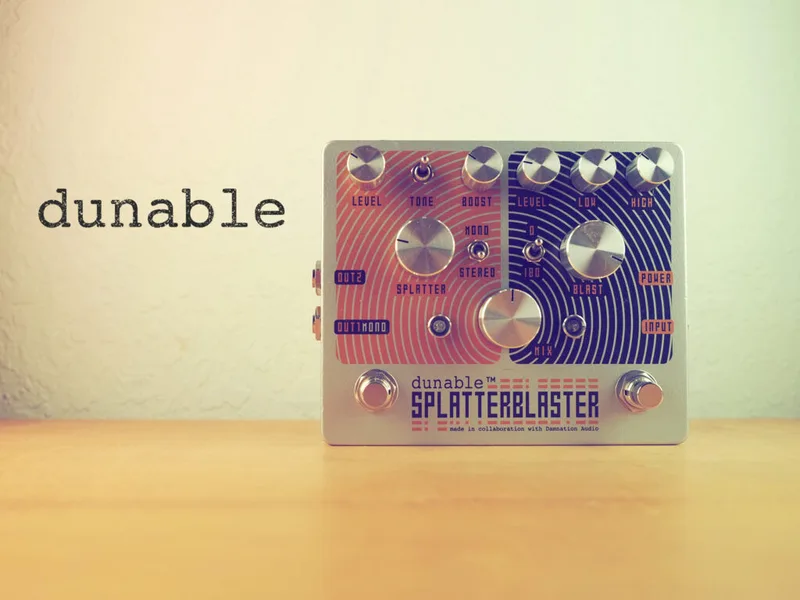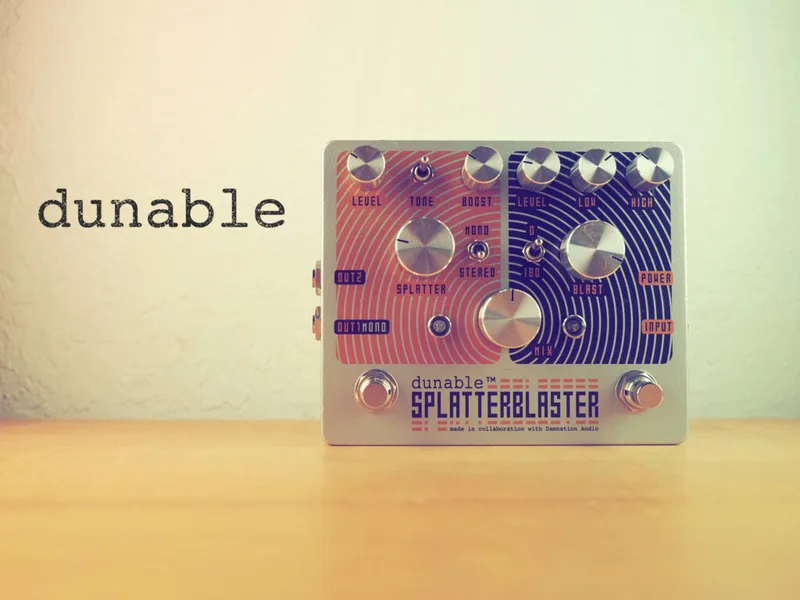


The Dunable SplatterBlaster is a fuzz pedal that puts two vintage fuzz circuits in one enclosure: the Splatter side is a Univox Super-Fuzz clone, and the Blaster side is a modified op amp Big Muff1. It is the debut pedal from Dunable Guitars, and Pedal of the Day describes it as a pedal developed by Dunable Guitars together with Damnation Audio2. What makes it unusual is that the two circuits run in parallel rather than in series, with a mix knob to blend them, a clean blend, and stereo outputs that can send each fuzz to its own amp1.
Two fuzz circuits in parallel
Most two-dirt pedals stack their channels, so one drives the other. The SplatterBlaster does the opposite: its circuits are arrayed in parallel, not series, so Splatter never cascades into Blaster or vice versa1. That changes what the pedal is for. Instead of adding gain stages for a heavier sound, you are blending two different fuzz voices, in any ratio, or blending either one against your clean signal.
The two voices come from well-known places. Splatter is a Univox Super-Fuzz clone, the octave-up Japanese fuzz design, while Blaster is a modified op amp Big Muff, the version of the Big Muff built around an op amp rather than discrete transistors1. Pedal of the Day describes the two channels as one fuzzy and one distorted, with the Blaster side covering a range from shoegaze to death metal to Pink Floyd2.
A stereo switch routes each effect to its own output, for feeding two amps or a stereo-compatible amp1. Pedal of the Day frames this as the pedal's reason for existing: it finally lets you run two different channels of dirt to two different outputs2.
The controls
Each side has its own control set, and Dunable supplemented the original circuits with extra knobs and switches1.
| Side | Control | What it does |
|---|---|---|
| Splatter | Splatter | Controls your gain2 |
| Splatter | Boost | Sets the amount of boost2 |
| Splatter | Level | Sets the output2 |
| Splatter | Tone toggle | Two-position switch, one setting fat and scooped, the other snotty and mids-forward1 |
| Blaster | Blast | Controls your distortion amount2 |
| Blaster | Level | Sets the output volume2 |
| Blaster | Low and High EQ | Two-band EQ section2 |
| Blaster | Bass | Hefty low-end boost centered around 100 Hz1 |
| Blaster | Tone | Single-knob control that adjusts bass and treble while reconfiguring the midrange1 |
| Blaster | 0/180 toggle | Flips the phase of the circuit2 |
The Splatter side's marquee feature is its two-position tone toggle: one setting is fat and scooped, the other snotty and mids-forward1. Dunable also supplements the original gain and volume controls with a boost pot1.
On the Blaster side, Dunable added a bass pot that applies a hefty low-end boost centered around 100 Hz1. The tone control is a faithful rendition of the Big Muff's iconic single-knob design, where the knob's sweep does not simply cut highs but adjusts bass and treble while reconfiguring the midrange1.
Two features work across both sides. A mix knob blends the fuzzes in varying ratios, and it stays active even when one fuzz is bypassed, so you can mix either fuzz with the clean signal1. And a phase-reverse switch flips the polarity of one circuit, which matters when you are running two amps or blending signals that can cancel each other's low end1.
What reviewers said
Premier Guitar reviewed the pedal in September 2023 and summed it up in three lines1:
"Two classic fuzz circuits in one box. Ferocious crunch tones. Clever blending options."
The reviewer found the pedal equally potent on guitar and bass, and said its mixing, stereo and clean-blend abilities unlock a world of compelling crunch tones1. On bass specifically, the verdict was stronger still: "SplatterBlaster may be my fave bass fuzz ever," with devastating results on bass1. Build quality and value also drew praise: the pedal is well made, with enclosure-mounted jacks and classy metal knobs, and fairly priced at $2991.
The review was not all positive. The circuits are not very responsive to guitar dynamics, so you cannot clean them up or soften their edges by lowering the guitar's volume1. The Splatter circuit is not loud: even maxed out, the signal is not much louder than bypass, and its control effects are less pronounced than a Super-Fuzz's1. On guitar, the Blaster side's bass pot can overwhelm the traditional tone control, generating overly dense and thudding tones1.
Pedal of the Day reviewed the pedal in October 2020 and called it "truly unlike any other pedal we've seen in our 7 years"2.
Power and practical notes
The SplatterBlaster has no battery compartment, so it needs a power supply. It runs on standard 9-volt power supplies1.
For a player comparing dirt pedals, the parallel layout is the main thing to weigh. If you want a fuzz that stacks gain into a distortion for a heavier composite sound, this is not that pedal. If you want two distinct fuzz voices you can blend with each other or against your clean signal, and the option to run each into its own amp, the SplatterBlaster is built exactly around that idea1. Bass players get an extra reason to look: the Blaster side's 100 Hz bass boost and the reviewer's bass verdict both point that way1.
Videos
Premier Guitar
Dunable Guitars
Dunable Guitars
Questions
Is the Dunable SplatterBlaster a stereo pedal?
Yes, in a specific way. It has two outputs, and a stereo switch routes each fuzz circuit to its own output, so you can feed two amps or a stereo-compatible amp. With the switch off, the two channels run together to a single output.
Does the Dunable SplatterBlaster take a battery?
No. Premier Guitar's review notes it has no battery compartment, so it needs a power supply. It runs on standard 9-volt power supplies, the same kind most pedalboards already use.
What circuits is the SplatterBlaster based on?
The Splatter side is a Univox Super-Fuzz clone, and the Blaster side is a modified op amp Big Muff. Dunable added extra controls to each, including a boost pot on the Splatter side and a bass pot centered around 100 Hz on the Blaster side.
Can the Dunable SplatterBlaster run both fuzzes at once?
Yes. The two circuits are arrayed in parallel rather than in series, so neither cascades into the other. A mix knob blends the two fuzzes in varying ratios, and it stays active even when one fuzz is bypassed, so you can also mix either fuzz with your clean signal.
Does the SplatterBlaster work on bass?
Yes. Premier Guitar's reviewer found it equally potent on guitar and bass, and went as far as calling it possibly a favorite bass fuzz ever, with devastating results on bass. The Blaster side's bass pot, which boosts lows around 100 Hz, is aimed at that kind of use.
Who made the Dunable Splatterblaster Stereo Fuzz Distortion?
It is the debut pedal from Dunable Guitars, the guitar maker. Pedal of the Day describes it as a pedal developed by Dunable Guitars together with Damnation Audio.
Sources (2)
- Dunable SplatterBlaster Review, Premier Guitar, 2018-12-06
- Dunable Splatterblaster Stereo Fuzz Distortion, Pedal of the Day, 2020-10-09