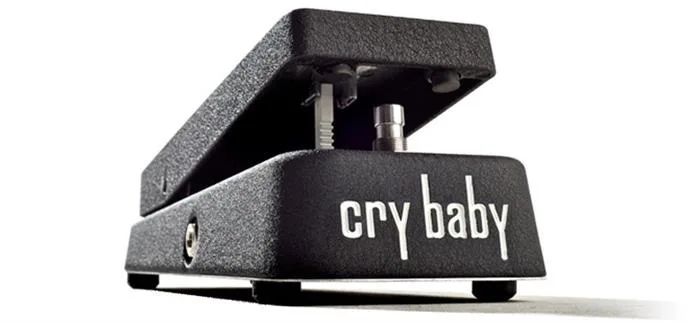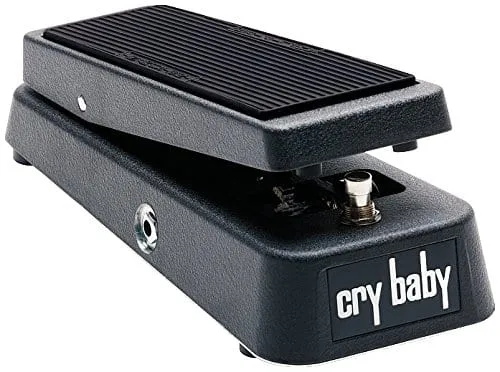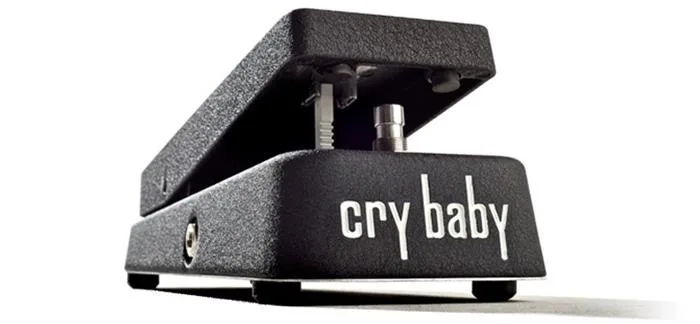


The Dunlop Cry Baby GCB-95 is a wah pedal: an analog bandpass filter that boosts a resonant frequency around 750 Hz while attenuating harmonics above and below it, and you sweep that peak up and down with your foot1. Dunlop calls it the Cry Baby Standard Wah, "a modern interpretation of the original 1966 Cry Baby Wah sound"2. It was introduced in 1982 as Dunlop's first Cry Baby, and a circuit analysis describes it as maybe the most sold guitar pedal of all time13.
The effect is simple to use but distinctive. Rocking your foot back and forth on the pedal changes the effect on your tone instantaneously, moving the resonant peak from about 450 Hz in the heel-down position to 1.6 kHz at toe down, with selected frequencies boosted by up to 18 dB14.
What it does to your sound
The GCB-95 is a bandpass filter with a resonant peak centered at 750 Hz when the rocker is at its mid position, sweeping from 450 Hz to 1.6 kHz across the pedal's travel1. The manual gives the underlying filter ranges as a low pass of 350 Hz to 450 Hz and a high pass of 1.5 kHz to 2.5 kHz4. Maximum gain is +19.5 dB heel down and +19 dB toe down, with a maximum output level of +10 dBV4.
Dunlop describes the result as a focused high end and an aggressive wah sound2, and Guitar.com notes that, compared to the original, the GCB95 has a more focused high-end and more aggressive wah characteristics8. In MusicRadar's buying guide, Michael Astley-Brown wrote that "the GCB95's aggressive sweep makes it one of the best wahs for cutting through swathes of distortion"9.
How the circuit works
The design uses three cascaded transistor stages with a handful of passive components and an inductor, which keeps power consumption below 1mA1. The transistors are an MPSA13 for the input buffer and MPSA18s for the two following stages1.
The stages in order:
- Input buffer: an emitter follower (common collector NPN amplifier) with unity voltage gain, high input impedance and low output impedance. A 0.01µF input capacitor isolates the guitar from the pedal's DC potential and removes hum1.
- Active filter: a common-emitter amplifier with a voltage shunt feedback network made up of R6 (470KΩ) and R8 (82KΩ). Its calculated gain of 56.4 (35 dB) is reduced in practice to 19 dB by the feedback network1.
- Output stage: another emitter follower acting as a low output impedance buffer with approximately unity gain, buffering the signal from the VR1 wiper1.
The wah action itself comes from a capacitance trick. The apparent capacitance of C2 depends on the gain of the first stage, which is set by the VR1 position; combined with the inductor L1 (500mH), this forms a resonant circuit tuned by that apparent capacitance1. One practical detail: the output jack is taken before VR1, so the pedal's position does not affect output volume level1.
The rocker and the 100K potentiometer
The foot pedal drives a 100KΩ potentiometer, which Dunlop brands the Hot Potz. The output of the second transistor stage feeds this VR1 voltage divider, and the rocking action shifts the resonant frequency up and down while regulating the active filter stage's voltage gain from 19 dB down to 1 dB1. MusicRadar's buying guide notes that "a 100k ohm Hot Potz potentiometer makes for some of the smoothest wah-ing in the biz"9.
Power and connections
Setup is straightforward: run a shielded instrument cable from your guitar into the GCB95's input jack, then another from the Amplifier jack into your amplifier input4.
Power options from the manual4:
- One 9 volt battery, accessed via the bottom of the pedal
- A Dunlop ECB003 AC adapter (ECB003E in Europe)
- A Dunlop DCB10 DC Brick power supply
Dunlop's product page also lists the DC Brick, Iso-Brick and Mini Iso-Brick supplies as compatible2. Current draw is 900µA4. On the power line, a ZL9M3 9.1V zener diode regulates the supply, protecting against voltage peaks over 9.1V and reverse polarity connections, while capacitors C6 and C7 remove noise1. A 2016 MusicRadar review noted that the power jack is standardized for PSU use10.
History: from the Vox V847 to the GCB-95
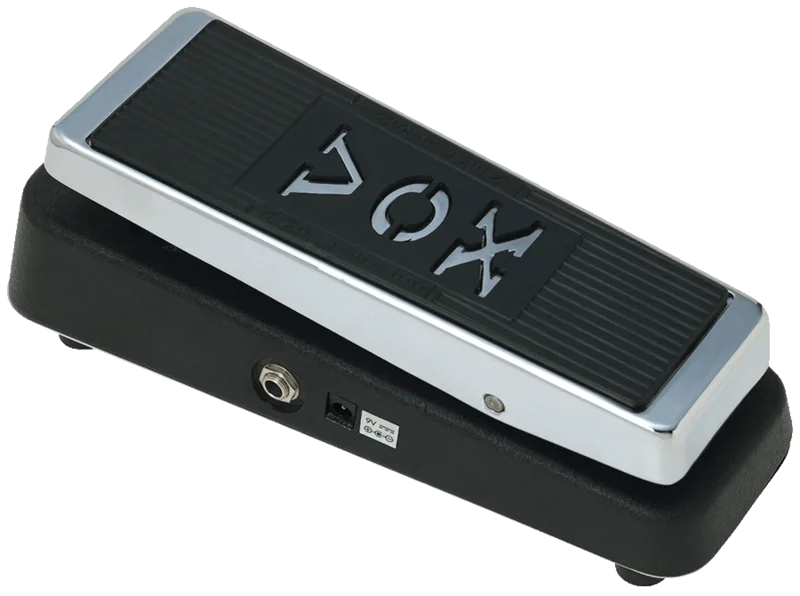
The pedal that would eventually become the Cry Baby was first created in 1966 by engineers at the Thomas Organ Company11. The GCB-95 itself is a copy of the original VOX model made by VOX/Thomas Organ Co in 19701, and Dunlop introduced the GCB95 Cry Baby Wah, its first, in 19823.
The circuit is very close to a Vox V847. As IvIark at Guitar FX Layouts put it111:
"And ...change the 390R with 510R and 82K with 100K and we'll have the Vox V847! :D without input buffer!"
The real difference is that input buffer. Dunlop added it to raise the input impedance from 69.5KΩ to 1MΩ, preserving the guitar's original tone; the trade-off is that the buffer filters part of the bass content, so the Cry Baby has slightly less bass than the V8471. The manual lists input impedance as 800 kΩ and output impedance as 10 kΩ4.
The design evolved over the years: before 1990 the jacks were wired to the board; from around mid-1990 they were mounted directly on the PCB; from mid-1991 a buffer circuit was added before the wah circuit (present if the PCB says "Rev F" or higher); and the current revision is much like models since mid-19921. In 2004 Dunlop replaced its original custom inductor with the classic red Fasel Inductor in the GCB953.
Versions and the GCB-95F Classic
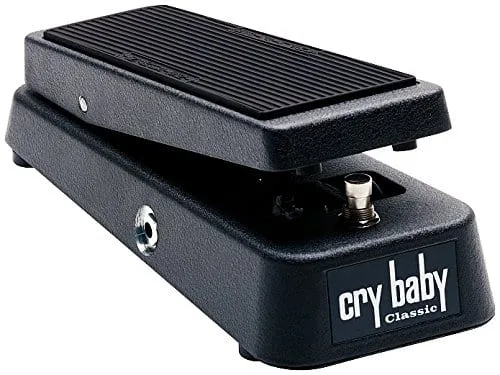
Dunlop makes many other Cry Baby wahs, including the GCB95F Cry Baby Classic12. Released in 2003, the GCB95F was built around the famous red Fasel Inductor for a lush, vocal sound, the same inductor later added to the GCB953. MusicRadar's review of the Classic highlighted its "vocal sweep and lush harmonics" and noted that it "scores big-time by enabling either the use of batteries or Dunlop's ECB03 AC adaptor"13. The GCB95F runs on 9 volts DC14.
The GCB95 circuit also lives on in signature models. The TBM95 Tom Morello Signature Cry Baby houses an identical circuit to Tom Morello's early-'80s GCB95, with the same 100K ohm Hot Potz potentiometer15. The GCB95 lists at $99.9926; MusicRadar noted in 2024 that you can pick one up for $9916.
Common mods
The GCB-95 is one of the most modded pedals around, and Griffin Effects' mod service covers GCB-95 all revisions, GCB-100, ZW-45, JH-1 and JC9517. Common modifications from the circuit analysis1:
| Mod | What changes |
|---|---|
| True bypass | A 3PDT switch bypasses the whole circuit, typically wired before the input buffer stage1. Griffin Effects sells a true bypass kit rated as beginner difficulty that works with all GCB-95 revisions18. |
| Vocal mod | Replace the 33KΩ R7 with a larger value such as 39KΩ, 68KΩ or 100KΩ for a more vocal sound; reducing R7 spreads the filter bell1. |
| Bass mod | Increase C2 (bass players typically go to 0.068µF) to move the sweep range lower for better bass wah response1. |
| Gain/bass mod | Reduce emitter resistor R4 (default 390Ω) for a slight addition of gain and bass content1. |
| Heel-down emphasis | Increase R2 from its default 1.5KΩ to 2KΩ or 2.7KΩ to make the heel-down position sound slightly stronger and more emphasized1. |
What reviewers said
MusicRadar's review of the Jim Dunlop Cry Baby GCB-95 summed it up as "some welcome tweaks for this classic wah"10. On That Pedal Show, comparing five classic wah pedals, the presenters came to a realization about the modern version:
"including the realisation that the modern GCB95 seems to be true bypass… which it never was back when this was all fields"
That bypass question is where sources disagree: the circuit analysis describes a true bypass switch1, That Pedal Show found the modern GCB95 seems to be true bypass12, while Gearnews describes the GCB95 as having a hardwire bypass that keeps your tone clean when switched off7. Older revisions were certainly not true bypass, which is why the 3PDT mod remains popular.
Videos
Sweetwater
Pedal Tone
Reverb
Questions
Is the Cry Baby GCB-95 true bypass?
Sources disagree. A circuit analysis of the GCB-95 describes a true bypass switch, and on That Pedal Show the presenters concluded the modern GCB95 seems to be true bypass, which it never was in earlier decades. A Gearnews buying guide, though, describes the GCB95 as having a hardwire bypass that keeps your tone clean when switched off. Older revisions were not true bypass, and a 3PDT true bypass mod is a common upgrade.
Does the GCB-95 take a 9V battery?
Yes. The Dunlop manual specifies one 9 volt battery accessed via the bottom of the pedal. It can also be powered by a Dunlop ECB003 9-volt adapter (ECB003E in Europe), or by Dunlop's DC Brick, Iso-Brick and Mini Iso-Brick power supplies. Current draw is 900µA, so a battery lasts a long time.
What is the difference between the GCB95 and GCB95F?
The GCB95 is the Standard Wah, a modern interpretation of the original 1966 Cry Baby sound with a more focused high end and more aggressive character. The GCB95F Cry Baby Classic, released in 2003, was built around the red Fasel inductor for a lush, vocal sound. The red Fasel was later added to the GCB95 as well, in 2004, so the two pedals now share that inductor.
What inductor is in the Cry Baby GCB-95?
The circuit uses an L1 inductor of 500mH. Since 2004 the GCB95 has been fitted with the red Fasel inductor, the type found in various vintage wahs, which Dunlop credits with a sweeter sweep. Before that it used Dunlop's own custom inductor.
How do you mod a Cry Baby for bass?
The common bass mod is to increase the value of capacitor C2, which moves the sweep range lower. Bass players typically go up to 0.068µF for a better bass wah response. Reducing the emitter resistor R4 also adds a slight amount of gain and bass content. Dunlop also makes dedicated bass wahs, such as the CBM105Q Cry Baby Mini Bass Wah.
Is the Cry Baby the same circuit as a Vox wah?
Very close, but not identical. The GCB-95 is based on the original Vox model made by Vox/Thomas Organ, and changing two resistor values (390R to 510R and 82K to 100K) essentially gives a Vox V847. The difference is that Dunlop added an input buffer, raising input impedance from 69.5KΩ to 1MΩ, which preserves the guitar's tone but filters some bass content.
Sources (18)
- Dunlop CryBaby GCB-95 Cicuit Analysis, GuitarPCB
- CRY BABY® STANDARD WAH, Dunlop (jimdunlop.com)
- Evolution of the Cry Baby Wah at Dunlop, Dunlop (lifestyle.jimdunlop.com), 2017-04-27
- GCB95.pdf, Jim Dunlop, 2019
- GCB95 Cry Baby Wah (Sparkly Red) by Dunlop, RockBoard (PedalPedia), 2026
- TOM MORELLO CRY BABY® WAH, Dunlop (jimdunlop.com)
- The Best Wah Wah Pedals for Iconic Guitar Tones: Cry Baby and Beyond, gearnews.com, 2025-08-18
- Dunlop announces limited edition Tom Morello Cry Baby Wah, Guitar.com, 2020-09-16
- Best wah pedals: Add extra expression to your sound, MusicRadar, 2020-09-20
- Jim Dunlop Cry Baby GCB-95 review, MusicRadar, 2016-12-20
- Guitar FX Layouts: Jim Dunlop CryBaby GCB-95, Guitar FX Layouts (tagboardeffects.blogspot.com), 2014-11-18
- Five Classic Wah-Wah Pedals Compared With Plenty Of Fuzz Face Fun, That Pedal Show, 2019-01-18
- Dunlop Cry Baby Classic GCB-95F review, MusicRadar, 2012-03-05
- GCB95F.pdf, Jim Dunlop, 2020
- Dunlop unveils the Tom Morello signature wah, MusicRadar, 2020-09-17
- “We are honoured that our company's relationship with the legendary guitar player continues to this day”: Dunlop salutes wah pedal pioneer Eric Clapton with a gold-plated signature Cry Baby, MusicRadar, 2024-11-19
- Griffin Effects Custom Modification Service Dunlop GCB-95 Crybaby Wah, Griffin Effects
- Crybaby GCB-95 True Bypass Kit, Griffin Effects