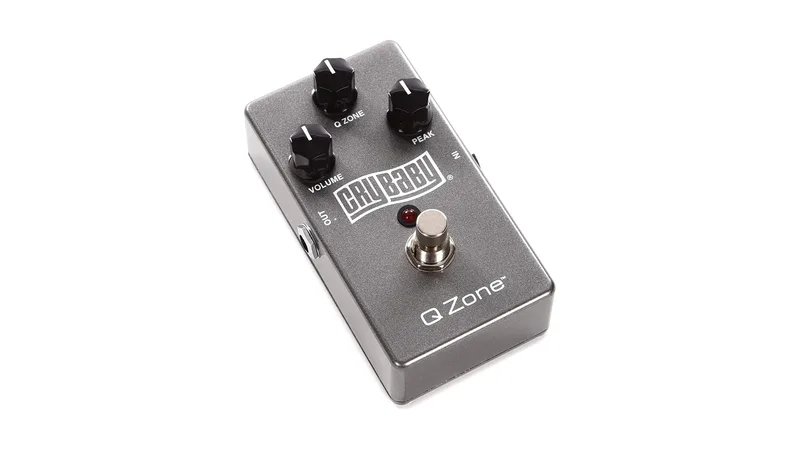


The Dunlop Cry Baby QZ1 Q Zone is a fixed wah pedal: instead of a rocking treadle that sweeps the wah effect up and down, it holds the effect at one chosen frequency and keeps it there. Guitar World's reviewer, Trevor Curwen, describes it as mimicking a "cocked wah", the sound of a wah pedal held in a fixed position, a technique many players use for its resonant treble boost and enhanced harmonic content1. Dunlop's own buying guide puts it simply: "Get the sound of a fixed wah without the rocker"2.
For a player, that means the Q Zone delivers the vocal, quacking quality of a parked wah without having to balance a treadle in position with a foot, and without the pedal taking up the long, treadle-shaped footprint of a standard Cry Baby. It is made in the USA by Dunlop1.
A fixed wah: the sound of a cocked wah pedal
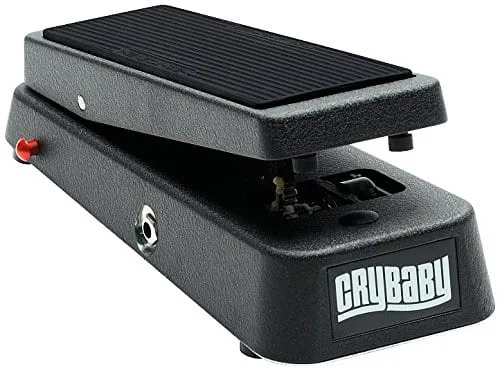
A conventional wah pedal, such as the Dunlop GCB95 Original Cry Baby, uses a treadle the player rocks with their foot to sweep a bandpass filter across the frequency spectrum. Many players instead park the treadle at one spot and leave it there, a technique known as a cocked wah, to get a fixed resonant peak that fattens single-note lines and adds harmonics. The Q Zone is built around that sound: it is a bandpass filter whose center frequency and shape are set with knobs rather than a treadle.
Dunlop's buying guide describes the control interface as allowing "adjustment of boost, bandpass shape, and frequency center"2. In other words, the pedal gives a player the three things they would otherwise get by physically positioning a wah treadle and hoping it stays put, plus a level control, all in a compact box that fits on a pedalboard.
The pedal is currently in its original three-knob form. Guitar World notes it is "back in original three-knob guise after the four-knob CSP030 Custom Shop version", so players comparing used or older stock may come across that earlier four-knob Custom Shop variant1.
The controls: Volume, Peak and Q Zone
The Q Zone has three knobs and a bypass footswitch1. Each knob maps directly onto something a player would otherwise do with a treadle or would want on top of one.
| Control | What it does |
|---|---|
| Volume | Sets the output level of the effect, with a range of 0 dBV to 20 dBv3 |
| Q Zone | Adjusts the bandpass shape from wide to narrow, dialing in the intensity of the effect31 |
| Peak | Sets the frequency center of the effect, across a range of 380 to 2000 Hz3 |
| Bypass footswitch | Switches the effect in and out1 |
The Peak control is the heart of the pedal. Guitar World explains that it "has the same function as the rocker pot of a wah pedal, setting the centre frequency and essentially mimicking the treadle position"1. Dunlop's buying guide says the same thing from the maker's side: "the Peak control acts like the rocker pot of a wah pedal"2. Turning Peak is the equivalent of moving a treadle to a new spot and leaving it there, with the 380 to 2000 Hz range covering the useful part of a wah's sweep3.
The Q Zone knob shapes how pronounced the effect is. Guitar World describes it as setting "the bandpass shape (broad or narrow) and effectively dials in the intensity for more throatiness or quack"1. A wide setting gives a gentler, broader emphasis; a narrow setting focuses the boost tightly around the center frequency for a more vocal, aggressive character.
The Volume knob is more than a matching control. Guitar World found that "the volume knob has plenty extra to drive your amp if you want to incorporate a boost"1, so the pedal can double as a level push into an overdriving amp. The manual's figures back this up: maximum gain at the center frequency is +16 dBV with the Q Zone knob fully clockwise3.
Power and connections
Setting the pedal up is straightforward. The manual's instructions are to run an instrument cable from the guitar into the QZ1's INSTRUMENT jack, then another instrument cable from the QZ1's AMPLIFIER jack into the amplifier's input3.
Power comes from one 9-volt battery, installed by removing the bottom plate, or from a 9V DC supply3. The manual names the Dunlop ECB003 and ECB003EU adapters, as well as the DC Brick and Iso-Brick power supplies, as suitable sources3. Guitar World notes the adapter is not supplied with the pedal1.
The QZ1 draws only 4 mA3, so it places very little demand on a shared or isolated power supply and is easy to accommodate on a crowded board.
The manual also lists an input impedance of 1 MΩ, an output impedance below 2.2 KΩ, and a noise floor of -91 dBV A-weighted with all controls at their mid positions3. For a player, the 1 MΩ input means the pedal presents the same loading to guitar pickups as a typical amplifier input, so passive pickups retain their top end.
What reviewers said
Guitar World's Trevor Curwen reviewed the pedal and summed it up as:
"A niche pedal maybe, but one that does its job perfectly with no worries about treadle positioning1."
Guitar World, 20261
The review's street price for the Q Zone is £1591.
Videos
Gear4music Guitars
The Bass Channel
MR-Max Tube
Questions
What frequency range does the Dunlop Q Zone cover?
The Peak knob sets the frequency center of the effect across a range of 380 to 2000 Hz, according to the Jim Dunlop manual. That range spans the sweep a player would find by rocking a wah treadle, so the Peak control effectively stands in for the treadle position.
Can the Q Zone be used as a boost?
Yes, in a practical sense. Guitar World's reviewer noted that the volume knob has plenty of extra level to drive an amp if a player wants to incorporate a boost. The manual lists a volume range of 0 dBV to 20 dBv, and a maximum gain of +16 dBV at the center frequency with the Q Zone knob fully clockwise.
Is the Dunlop QZ1 true bypass?
The Jim Dunlop manual lists the bypass as True Hardwire, and Guitar World's review lists it as true bypass. When the pedal is off, the signal path does not pass through the effect circuitry.
Does the Dunlop Q Zone run on a battery?
Yes. The manual specifies one 9-volt battery, installed by removing the bottom plate. It can also run on a 9V DC adapter such as the Dunlop ECB003 or ECB003EU, or from Dunlop's DC Brick and Iso-Brick power supplies.
How much current does the QZ1 Q Zone draw?
The Jim Dunlop manual lists a current draw of 4 mA, which is low enough that the pedal places very little demand on a shared power supply.
Sources (3)
- Dunlop Cry Baby QZ1 Q Zone review, Guitar World, 2020-07-14
- RANGE OF EXPRESSION: FIND YOUR CRY BABY® WAH, Dunlop (lifestyle.jimdunlop.com), 2021-10-08
- QZ1.pdf, Jim Dunlop, 2020