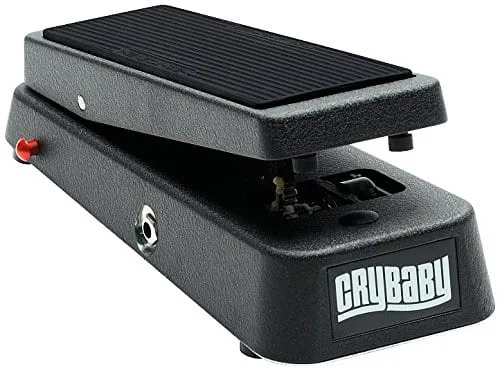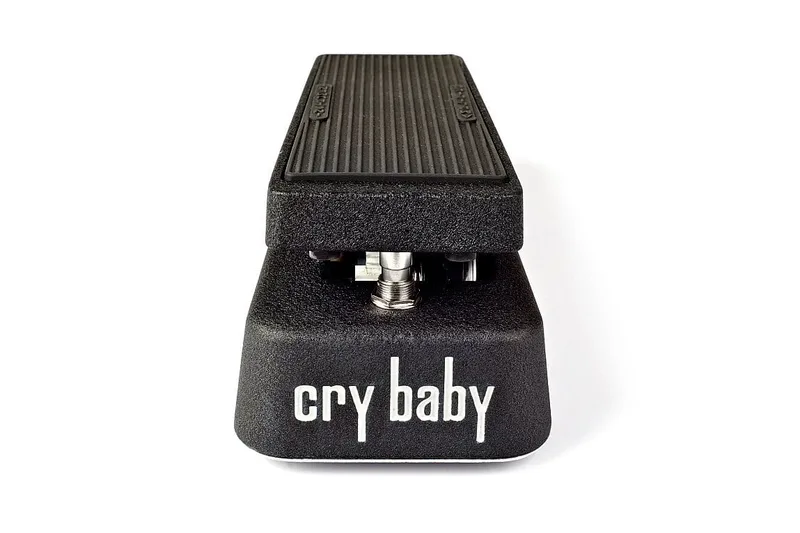


The Dunlop Clyde McCoy Cry Baby (CM95) is a wah pedal from Dunlop that pays tribute to the first production wah wah ever made. Dunlop describes it as capturing the throaty, expressive sound of the original Clyde McCoy wah, with a smooth vocal quality that comes from its Halo inductor1. It was released in 20142 and is aimed at gigging players who want the classic Clyde McCoy sound with the consistency and convenience needed on the road, so a vintage wah can stay safely at home1.
The original Clyde McCoy wah goes back to 1967, when Vox and the Thomas Organ Company began manufacturing it3. Dunlop later inherited the original tooling and machinery used to design and manufacture the first Clyde McCoy pedals from the Thomas Organ Company and Jen Electronica4, and drew on decades of wah design experience to make the CM95 faithfully represent that tone5.
What it does and how it sounds
A wah pedal is a bandpass filter whose center frequency you control with your foot: rocking the pedal sweeps the filter up and down, giving the guitar a vocal, talking quality. On the CM95, the filter center frequency sweeps from 410 Hz to 2.2 kHz5. Pushing the toe of the pedal down until you feel a click turns the pedal on and off5.
Dunlop says the CM95 captures the throaty voice and expressive sweep of the original Clyde McCoy while offering gigging players consistency and convenience on the road5. The company calls it the definitive recreation of the Clyde McCoy circuit and sound2.
The heart of that sound is the inductor. The CM95 uses Dunlop's proprietary Halo inductor, which Dunlop says reproduces the Clyde McCoy's famous vocal sound while minimizing microphonic noise thanks to its stabilized cup core4. Guitar World's review identified it as the HI01 Halo inductor:
"The secret is Dunlop's HI01 Halo inductor, which produces the incredibly expressive midrange of the original, but without its microphonic problems."
Controls, connections and specifications
The CM95 is a single-pedal, single-control design: the rocker itself is the only control, and the footswitch under the toe turns the effect on and off5. Setup is a two-step process:
- Run an instrument cable from your guitar to the CM95's INSTRUMENT jack.
- Run another instrument cable from the CM95's AMPLIFIER jack into your amplifier's input5.
| Specification | Value |
|---|---|
| Filter center frequency | 410 Hz to 2.2 kHz5 |
| Input impedance | 70 kΩ5 |
| Output impedance | 20 kΩ5 |
| Max input | -9.0 dBV5 |
| Max output | +7.6 dBV5 |
| Max gain | +18 dB5 |
| Noise floor | < -89 dBV5 |
| Current draw | 600 µA5 |
| Power supply | 9 volts DC5 |
| Bypass | Hardwired5 |
Power: 9V battery or adapter
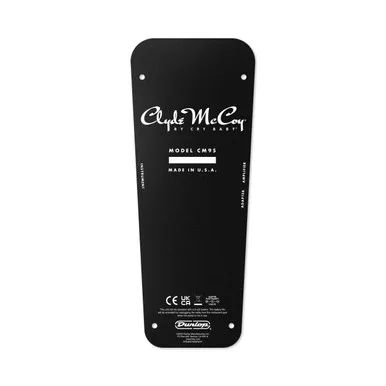
The CM95 is powered by one 9-volt battery, installed by removing the bottom plate5. Dunlop also sells a replacement Clyde McCoy Cry Baby Wah bottom plate for the pedal6. For players who prefer not to open the pedal, it can be powered by a Dunlop ECB003 9-volt adapter1, or by Dunlop's DC Brick, Iso-Brick and Mini Iso-Brick power supplies, which are not included1. The manual lists the acceptable options as an AC adapter such as the Dunlop ECB003/ECB003EU, or a DC Brick power supply5. Guitar World's review noted the added convenience of a nine-volt adapter jack as one of the improvements over the vintage build7.
The manual lists the CM95's bypass as hardwired5, while Dunlop's own history article about the pedal's development says the company included true bypass switching for tonal purists2. The two statements conflict; the manual is the more specific specification.
From the Thomas Organ Clyde McCoy to the CM95
The Clyde McCoy wah was the first production wah wah pedal, and Guitar World has called the Cry Baby line it spawned the most recognizable effects pedal ever made1. Vox and the Thomas Organ Company began manufacturing the Clyde McCoy in 19673. Dunlop's own account of the CM95's development explains that the company inherited the original tooling and machinery used to design and manufacture the first Clyde McCoy pedals from the Thomas Organ Company and Jen Electronica4.
Dunlop released the Clyde McCoy Cry Baby Wah in 20142, and a Dunlop history article from 2017 described it as a recent release that brought the company's commitment to legacy and innovation full circle8. Dunlop calls the CM95 the definitive recreation of the Clyde McCoy circuit and sound2.
How the CM95 differs from an original Clyde McCoy
The CM95 is built with thru-hole components in a classic housing with a premium pot, switch and jacks1. Guitar World's review found it to be a dead-on reproduction of the vintage version's sound, with premium-quality input and output jacks, a heavy-duty footswitch and the added convenience of a nine-volt adapter jack7. The reviewer also found the pedal much more durable and roadworthy than the original7.
One practical difference players used to modify vintage Clyde McCoy wahs for a wider sweep range by removing felt, lowering the switch and adjusting pot rotation. Dunlop says the CM95 has this taken care of right out of the box2.
"The new Dunlop Clyde McCoy Cry Baby Wah Wah resurrects this esteemed pedal by duplicating the original Cry Baby sound to the nth degree."
Videos
Guitar World
Sweetwater
Premier Guitar
Questions
Is the Clyde McCoy Cry Baby true bypass?
Dunlop's manual lists the CM95's bypass as hardwired, not true bypass. However, Dunlop's own history article about the pedal's development says the company included true bypass switching for tonal purists. The two statements conflict, and the manual is the more specific specification, so treat the switching as hardwired unless Dunlop says otherwise.
What inductor is in the CM95?
The CM95 uses Dunlop's proprietary Halo inductor, listed as the HI01 in Guitar World's review. Dunlop says it reproduces the Clyde McCoy's famous vocal sound while minimizing microphonic noise, thanks to a stabilized cup core. Guitar World credited it with the incredibly expressive midrange of the original.
What is the sweep range of the Clyde McCoy Cry Baby?
According to Dunlop's manual, the CM95's filter center frequency sweeps from 410 Hz to 2.2 kHz. Dunlop also says the pedal has a wider sweep range taken care of right out of the box, something players used to modify original Clyde McCoy wahs to get by removing felt, lowering the switch and adjusting pot rotation.
Does the CM95 take a battery?
Yes. The CM95 is powered by one 9-volt battery, installed by removing the bottom plate. It can also run on a Dunlop ECB003 9-volt adapter or DC Brick, Iso-Brick and Mini Iso-Brick power supplies, which are not included. Current draw is 600 microamps.
How is the CM95 different from an original Clyde McCoy wah?
The CM95 is a modern reissue built with thru-hole components in a classic housing with a premium pot, switch and jacks. It keeps the original's throaty voice and expressive sweep but adds a nine-volt adapter jack, true hardwired durability and a Halo inductor that avoids the microphonic noise of vintage units. Dunlop says you can leave your vintage wah safely at home.
Sources (8)
- CLYDE MCCOY® CRY BABY® WAH, Dunlop (www.jimdunlop.com)
- Evolution of the Cry Baby Wah at Dunlop, Dunlop (lifestyle.jimdunlop.com), 2017-04-27
- Dunlop Cry Baby Bass Wah: the most recognizable effects pedal ever made?, Guitar World, 2023-04-05
- NAMM 2014: Six new Jim Dunlop pedals, MusicRadar, 2014-01-24
- CM95 Clyde McCoy Cry Baby Wah Wah Manual, Jim Dunlop (www.jimdunlop.com), 2021
- CLYDE MCCOY® CRY BABY® WAH BOTTOM PLATE, Dunlop (www.jimdunlop.com)
- Review: Dunlop Clyde McCoy Cry Baby Wah Wah, Guitar World, 2014-04-29
- Celebrating Fifty Years of Cry Baby, Dunlop (lifestyle.jimdunlop.com), 2017-03-14
 Clyde McCoy