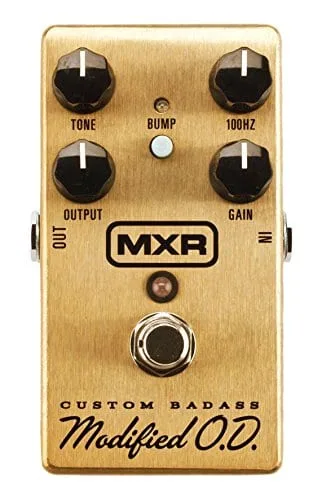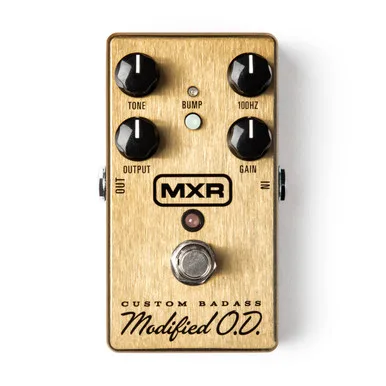


The MXR Custom Badass Modified O.D. is an overdrive pedal from MXR, the Dunlop brand, carrying the model number M771. Dunlop describes it as a classic overdrive circuit with modern modifications for improved performance and versatility1. What sets it apart from most overdrives is its EQ flexibility: a 100Hz cut and boost control and a Bump switch that engages an alternate voicing, both added on top of the usual tone, output and gain knobs12.
The pedal was introduced at Winter NAMM 2012, where Guitar World demoed it from Dunlop's booth as part of the MXR Custom Badass line3. Vintage Guitar had reported on it the previous November as an overdrive circuit with modern modifications4.
The controls: 100Hz and Bump
Three of the knobs, tone, output and gain, are the standard overdrive set. Premier Guitar's review notes that these are "practically de rigueur" for the type, and that the fourth control is what makes the pedal different2.
| Control | What it does |
|---|---|
| Gain | Sets the amount of overdrive2 |
| Output | Sets the level2 |
| Tone | Sets the overall tonal balance2 |
| 100Hz | Cut and boost at 100Hz: cut for a more focused EQ, boost for a beefier tone1 |
| Bump switch | Engages an alternate EQ voicing that boosts the lows and mids1 |
The 100Hz control is the pedal's signature feature. Dunlop says cutting it gives a more focused EQ while boosting it gives a beefier tone1. MusicRadar described it at launch as a 100Hz filter control designed to help retain the bottom end when boosting the mids in your tone5.
Premier Guitar's reviewer found it does more than tighten or fatten the low end2:
"The 100 Hz knob has remarkable shaping power through the whole range of gain levels. And it's especially effective in ro"
The Bump switch is a miniature button on the enclosure rather than a full-size footswitch. Premier Guitar's review observed that the four small knobs and miniature bump button look a little less robust than the big rubber knobs that once graced MXR pedals2. Functionally, it engages an alternate EQ voicing that boosts the lows and mids1, so you can flip between two voicings depending on the amp and guitar.
Overdrive, booster, or both
Dunlop lists the pedal as an overdrive, built on a classic overdrive circuit upgraded with the 100Hz control and Bump switch1. RockBoard's PedalPedia entry for the M77 tags it as both overdrive and booster6, so players who want a mostly-clean level push with the gain low and the output up can use it that way, though its core design is overdrive.
The pedal is true bypass, as Premier Guitar's review confirms2, so it leaves your dry signal alone when disengaged.
Where it came from
The Custom Badass Modified O.D. came from the same MXR team behind the MXR Custom Badass '78 Distortion, released the year before; MusicRadar reported at NAMM 2012 that the team behind that distortion had turned their attention to overdrive pedals5. Guitar World's Josh Hart, demoing the pedal at the Dunlop booth, framed it the same way: "Next up in the MXR Custom Badass line is the Modified Overdrive, a classic overdrive circuit with modern modifications for improved performance and versatility"3.
Vintage Guitar introduced the pedal in November 2011 as "an overdrive circuit with modern modifications," including the 100-hertz cut/boost control and a Bump switch that engages an alternate EQ voicing to boost lows and mids4.
Pairing it with the '78 Custom Badass Distortion
Dunlop's own recommendation for the pedal is to stack it:
"Put it in front of the '78 Custom Badass Distortion for a slew of amp-like gain structures that won't mask your tone."
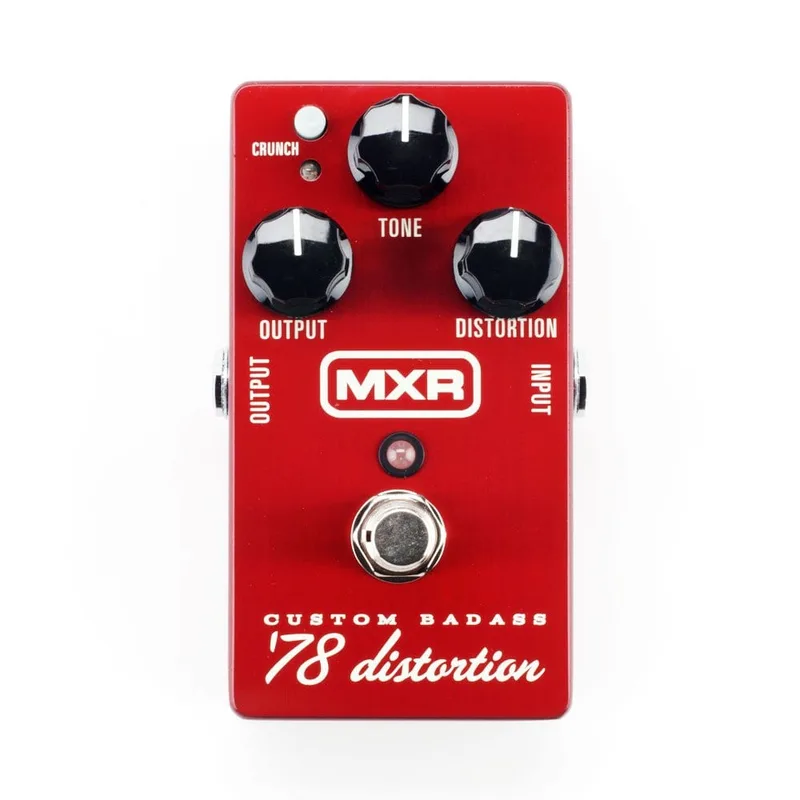
The idea is classic overdrive-into-distortion stacking: the Modified O.D. shapes the front end while the '78 Distortion supplies the heavier clipping, and Dunlop's claim is that the combination yields amp-like gain structures without burying your core tone1. The '78 Custom Badass Distortion itself carries a Crunch switch that boosts the harmonic content, as Pedal of the Day's review notes7, giving the pair two switchable voicings between them.
Videos
jimdunlopusa
jimdunlopusa
gearuptmntv
News
Questions
What does the Bump switch do on the MXR Custom Badass Modified O.D.?
The Bump switch engages an alternate EQ voicing that boosts the lows and mids. It is a small button on the enclosure rather than a footswitch, so you set it before playing rather than stomping it mid-song. With it off, the pedal runs its standard voicing; with it on, the low end and midrange get pushed forward.
What is the model number of the MXR Custom Badass Modified Overdrive?
The model number is M77. It appears on Dunlop's product page for the pedal, which lists it as the MXR Custom Badass Modified O.D. The same pedal is sometimes referred to by press and retailers as the MXR M77 Custom Badass Modified O.D.
Can the Custom Badass Modified O.D. be used in front of the '78 Custom Badass Distortion?
Yes. Dunlop specifically recommends putting the Modified O.D. in front of the '78 Custom Badass Distortion, describing the pairing as producing a slew of amp-like gain structures that won't mask your tone. Both pedals come from the same MXR Custom Badass team.
Is the MXR Custom Badass Modified O.D. an overdrive or a booster?
It is an overdrive pedal. Dunlop describes it as a classic overdrive circuit with modern modifications for improved performance and versatility. RockBoard's PedalPedia entry for the M77 also tags it as usable as a booster, but its core function is overdrive.
Sources (7)
- MXR® CUSTOM BADASS™ MODIFIED O.D., Jim Dunlop (jimdunlop.com)
- MXR Custom Badass Modified O.D. Pedal Review, Premier Guitar, 2012-02-10
- NAMM 2012: Dunlop Custom Badass Modified Overdrive Video Demo, Guitar World, 2012-01-20
- MXR Intros Custom Badass Modified OD, Vintage Guitar magazine, 2011-11-22
- NAMM 2012: 10 Of The Best Guitar Effects Pedals, MusicRadar, 2012-01-30
- M77 Custom Badass Modified O.D. by MXR, RockBoard PedalPedia, 2026
- Dunlop MXR M78 Custom Badass '78 Distortion, Pedal of the Day, 2014-07-17