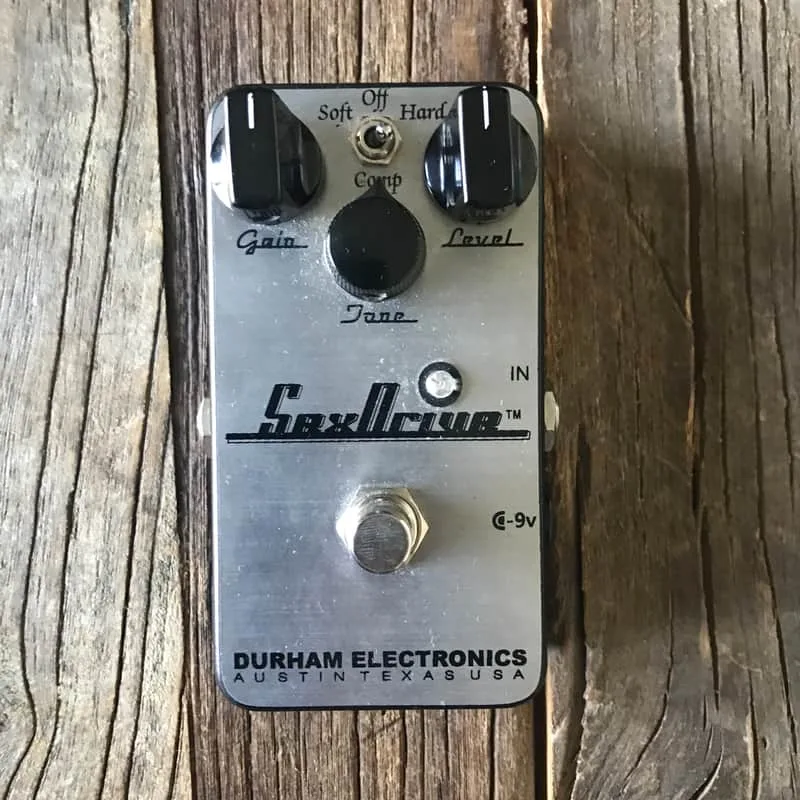


The Durham Sex Drive is a clean boost pedal, designed by Durham for the guitarist Charlie Sexton to fulfill his very particular needs. The goal was a "clean-boost" pedal that would supply additional bottom end and sustain when needed, without altering the original quality of the amplifier's natural tone, and specifically without the nasal quality some boosts introduce1. In the wider family of boost pedals, it sits with the designs meant to push an amp while leaving its voice alone.
What it does to your sound
Durham's stated aim was a boost that would not change the amp's natural tone, adding low end and sustain instead of coloring the signal. The compression in the circuit is subtle, and as the design description puts it, "The compression is pretty subtle, but it's supposed to be"1. Players looking for heavier clipping territory would be in overdrive or distortion land instead; this is a boost first.
A builder who made the circuit, kirshman, reported in January 2017: "It's actually a really nice boost with a little grit at the high gain settings." The same builder preferred it to the SHO, which colors tone too much, and noted it is "supposed to be a real nice boost/OD"1.
Controls
| Control | What it does |
|---|---|
| Tone | Mostly affects the highs and some mids; subtle through most of the sweep, with a big difference in the last 1/8th of the turn1 |
| Gain | Sets the boost; on the DIY layout it can be increased to 500K or 1M for more gain1 |
The tone control's behavior is worth knowing before you dial it in: most of its range is gentle, and the dramatic change comes right at the end of the turn1.
Building one yourself
A vero (stripboard) layout for the Sex Drive was published on Guitar FX Layouts on 5 January 2017, and the circuit has been discussed on freestompboxes.org1. A few notes from that layout's discussion:
- Increasing the gain pot to 500K or 1M is suggested as a way to get more gain from the build1.
- D6 on the layout is for polarity protection1.
- The CLR has no set value: it is the current limiting resistor for the LED. A lower value means a brighter LED, with 2.2k or 4.7k common, and it should never be 0 ohms1.
The CLR is the LED's current limiting resistor and must not be left at 0 ohms; 2.2k or 4.7k are the common values1.
Videos
ProGuitarShopDemos
Durham Electronics
Chicago Music Exchange
Questions
Who was the Durham Sex Drive designed for?
Durham designed the Sex Drive for the guitarist Charlie Sexton, described as a good friend of the maker. It was built to fulfill Sexton's very particular needs: a clean boost that would supply additional bottom end and sustain when needed, without altering the natural tone of the amplifier.
Is the Durham Sex Drive a boost or an overdrive?
It is described as a clean-boost pedal, meant to add bottom end and sustain while leaving the amplifier's natural tone untouched. Builders who have made the circuit report it works as a really nice boost with a little grit at the high gain settings, so it sits on the boost side of the line with a touch of overdrive available at the top of its range.
Can you build a Durham Sex Drive yourself?
A vero (stripboard) layout for the Sex Drive was published on Guitar FX Layouts in January 2017, and the circuit has been discussed on freestompboxes.org. Builders can also modify the design: increasing the gain pot to 500K or 1M is suggested as a way to get more gain from the circuit.
What does the tone control do on the Durham Sex Drive?
The tone control mostly affects the highs and some mids. It is subtle through most of its sweep, but in the last eighth of the turn it makes a pretty big difference, so most of the tonal shaping happens right at the end of the control's range.
Sources (1)
- Guitar FX Layouts: Durham Sex Drive, Guitar FX Layouts (tagboardeffects.blogspot.com), 2017-01-05