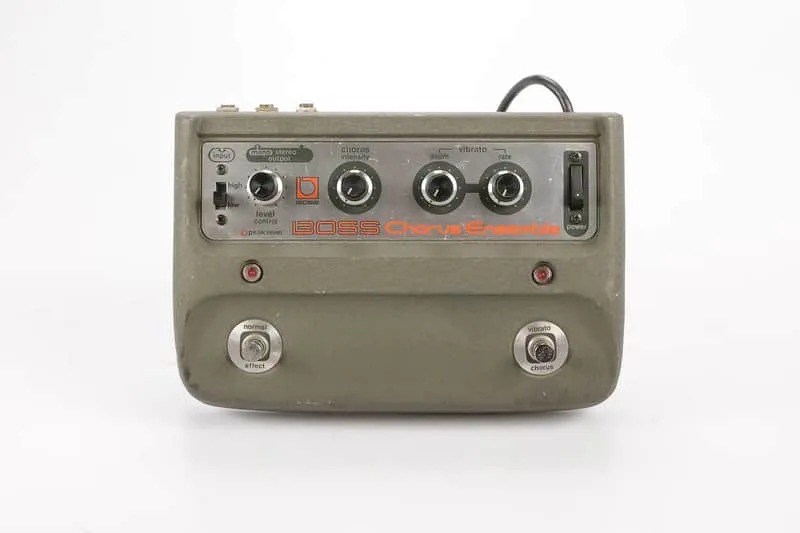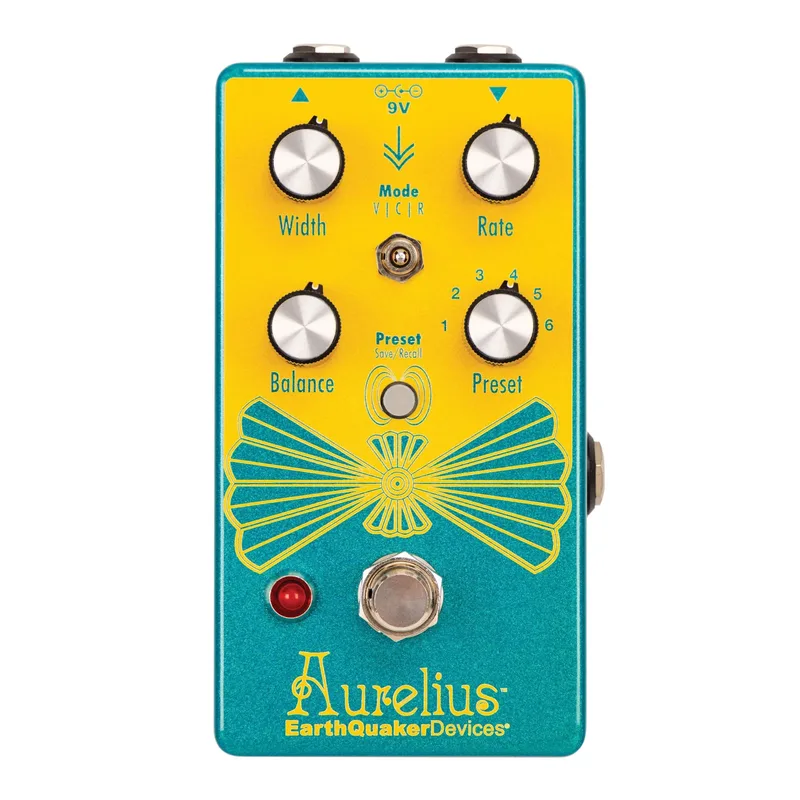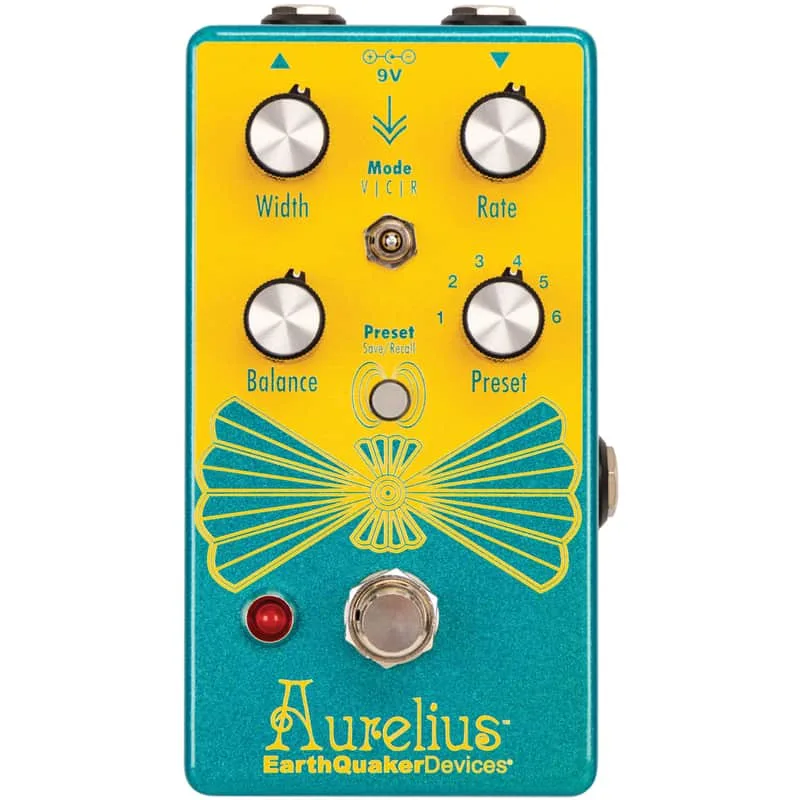


The EarthQuaker Devices Aurelius Tri-Voice Chorus is a compact digital chorus pedal that packs three modulation voices into one box: Chorus, Vibrato and Rotary. It was the newest addition to the EarthQuaker Devices lineup when it was announced, hand crafted in Akron, Ohio, USA1. EarthQuaker says the circuit is inspired by the 1970s Boss CE-1 Chorus Ensemble, and the Rotary voice reaches even further back, to the Leslie rotating speaker of the 1940s21.
For a player, that means one small pedal can cover classic CE-1 style chorus, pitch-wobble vibrato, and a Leslie-style rotary simulation, with six presets to jump between them on a gig. Guitar World's Paul Riario summed up the appeal: three modes makes for a lot of modulation options2.
Three voices: chorus, vibrato and rotary
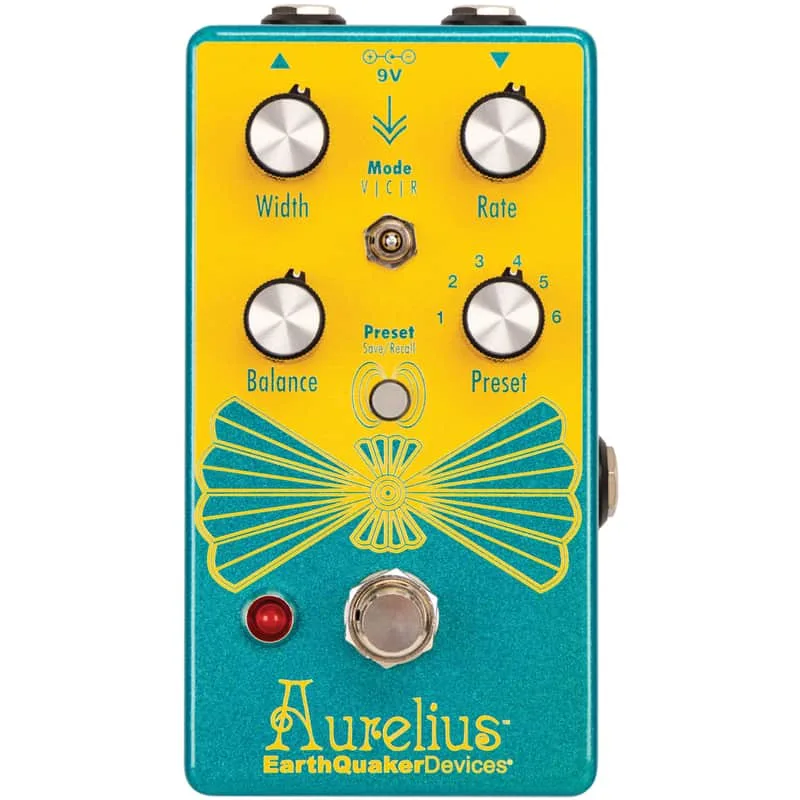
A mini-toggle Mode selector on the face of the pedal switches between the three voices: Vibrato Mode, Chorus Mode and Rotary Mode21. Each voice has its own character and its own lineage.
- Chorus Mode is the CE-1-inspired core of the pedal, the classic thickened, doubled-guitar sound. Pushing the Balance knob to extremes in this mode brings out a pronounced flanging effect2.
- Vibrato Mode gives pitch modulation only. EarthQuaker describes it as "a really subtle chorus with a seasick vibrato," with quick switching between the two characters1. Here the Balance control blends the amount of modulation against the dry signal, so you can go from a light shimmer to full pitch wobble2.
- Rotary Mode emulates a Leslie speaker. Founder Jamie Stillman studied the way the horn and the rotor moved on Leslie speakers and emulated the phasing and speeds of the low frequency oscillator to capture that sound, tracing the effect back to the 1940s1.
The controls and presets
Guitar World praised the pedal's good design and unfussy layout2. The control set is small and each knob does real work:
| Control | What it does |
|---|---|
| Mode toggle | Mini-toggle selecting Vibrato, Chorus or Rotary2 |
| Width | Shapes the modulation depth2 |
| Rate | Sets the modulation speed2 |
| Balance | Blends modulation with dry signal; in Chorus mode, extremes produce flanging2 |
| Preset knob | Six-position rotary selector for saved settings2 |
| Save/Recall button | LED button to access and save presets2 |
The Width, Rate and Balance knobs let you finely tailor the warble and wobble in any mode2. Presets are the other half of the story: one tap of the Preset footswitch summons up to six settings of your choosing1, so a subtle chorus verse sound, a seasick vibrato and a big rotary chorus can all live in the box at once.
Flexi-Switch and expression control
The Aurelius carries EQD's Flexi-Switch technology, a relay-based true bypass switching system that lets you use momentary and latching switching on the same footswitch2. In practice, hold the switch for a quick burst of modulation and release to go clean, or tap it once to latch the effect on, the way a conventional footswitch works.
There is also an expression pedal input. The Aurelius accepts any TRS expression pedal to manipulate Width, Rate or Balance in real time1, which opens up swells of modulation depth or speed under your foot while you play.
Inspired by the Boss CE-1 and the Leslie speaker
The Aurelius sits at the end of a long lineage. EQD claims it is inspired by the '70s Boss CE-1 Chorus Ensemble2, the pedal MusicRadar calls the vintage chorus box the Aurelius takes its cues from3. It is a digital unit rather than a CE-1 clone: EarthQuaker says it was "tirelessly tweaked and fine-tuned" to capture that character1. The Rotary voice draws on an older source still, the Leslie speaker's rotating baffle system, whose sound Stillman studied directly when designing the mode1.
Guitar World's reviewer found the digital design does not get in the way of the sound, writing that "the Aurelius is still a warm-sounding chorus that's richly textured and comes damn close to sounding analog"2.
"the Aurelius is still a warm-sounding chorus that's richly textured and comes damn close to sounding analog"
The same review noted the trade-offs: the pedal is compact and the layout unfussy, but there is no stereo operation, so players running two amps get a mono chorus2. At $199 it sits in EarthQuaker's familiar compact chassis, the same traditional enclosure the reviewer noted houses its comprehensive chorus emulations2.
Videos
Sweetwater
Premier Guitar
EarthQuakerDevices
Questions
Is the EarthQuaker Aurelius stereo?
No. The Aurelius has a single input and output with no stereo option, which Guitar World's review listed among its cons. Players who want a wide stereo chorus spread across two amps will need to look elsewhere.
Is the Aurelius analog or digital?
It is a digital pedal. EarthQuaker Devices says it was tweaked and fine-tuned to capture the character of the 1970s Boss CE-1 Chorus Ensemble, and Guitar World's reviewer found it comes close to sounding analog, with a warm, richly textured character.
How much current does the Aurelius draw?
It runs on 9V DC with a center negative plug and draws 75 mA. That is modest by digital pedal standards, but it means the pedal needs a power supply rather than a battery.
Is the EarthQuaker Aurelius true bypass?
Yes. It uses EarthQuaker's Flexi-Switch technology, a relay-based true bypass switching system that lets the same footswitch work in both momentary and latching styles, so you can hold it for a quick burst of modulation or tap it to stay on.
How many presets does the Aurelius have?
Six. A Preset footswitch summons up to six saved settings, and a six-position Preset knob with a Save/Recall button lets you access and store them, so a whole set's worth of modulation sounds can live in one compact box.
Sources (3)
- New Gear: EarthQuaker Aurelius Tri-Voice Chorus, Bass Musician Magazine, 2023-04-07
- EarthQuaker Devices Aurelius Tri-Voice Chorus review, Guitar World, 2023-08-16
- The must-have new guitar effects pedals of 2023, MusicRadar, 2023-05-04