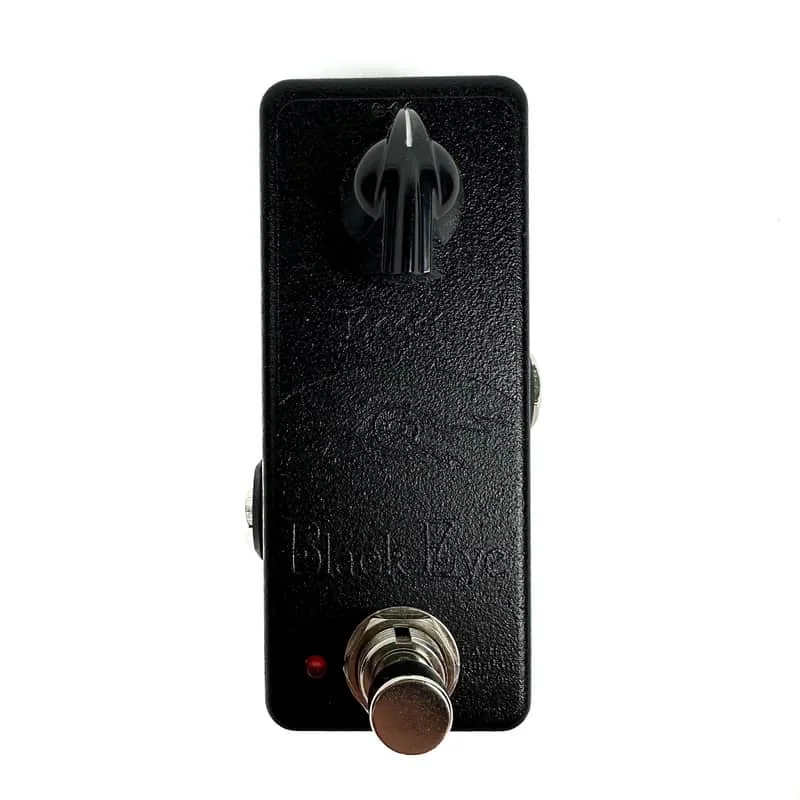


The EarthQuaker Devices Black Eye is a clean boost pedal: a discrete, MOSFET based circuit that RockBoard's PedalPedia says delivers nearly 30dB of unadulterated clean gain with a minimum amount of tone coloration1. It is true bypass, analog, and built one at a time in Akron, Ohio1. Beyond straight boosting, the same pedal pulls double duty as an attenuator and as a buffer, which makes it a flexible tool on a boost pedal board despite its single knob.
What it does to your sound
RockBoard's PedalPedia describes the Black Eye as providing "nearly 30db of unadulterated clean gain boost with a minimum amount of tone coloration"1. In practical terms, that is a lot of level on tap from a circuit built to leave the character of your guitar and amp alone. Because the circuit is MOSFET based and fully discrete, it also presents a high input impedance of around 5M Ohms, and RockBoard's PedalPedia says it can be used as a powerful buffer with an output of around 1K Ohm1. Placed early in a chain, it can therefore do the work of a dedicated buffer pedal as well as a boost.
Controls
The front panel carries a single control, with a second adjustment inside the pedal2.
| Control | What it does |
|---|---|
| Boost knob | Sets the boost level; counterclockwise from noon, the pedal acts as an attenuator1 |
| Internal trimmer (VR1) | A gain control used to set the bias2 |
The Boost knob is the whole interface. Turned clockwise it pushes the level up; RockBoard's PedalPedia notes that turning it counterclockwise away from the noon position turns the pedal into an attenuator instead, so the same knob spans cutting and boosting1. Inside, the trimmer is a gain control used to set the bias of the circuit, per an independent technical analysis of the layout2. That analysis also traced how the boost pot is wired, with its lugs carrying boost 1, boost 2 and boost 3, where boost 2 goes to the output2.
The internal bias trimmer means the pedal's operating point can be adjusted, but it is set inside the box. If a used Black Eye sounds off, the trimmer position is the first thing to look at.
Circuit background
An independent circuit analysis published on Guitar FX Layouts in March 2017 placed the Black Eye's lineage clearly. Its author wrote, "I like this circuit, and it IS a version of a ZVex Super Hard On," adding, "When you look at the circuit you can see it's basically a modified SHO"2. The same analysis noted an unusual protection arrangement: a 1N4001 diode between the source and gate, cathode to gate, to protect the MOSFET from static shock, plus a second 1N4001 for polarity protection2.
For players who build their own effects, the site's verified vero layout for the Black Eye was reported working, with one builder confirming "Verified..sounds great!"2. The layout can be built slightly smaller by removing the F stripe row and moving the components and wiring up one row2.
Power and practicalities
The Black Eye runs on 9V DC, center negative, and draws 2mA1. That is a very light current draw, so it fits easily on a daisy-chained or shared supply alongside other pedals. There is no battery compartment mentioned in the maker's specifications, so plan on a standard pedalboard power supply.
Related EarthQuaker Devices boosts
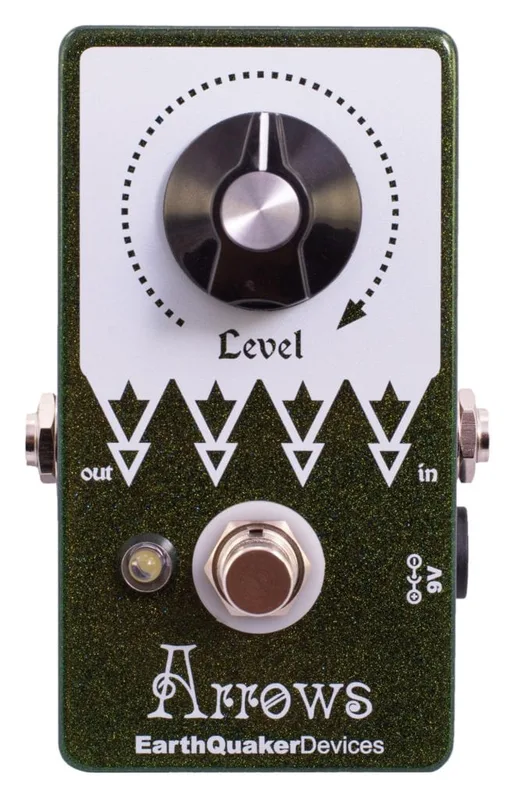
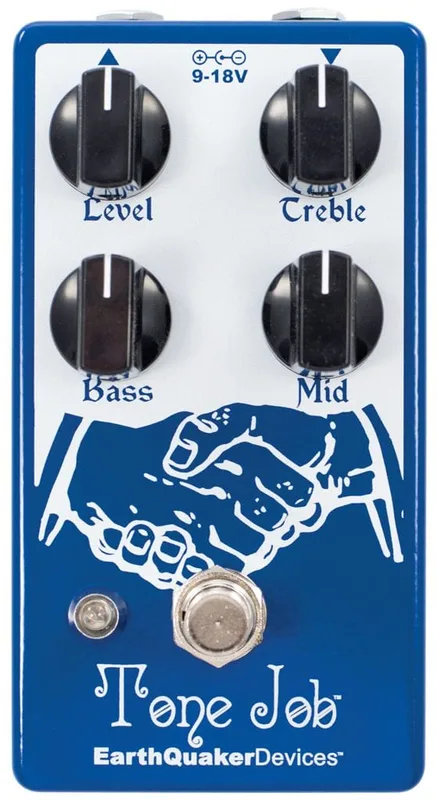
EarthQuaker Devices makes several other gain-staging pedals that sit near the Black Eye's territory. The Arrows is the maker's pre-amp booster, and the Tone Job V2 combines EQ with boost for players who want tone shaping along with the level change. The Black Eye's own angle is the simplest of the set: one knob, clean gain, and the attenuator and buffer functions built in1.
Videos
EarthQuakerDevices
EarthQuakerDevicesJP
Sleep Vai
Questions
Is the EarthQuaker Devices Black Eye true bypass?
Yes. EarthQuaker Devices describes the Black Eye as true bypass, and notes it is built one at a time by hand on the shore front of Akron, Ohio. That means the pedal takes itself fully out of the signal path when switched off, so your guitar's signal reaches the amp untouched when the effect is not engaged.
Can the Black Eye be used as an attenuator?
Yes. According to the maker, turning the Boost knob counterclockwise away from the noon position lets the pedal work as an attenuator, cutting level rather than boosting it. That gives the single knob a second job: instead of only adding clean gain, it can also pull the volume down.
What power supply does the Black Eye need?
The Black Eye runs on 9V DC with a center negative plug, the standard pedalboard supply format, and draws a very light 2mA of current. That low draw means it sits comfortably alongside other pedals on a shared supply without straining it.
Is the Black Eye based on the ZVex Super Hard On?
The circuit's lineage points that way. An independent technical analysis of the circuit on Guitar FX Layouts concluded that it is a version of the ZVex Super Hard On, describing it as basically a modified SHO when you look at the circuit. EarthQuaker Devices describes it as a discrete, MOSFET based boost.
Can the Black Eye work as a buffer?
Yes. The maker says the pedal can be used as a powerful buffer, with an input impedance of around 5M Ohms and an output of around 1K Ohm. Those figures suit keeping a guitar's high end intact over long cable runs, which is what a buffer is for.
Where is the Black Eye made?
EarthQuaker Devices builds the Black Eye one at a time in Akron, Ohio. The maker's own description puts it plainly: true bypass and built one at a time by human beans on the shore front of Akron, Ohio.
Sources (2)
- Black Eye by EarthQuaker Devices, RockBoard (www.rockboard.de), 2026
- Guitar FX Layouts: Earthquaker Devices Black Eye, tagboardeffects.blogspot.com (Guitar FX Layouts), 2017-03-02