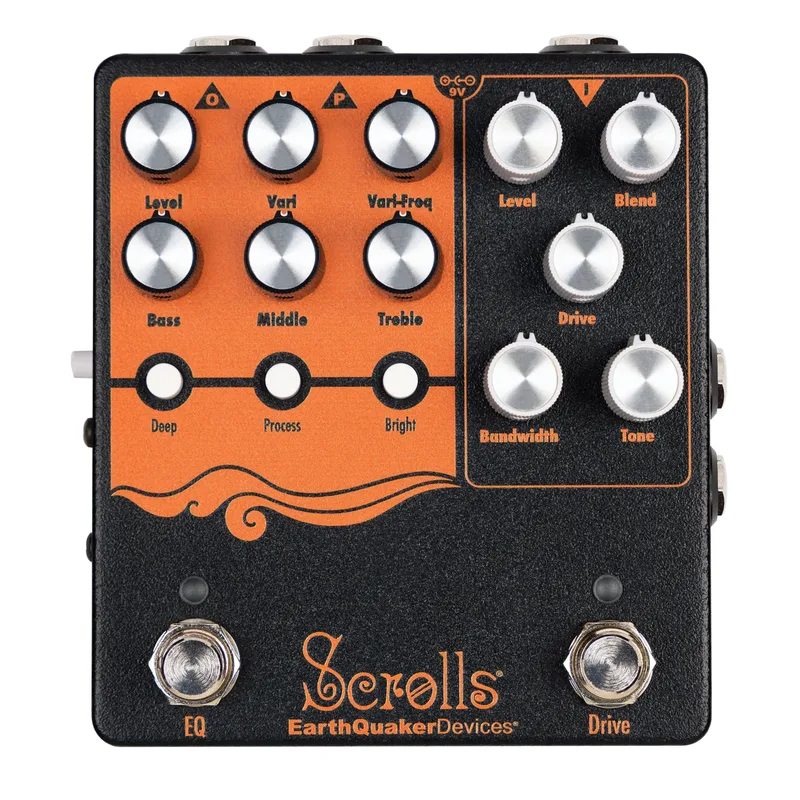


The Scrolls Bass Odyssey is a two-channel bass preamp and overdrive pedal from EarthQuaker Devices, created in collaboration with Japanese bassist Kentaro Nakao and released in May 20261. One side is a Drive channel that delivers tube amp-like distortion; the other is an active EQ channel with three push-button switches for one-click tone sculpting2. Around those two channels sit a buffered parallel out, an onboard effects loop, and a balanced XLR out with analog speaker cabinet simulation2.
EarthQuaker pitches its range as "From Motown to Metal and everywhere between and beyond"2, and Bass Musician Magazine described the result as "a powerful, modern tool capable of shaping any bass signal to match virtually any bass and amp combination imaginable"3. Everything in the pedal is analog, and it is built one at a time at the EarthQuaker Devices Tone Wellness Clinic in Akron, Ohio3.
The two channels: tube amp-like drive and active EQ
The Drive channel is inspired by a rare, little-known overdrive pedal in Kentaro Nakao's personal collection, and Bass Musician Magazine describes its character as "a rich, tube amp-like distortion"3. Bass Magazine's release coverage calls it "versatile, tube amp-like distortion"1. A Drive knob sets the intensity of the overdrive and a Level knob sets the Drive channel's output volume2.
The EQ channel is a separate, always-shapeable layer. Bass Musician Magazine notes it "boasts a full suite of active, audiophile-quality controls" and that it is transparent when its controls are set to 12 o'clock3. That means you can leave the EQ channel engaged as a neutral preamp and dial in cuts or boosts only where you want them.
The two channels have dedicated footswitches, so each can be used independently or both at once, which Gearnews flagged as making the pedal "perfect for live and studio sessions"5.
The controls
EarthQuaker's product page lists the front-panel controls and push-button switches2:
| Control | Channel | What it does |
|---|---|---|
| Drive | Drive | Controls the intensity of the overdrive |
| Level | Drive | Output volume control for the Drive channel |
| Vari-Freq | EQ | Variable frequency control, adjustable from approximately 20 Hz to 10 kHz |
| Bright | EQ (push button) | 5 kHz boost |
| Deep | EQ (push button) | 80 Hz boost |
| Process | EQ (push button) | Low-mid scoop for a more modern sound |
| EQ Footswitch | Both | Activates the EQ channel |
| Drive Footswitch | Both | Activates the Drive channel |
The three EQ push-buttons give one-click access to a treble boost, a low-end boost, and a scooped low-mid shape, while Vari-Freq lets you place the EQ's action anywhere from roughly 20 Hz to 10 kHz2.
Power, switching and connections
Scrolls runs on a standard 9-volt DC power supply with a 2.1 mm negative center barrel, drawing 70mA, and EarthQuaker warns not to run it at higher voltages24. Because the true bypass switching is relay-based, the pedal requires power to pass a signal: with no power, your bass signal does not get through2. The EQ side uses standard on/off switching, while the Drive side uses EarthQuaker's Flexi-Switch Technology2.
The relay-based bypass means Scrolls cannot pass signal without power. Unlike mechanical true bypass pedals, it needs a live 9V DC supply at all times, so plan your pedalboard power accordingly.
The pedal has three outputs that all work simultaneously2:
- ¼" amp output: the main output to your amp, with an EQ output impedance under 1 kΩ2
- Parallel Out: a buffered output carrying your clean signal, always active, for routing to an amp, DI, a separate pedal chain, a tuner and more2
- Direct Out: a balanced XLR out with a subtle amount of analog filtering in the signal path to simulate the tonal characteristics of a bass speaker cabinet2
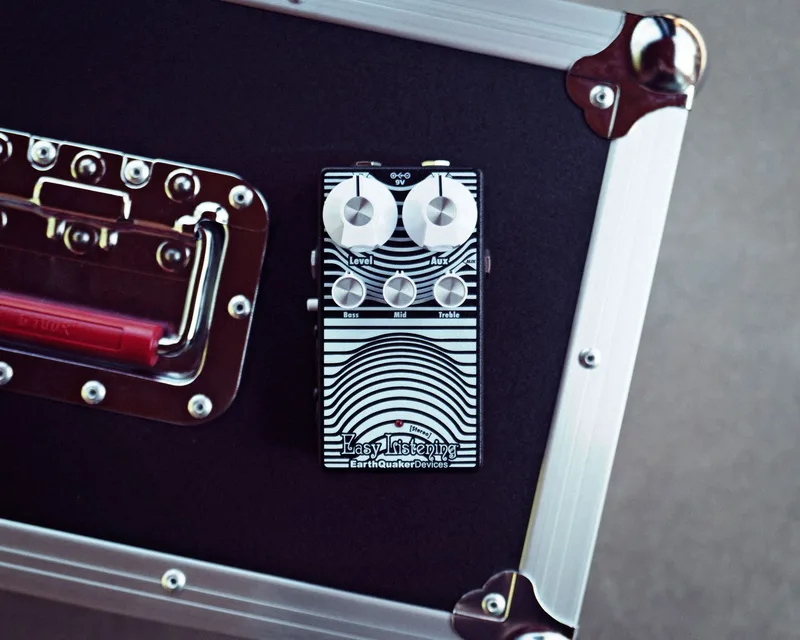
On the XLR's cabinet simulation, Bass Musician Magazine notes that "the signal from the XLR out on Scrolls includes just a splash of discrete analog filtering to give it some amp-like-character," comparing it to the cab sims on EarthQuaker's Easy Listening and ZEQD-Pre pedals3. There is also an onboard effects loop for inserting other effects into the signal path2.
History: a collaboration with Kentaro Nakao
Scrolls was born from a partnership between EarthQuaker Devices and Kentaro Nakao, a Japanese bassist and longtime friend of the company2. The Drive channel traces back to a rare overdrive pedal from Nakao's own collection, which became the reference for its tube amp-like character31.
The pedal was announced and released on May 14, 2026, and Bass Musician Magazine confirmed it "is available now wherever EarthQuaker Devices are sold"31. Every unit is all-analog and "built one-at-a-time by credentialed professionals at the EarthQuaker Devices Tone Wellness Clinic under the malt gray skies of Akron, Ohio"3.
What reviewers said
Guitar World's review, by Connor Flys, found the pedal "absolutely stuffed full of features, but very sensibly sized"4. The review also echoed the maker's own framing of the pedal's range, noting it covers "from Motown to metal," as EarthQuaker puts it4.
"Absolutely stuffed full of features, but very sensibly sized."
Price
Pricing varies across reports. Guitar World lists a launch price of $349 USD4. Gearnews reported $393 at the May 2026 launch, with an affiliate listing showing $375.005. Given the disagreement between sources, treat $349 to $393 as the reported range and expect retailer prices to differ.
Videos
EarthQuakerDevices
EarthQuakerDevicesJP
Bass Magazine and EarthQuakerDevices
Questions
Is the Scrolls Bass Odyssey true bypass?
Yes. EarthQuaker Devices says Scrolls uses relay-based true bypass switching. Because the switching is relay-based, the pedal requires power to pass a signal, so it will not pass your bass signal if the power supply is disconnected. The EQ side uses standard on/off switching and the Drive side uses the company's Flexi-Switch Technology.
Does the Scrolls Bass Odyssey pass signal without power?
No. The relay-based true bypass switching requires power to pass a signal, according to EarthQuaker Devices. If the pedal loses power, your signal does not get through, so a reliable 9V DC supply is essential on a gigging board.
Can I use the EQ and drive channels at the same time?
Yes. The EQ channel and Drive channel each have their own dedicated footswitch, so you can run either channel alone or both together. The EQ channel is described as transparent with its controls at 12 o'clock, so it can sit on as a clean shaping layer while the Drive channel adds tube amp-like distortion.
Does the XLR out on the Scrolls have a cab sim?
Yes. The Direct Out is a balanced XLR with a subtle amount of analog filtering in the signal path that simulates the tonal characteristics of a bass speaker cabinet. EarthQuaker compares this discrete analog filtering to the cab sims on its Easy Listening and ZEQD-Pre pedals.
How much does the EarthQuaker Scrolls Bass Odyssey cost?
Guitar World listed the launch price at $349 USD. Gearnews reported it at $393 when the pedal launched in May 2026, with an affiliate listing showing $375.00, so street prices vary by retailer. It is available wherever EarthQuaker Devices are sold.
Sources (5)
- EarthQuaker Devices Releases the Scrolls Bass Odyssey, Bass Magazine, 2026-05-14
- Scrolls Bass Odyssey, EarthQuaker Devices
- Gear News: EarthQuaker Devices Scrolls Bass Odyssey, Bass Musician Magazine, 2026-05-14
- Earthquaker Devices Scrolls Bass Odyssey review, Guitar World, 2026-10-21
- EQD Scrolls Bass Odyssey: Bass Pre & Drive, gearnews.com, 2026-05-14