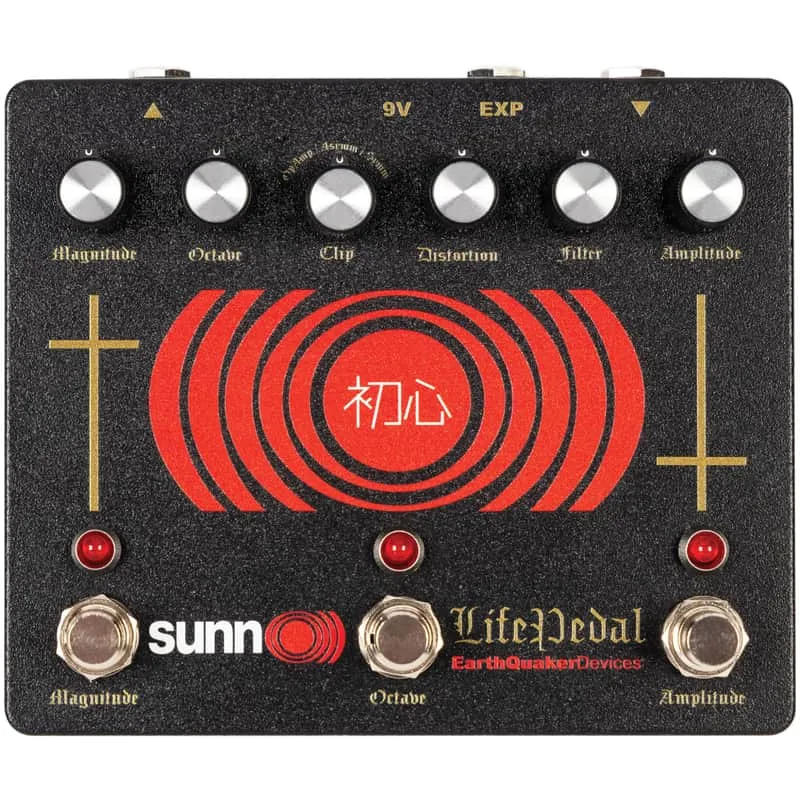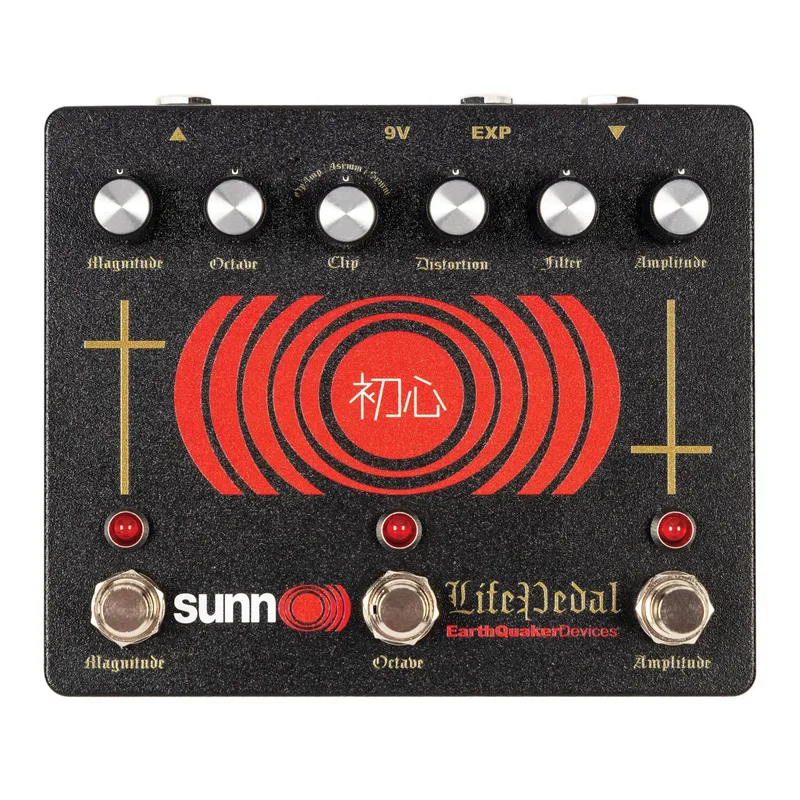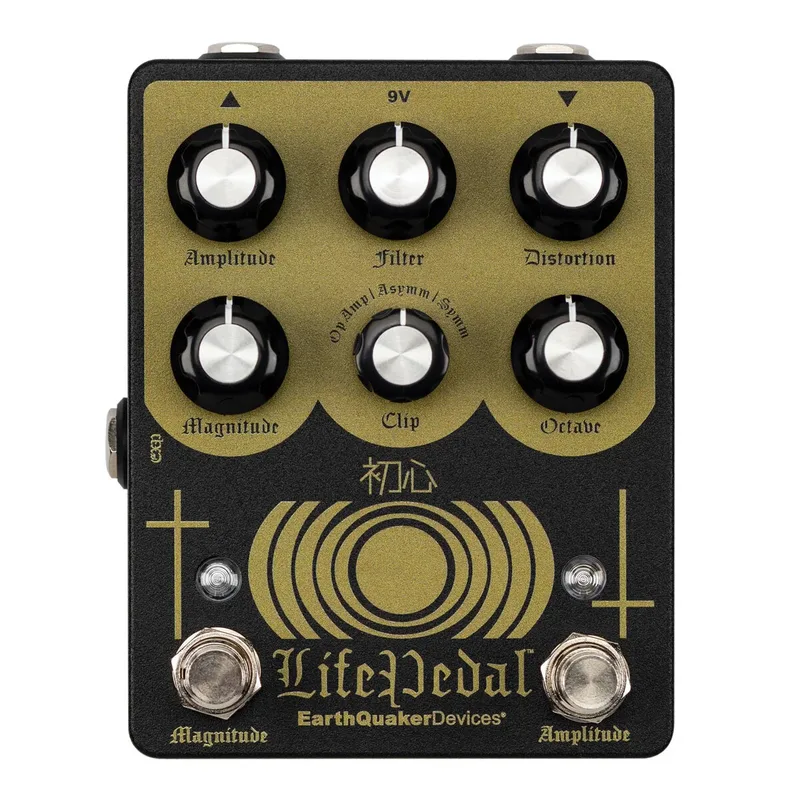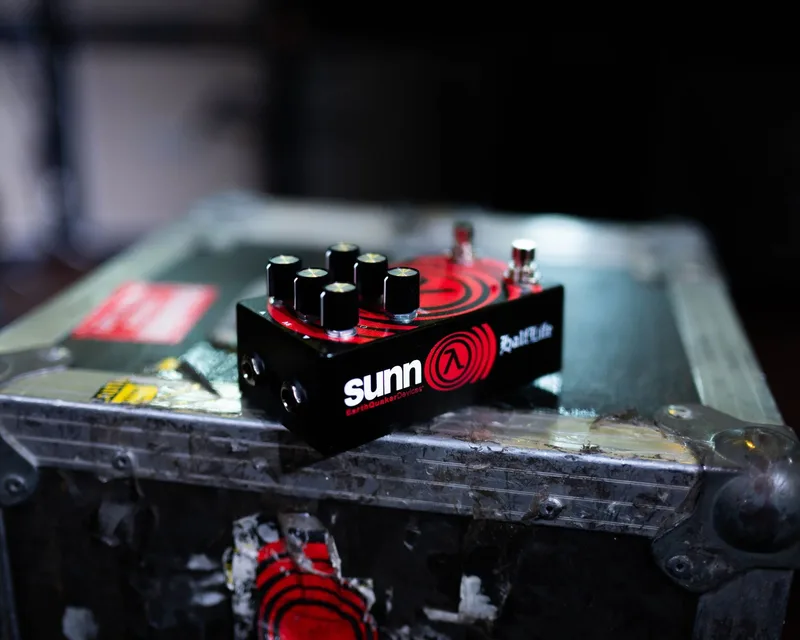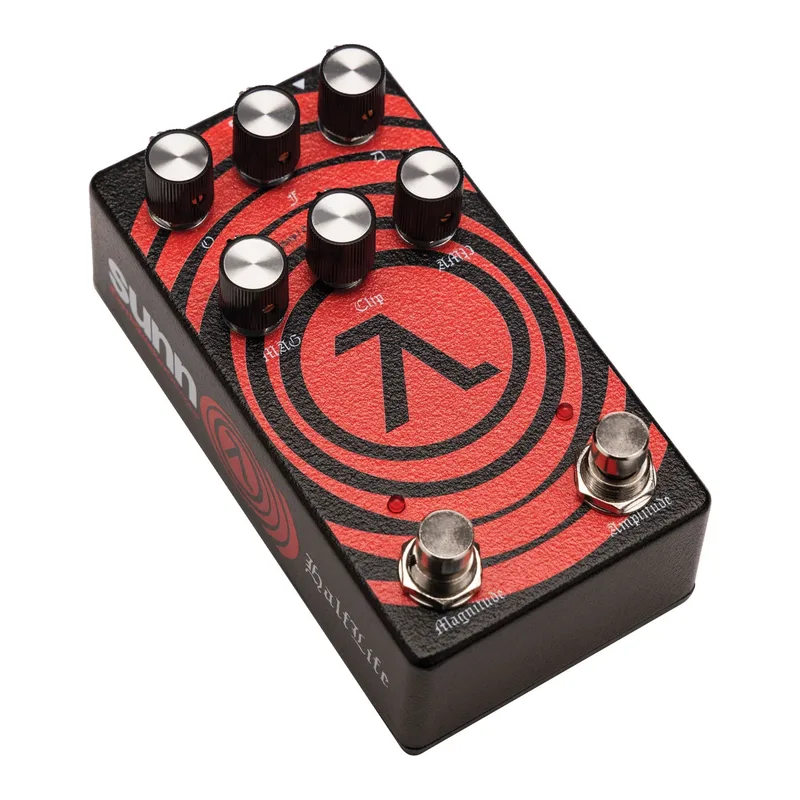


The EarthQuaker Devices Sunn O))) HalfLife is a distortion pedal with a blendable analog octave-up and a clean booster combined in one compact package1. It is a collaboration between EarthQuaker Devices and the drone metal band Sunn O))), and it is designed to represent the core front-end chain used in the band's Life Metal sessions to drive the tubes of their vintage Sunn Model T amplifiers into overload1. Where the original Life Pedal was a large, often limited-edition pedal, the HalfLife is the most compact, pedalboard-friendly version of that distortion circuit to date1.
The signal path is fixed: Octave, then Distortion, then Boost1. The distortion section is faithfully modeled after the classic "White Face" ProCo RAT circuit12, and Guitar World's reviewer describes the whole thing as a compact pedal for "targeted drone strikes of blendable upper octave-fueled fuzz, aggressive distortion, and a powerful clean boost for massive, amp-pushing guitar tones"3. The final stage is a completely clean, high-impedance, discrete MOSFET booster that adds no coloration or clipping, engineered to drive tube amplifiers into total harmonic saturation and feedback2.
Controls and switching
The HalfLife has five knobs, a three-way clipping switch and two footswitches. The octave distortion and the booster can be used independently with their own respective footswitches1.
| Control | What it does |
|---|---|
| Octave (O) | Blends in the analog octave as you turn it clockwise1 |
| Filter (F) | Low pass filter, roughly 500 Hz to 30 kHz; counterclockwise for more high end, clockwise for less1 |
| Distortion | Sets the gain of the RAT-style distortion stage3 |
| Magnitude | Sets the level of the clean MOSFET booster32 |
| Amplitude (AMP) | Output volume for the octave distortion side1 |
| Clipping switch (CLIP) | Selects OpAmp, Asymm or Symm clipping1 |
The right footswitch (Amplitude) activates the octave distortion and the left footswitch (Magnitude) activates the booster13. The Magnitude stage is designed to overload your preamp tubes with a clean, high-impedance boost while preserving your amp's natural character3. An Octave EXP jack on the side accepts any expression pedal to control the analog octave blend1, a feature first added on the Life Pedal V24.
The three clipping modes
The clipping switch is where the HalfLife's distortion character changes. All three positions come from the maker's own description1:
- OpAmp: No diodes at all, allowing a full, grinding op-amp assault at maximum volume. Gearnews describes it as bypassing all diodes for a massive, uncompressed, high-volume assault, and Guitar World's reviewer found it unleashes the full output for an aggressively brighter, high-volume attack32.
- Asymm: Two silicon diodes and one LED in an asymmetrical clipping configuration, giving a slightly compressed, smooth crunch similar to a valve amplifier1. Guitar World calls it a smoother amp-like crunch3.
- Symm: The stock double silicon diode configuration, which EarthQuaker Devices says provides "that classic tone you know and love"1. Guitar World's reviewer describes it as the classic, familiar rodent-like saturation3.
The octave: analog, monophonic, fuzz-adjacent
The octave in the HalfLife is an all-discrete analog full-wave rectifier circuit1. Because it is analog, it is monophonic and works best playing single notes above the twelfth fret with the neck pickup1. Pushed to a full octave blend, the maker says it transforms into a swelling, raging fuzz similar to the classic Super Fuzz1. Guitar World notes the design draws on vintage Shin-Ei FY2 Companion and FY6 Super Fuzz boxes alongside the vintage white-logo RAT-style circuit3.
From the Life Pedal to the HalfLife
The HalfLife carries forward EarthQuaker Devices' Octave Distortion + Booster format, the same product type as the Sunn O))) Life Pedal V24. Its distortion section is faithfully modeled after the "White Face" (ProCo RAT) circuit23, and its final Magnitude stage is an all-discrete MOSFET clean booster, activated by its own footswitch, designed to overload your preamp tubes with a clean, high-impedance boost while preserving your amp's natural character2.
The HalfLife's artwork is by Stephen O'Malley, with an irradiated rat fossil drawing by Savage Pencil1. It is priced at $291 USD at Thomann2.
The HalfLife's relay-based Flexi-Switch bypass means the pedal will not pass signal without power, so it cannot sit in a chain unpowered. It also must not be run at voltages above 9V DC1.
What reviewers said
Guitar World's Paul Riario reviewed the HalfLife and rated its build quality five stars, calling it "about as solidly built as they come and employs premium components," housed in a rugged, textured enclosure with contrasting red and black spirals3. His review also confirmed the three-mode clipping, the octave-up and the expression pedal control as the headline features3. Earlier in the line, gearnews rated the Life Pedal V3 4.5 out of 55, and Guitar Pedal X's Stefan Karlsson called the V2 his favorite Life Pedal edition, noting its handy size and the same controls the HalfLife now carries6.
Videos
B's Music Shop
Guitar Interactive Magazine
Chuck Levin's Washington Music Center
Questions
What is the difference between the HalfLife and the Sunn O))) Life Pedal?
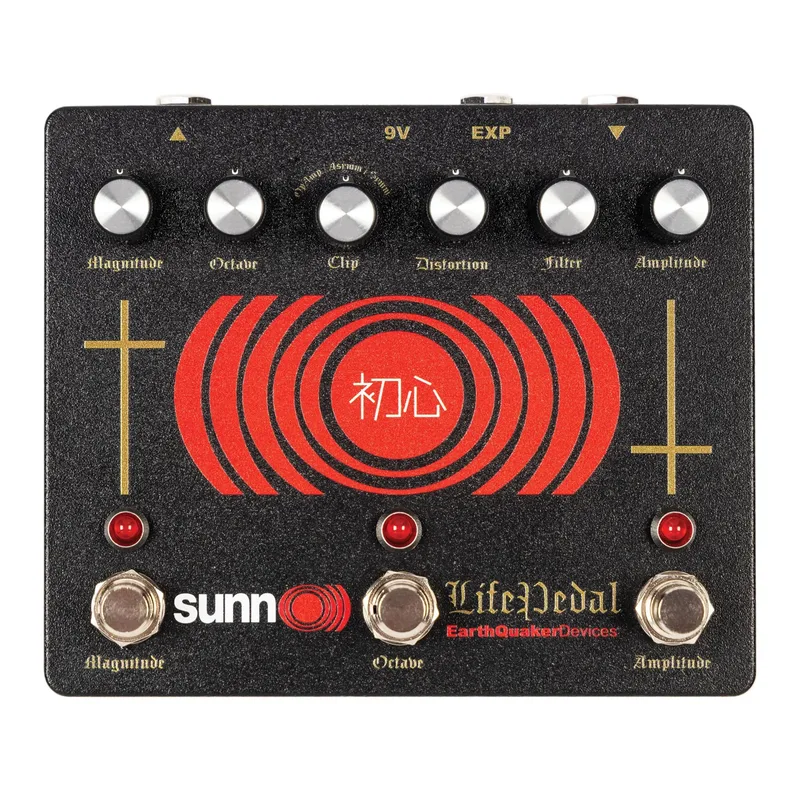
The HalfLife is the most compact, pedalboard-friendly version of the Life Pedal distortion circuit. It keeps the octave-up, the three-mode RAT-style distortion and the clean boost, but in a smaller enclosure. The larger Life Pedal line went through limited editions and a V3 before the HalfLife arrived as a standard-issue, permanently available pedal.
Does the HalfLife need power to pass signal?
Yes. The HalfLife uses relay-based true bypass with Flexi-Switch Technology, which allows both momentary and latching switching, and because the switching is relay based it requires power to pass signal. It runs on a standard 9V DC supply with a 2.1mm negative center barrel and draws 15 mA.
Can I use an expression pedal with the HalfLife?
Yes. The Octave EXP jack accepts any expression pedal, and it controls the analog octave blend. This feature was first added on the Life Pedal V2 and carried over to the V3 and the HalfLife.
Can the boost be used without the distortion?
Yes. The octave distortion and the booster each have their own footswitch and can be used independently. The Magnitude footswitch activates the clean MOSFET booster on its own, so you can use it as a straight volume push into your amp.
How does the HalfLife octave track chords?
It does not track chords well. The octave is an all-discrete analog full-wave rectifier circuit, which makes it monophonic. EarthQuaker Devices says it works best on single notes played above the twelfth fret using the neck pickup. Pushed to a full octave blend, it turns into a swelling, raging fuzz similar to the classic Super Fuzz.
What was the HalfLife Fer MMXXV?
The HalfLife Fer MMXXV was an extremely limited-edition run that preceded the standard HalfLife. It was housed in a cast-iron enclosure made using the centuries-old Nanbu-tekki casting technique. The regular HalfLife is the mass-production successor to that edition.
Sources (6)
- Sunn O))) HalfLife Octave Distortion + Booster, EarthQuaker Devices
- EQD Sunn O))) HalfLife: Compact Doom!, gearnews.com, 2026-06-17
- EarthQuaker Devices Sunn O))) HalfLife Octave Distortion & Booster review, Guitar World, 2026-07-29
- Sunn O))) Life Pedal Octave Distortion + Booster, EarthQuaker Devices
- EarthQuaker Devices Sunn O))) Life Pedal V3, gearnews.com, 2022-11-04
- Guitar Pedal X, Guitar Pedal X, 2026-06-17