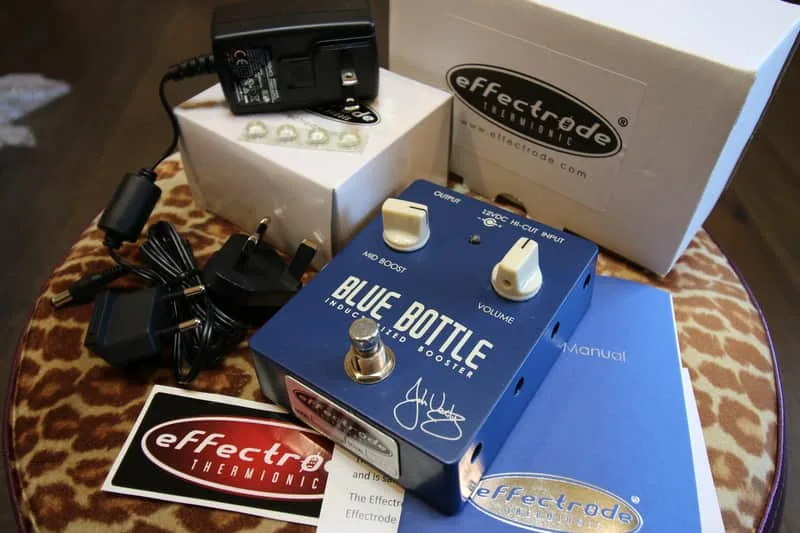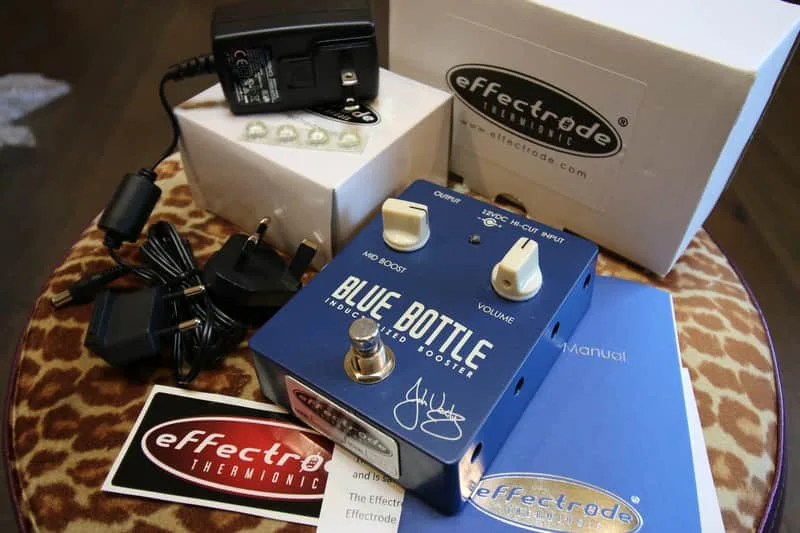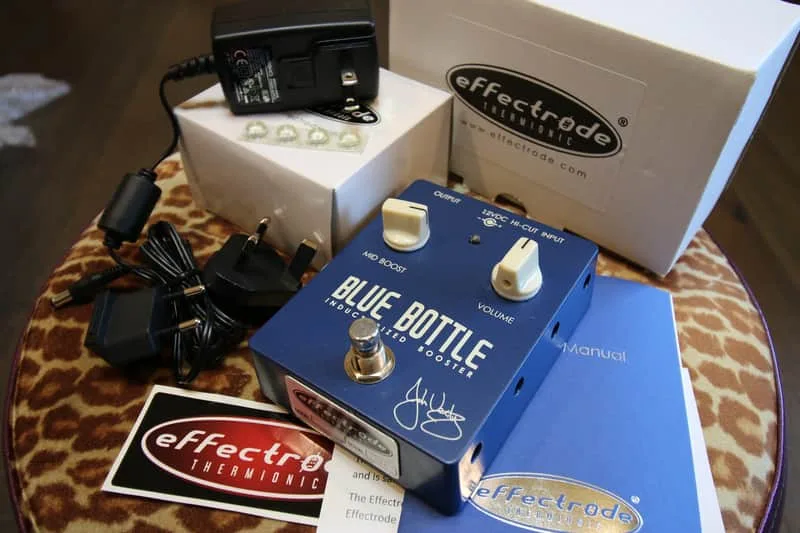


The Effectrode Blue Bottle Inductorized Booster is a tube boost pedal from UK-based pedal company Effectrode. It is a signature pedal for Argent guitarist John Verity, who wanted a pedal that would fatten up his single coils1. What sets it apart from most boost pedals is its circuit: it houses a real inductor alongside a NOS Sylvania 6021 sub-miniature triode valve1.
For inspiration, Effectrode looked to valve-based Pultec equalizers, the high-end units you would find in a recording studio1. The earlier JV-1A version of the pedal was described as an all-tube inductorized mid booster based on a Pultec tube EQ2, and the design carries through to the current pedal.
A mid booster built around a real inductor
The Blue Bottle's job is twofold: it boosts your signal, and it fattens the midrange. The Mid Boost control is flat at its lowest position and adds up to 12dB of midrange boost centerd around 500Hz at its extremes13. The Volume control offers up to 18dB of boost, with unity gain found around the 11 o'clock position13.
| Control | What it does |
|---|---|
| Mid Boost | Flat at minimum; up to 12dB of midrange boost centerd around 500Hz13 |
| Volume | Up to 18dB of gain; unity gain around 11 o'clock13 |
| Hi-Cut switch (rear) | -6dB/octave low-pass filter rolling off top end above 6kHz or 3kHz13 |
| Bypass footswitch | True bypass switching1 |
The Hi-Cut switch is a rear-panel toggle for sculpting your top end. It engages a -6dB/octave low-pass filter that rolls off top-end above either 6kHz or 3kHz, depending on the position13. For a player using the pedal as a boost into an already-bright amp, that gives a way to take the edge off without touching the amp's own controls.
The pedal is built with audiophile-grade components, including precision, low-noise metal-film resistors and polyester coupling capacitors, a carry-over from the JV-1A's build2.
Power and connections
The Blue Bottle comes supplied with a 12V DC adaptor rated at 600mA1. Connections are a standard input and a standard output1.
Sources disagree on the power plug's polarity. Gearnews reported the JV-1A Blue Bottle's supplied supply as 12V DC, 600mA, center positive2, while RockBoard's listing for the Blue Bottle gives 12V DC, center negative4. Because of that conflict, use the supplied adaptor rather than a generic 12V supply, and check the pedal's own marking before plugging in anything else.
The 600mA draw also rules out a battery, and it is heavy enough that a typical daisy chain shared with other pedals may not serve it well21.
Where it came from
The Blue Bottle's lineage goes back to the Effectrode JV-1A Blue Bottle, a signature pedal for Argent guitarist John Verity, who wanted a pedal that would fatten up his single coils1.
What reviewers said
MusicRadar's review team was positive about the pedal's core job:
"The Blue Bottle works a treat as a fattener of single coils, but it's also a formidable sweetener of tone and could well be your go-to boost, or secret weapon in the signal chain."1
Guitar World's reviewer, Trevor Curwen, summed up the pedal's strengths as classy tone enhancement, loads of boost on tap, and satisfying midrange fattening, with no drawbacks unless your board lacks room for the 12V DC adaptor3.
Videos
Effectrode
Joe Perkins
Questions
Is the Effectrode Blue Bottle true bypass?
Yes. Both MusicRadar and Guitar World list the Blue Bottle as true bypass in their reviews. The earlier JV-1A version was also true bypass, with what Effectrode described as anti-pop or anti-thump foot switching circuitry to keep the switching quiet.
What power supply does the Blue Bottle use?
It runs on a supplied 12V DC adaptor rated at 600mA. Note that sources disagree on the plug polarity: Gearnews reported the JV-1A's supply as centre positive, while RockBoard's listing gives 12V DC center negative. Use the supplied adaptor rather than a generic one.
What is the Hi-Cut switch on the Blue Bottle for?
It is a rear-panel switch that shapes the top end. It engages a -6dB/octave low-pass filter that rolls off frequencies above either 6kHz or 3kHz, depending on the position. It is useful for taming brightness, particularly with a boost pushing an amp harder.
Where is unity gain on the Blue Bottle volume knob?
Both MusicRadar and Guitar World place unity gain at around the 11 o'clock position on the Volume knob, with the Mid Boost knob not in play. Below that the pedal cuts level; above it, the knob delivers up to 18dB of boost.
How big is the Effectrode Blue Bottle?
Its dimensions are 92mm wide by 125mm deep by 55mm high, as listed by both MusicRadar and Guitar World. That is larger than a typical compact boost pedal, so plan board space accordingly, including room for the 12V DC adaptor.
Sources (4)
- Effectrode Blue Bottle Inductorized Booster review, MusicRadar, 2020-08-18
- Effectrode JV-1A Blue Bottle Tube Booster, gearnews.com, 2019-01-23
- Effectrode Blue Bottle Inductorized Booster review, Guitar World, 2020-08-20
- Blue Bottle by Effectrode, RockBoard PedalPedia, 2026