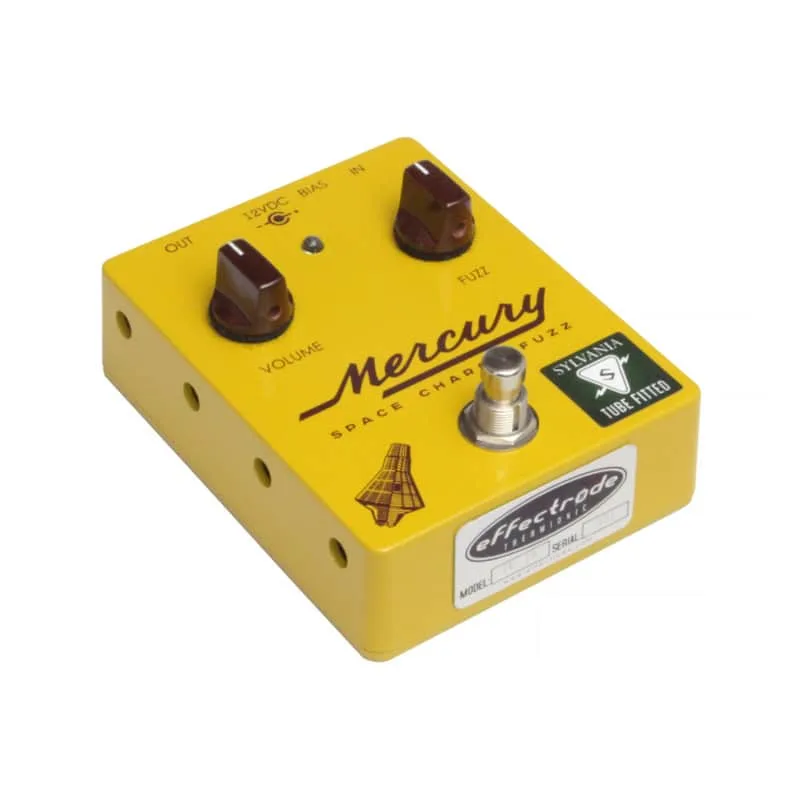



The Mercury Fuzz is a limited-edition valve-driven fuzz pedal from Effectrode, a maker that specialises in valve-driven stompboxes. It is built around NOS (new old stock) components: a Philips subminiature valve and vintage germanium diodes, a combination designer Phil Taylor describes as giving a fatter, more robust sounding fuzz1. Effectrode markets it as the Mercury Tube Fuzz pedal2.
The Mercury is powered from a supplied 12-volt adaptor1, so plan your pedalboard power accordingly rather than expecting to run it from a regular supply outlet.
What it does to your sound
MusicRadar's reviewer Trevor Curwen found that with the fuzz control up, "whack it up and you get a lovely fat creamy fuzz sound with plenty of sustain and harmonic content"1. The pedal carries standard volume and fuzz knobs on its face, with the Heat switch and an internal trim pot shaping the character beyond that1.
Controls at a glance
| Control | What it does |
|---|---|
| Volume knob | Sets the pedal's output level1 |
| Fuzz knob | Sets the amount of fuzz; up, it gives a fat, sustaining fuzz tone1 |
| Heat switch | Makes the fuzz harder, tighter and less squashy when engaged1 |
| Internal trim pot (second) | Dials in the plate voltage that shapes what the Heat switch does1 |
The Heat switch and internal trim pot
The Heat switch is the Mercury's main extra control. Flick it and, in the reviewer's words, "the fuzz gets harder, tighter and less squashy, the actual sound depending on how low a plate volt" has been set1. A second internal trim pot dials in that plate voltage, so the switch's effect can be tailored inside the pedal rather than from the top panel1.
Where it came from
The Mercury follows on from the now sold out Helios valve-driven fuzz, and it is an original valve-driven design rather than a clone of a vintage circuit1. That originality, together with the NOS valve and germanium diodes, is part of why it is a limited-edition release1.
Build and switching
The Mercury is hand-built and, in the reviewer's words, "ruggedly put together for heavy road use"1. Switching is handled electronically rather than with a mechanical bypass, and the reviewer found "excellent silent switching with no thumps or pops," noting that the necessary circuitry does cause a momentary volume dip when the pedal is engaged1.
What reviewers said
MusicRadar's verdict was positive on value as well as sound: "if you are willing to spend over £200 on a pedal, we reckon that the price tag is justified"1. The review paired praise for the fat, sustaining fuzz tone with the build quality and the originality of the design1.
Videos
Mike Hermans
Joe Perkins
John Verity
Questions
Is the Effectrode Mercury Fuzz a clone of another fuzz?
No. MusicRadar's review describes it as an original valve-driven design that is not a mere clone. It follows on from Effectrode's Helios valve-driven fuzz, which is now sold out, and it is a limited-edition pedal built around NOS components: a Philips subminiature valve and vintage germanium diodes.
What does the Heat switch do on the Mercury Fuzz?
The Heat switch makes the fuzz harder, tighter and less squashy when engaged. The actual sound depends on how low a plate voltage has been dialed in with a second internal trim pot, so the switch's character can be tailored inside the pedal.
What power supply does the Effectrode Mercury Fuzz use?
It is powered from a supplied 12-volt adaptor, so it is not a standard 9V pedal. Plan your pedalboard power accordingly rather than expecting to run it from a regular 9V outlet.
Does the Mercury Fuzz use a real vacuum tube?
Yes. It is built around a Philips subminiature valve, paired with vintage germanium diodes. Effectrode specialises in valve-driven stompboxes, and the Mercury's designer Phil Taylor describes the valve as giving a fatter, more robust sounding fuzz.
Does the Mercury Fuzz pop when you switch it on and off?
MusicRadar's reviewer found the pedal has excellent silent switching with no thumps or pops. The switching circuitry does cause a momentary volume dip, but no audible switching noise.
Who designed the Effectrode Mercury Fuzz?
The Mercury Fuzz was designed by Phil Taylor, Effectrode's designer, whose company specialises in valve-driven stompboxes.
Sources (2)
- Effectrode Mercury Fuzz review, MusicRadar, 2015-04-23
- Mercury Tube Fuzz pedal, Effectrode, 2026-10-03