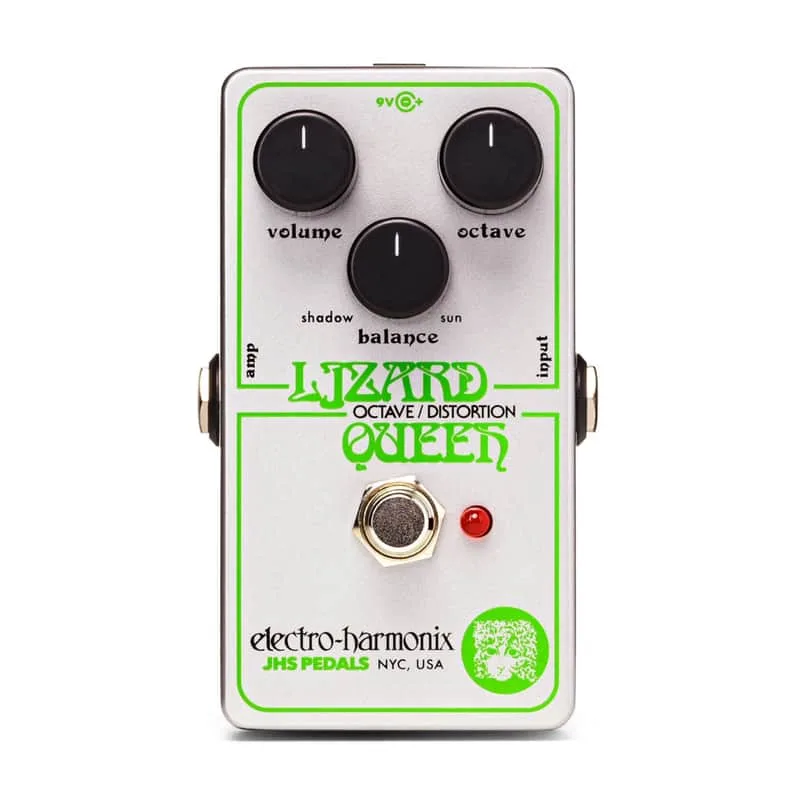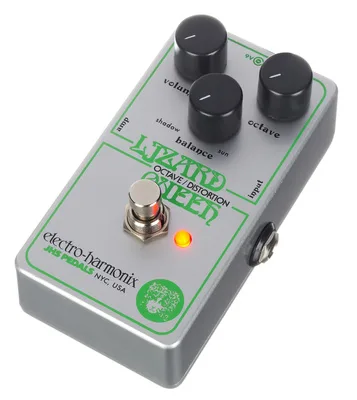


The Lizard Queen is an octave fuzz distortion pedal made as a collaboration between Electro-Harmonix and JHS Pedals. It is an analog octave-up circuit built on silicon transistors, designed to sound like a "lost" 1970s EHX fuzz that never actually existed, an homage to Electro-Harmonix in what Josh and Daniel consider the company's design heyday1. Premier Guitar reviewed it as "this silicon-transistor-based octave-up fuzz"2, and gearnews described it as "An octave fuzz distortion that never was, but which takes its inspiration from those classic EHX pedals"3.
The controls: Volume, Octave and Balance
The Lizard Queen has three knobs and no gain control. Pedal of the Day describes it as "a fixed gain fuzz pedal"1, so the saturation level is what the circuit delivers, and the knobs shape level, octave and tone around it.
| Control | What it does |
|---|---|
| Volume | Controls the overall output volume level1 |
| Octave | Adjusts the level of the octave-up signal, from zero to full octave chaos1 |
| Balance | Sets the tone balance between the smoother Shadow setting and the raspy, biting Sun setting1 |
The Balance knob works as a filter with two named poles. Premier Guitar's reviewer explains: "The balance control is a filter that shifts between 'shadow' (to the left) and 'sun' (to the right) settings," with shadow rolling off highs to create a darker tone and sun adding treble2. Pedal of the Day adds that "The effect of the Balance control is especially apparent with the octave set high"1, and gearnews notes that "The Balance control behaves very differently depending on the Octave level"3. In practice, the two knobs are meant to be explored together rather than set independently.
The octave-up signal itself is generated by an analog circuit, not digital processing1. If you are new to this corner of effects, octave fuzz adds a synthesized note one octave above what you play on top of the fuzzed-out fundamental; see Octave & Pitch Pedals and Fuzz Pedals for how the two families work.
A JHS and Electro-Harmonix collaboration
The original Lizard Queen was designed by Josh Scott of JHS Pedals and graphic designer Daniel Danger. Premier Guitar describes it as "created by JHS Pedals founder Josh Scott and artist Daniel Danger in an effort to conjure a mythical 'lost' EHX fuzz pedal"2. gearnews reported that it was "originally designed, in secret, as a loving tribute to the historic sound and design" of Electro-Harmonix3.
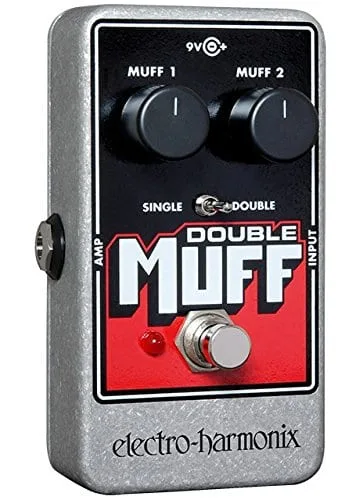
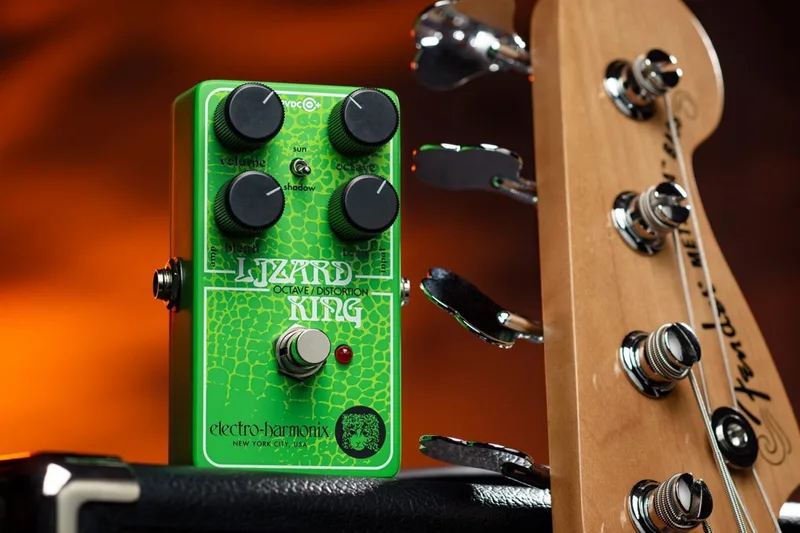
The pedal exists in two versions. The JHS-built original is covered on the Electro-Harmonix/JHS Lizard Queen page, while the EHX version covered here is "a nano-sized version of the pedal brought to life by the engineers at Electro-Harmonix," housed in EHX's Nano-sized chassis1. That puts it in the same compact format as pedals like the Electro-Harmonix Nano Double Muff. A related design, the Electro-Harmonix Lizard King, shares the family name.
Pedal of the Day's verdict on the sound: "This creates a completely new and unique EHX fuzz sound we've never heard before"1. That is the point of the design: rather than recreating a specific vintage circuit the way a reissue would, it imagines the fuzz Electro-Harmonix might have built in the 1970s and never did13.
Videos
JHS Pedals
EHX
Nate Navarro
Questions
Is the Lizard Queen analog or digital?
It is analog. Pedal of the Day describes it as a unique analog octave up circuit, and Premier Guitar's reviewer calls it a silicon-transistor-based octave-up fuzz. There is no digital processing or modeling involved; the octave-up effect comes from the analog circuit itself, which is typical of octave fuzz designs of the kind it pays tribute to.
Does the Lizard Queen have a gain knob?
No. Pedal of the Day describes the Lizard Queen as a fixed gain fuzz pedal. The gain structure is set by the circuit, and the three knobs, Volume, Octave and Balance, handle output level, the amount of octave-up signal, and tone shaping. Players who want more or less saturation adjust it with their guitar's volume or an overdrive in front of it.
Who designed the Lizard Queen?
The original design came from Josh Scott, founder of JHS Pedals, together with artist and graphic designer Daniel Danger. Premier Guitar describes it as an effort to conjure a mythical lost EHX fuzz pedal, and Electro-Harmonix engineers later brought the design to life in the nano-sized EHX version.
What do the Shadow and Sun settings on the Balance knob do?
Balance is a tone filter that shifts between two characters. The Shadow setting, to the left, rolls off highs for a darker tone, while the Sun setting, to the right, adds treble for what Pedal of the Day calls a raspy, biting sound. Its effect is especially apparent when the Octave knob is set high, and it behaves differently depending on the Octave level.
How big is the Lizard Queen compared with other EHX pedals?
The Electro-Harmonix version is a nano-sized pedal, built in EHX's Nano-sized chassis, the same compact format the company uses across much of its current range. It is a nano-sized version of the pedal originally designed by JHS, brought to life by the engineers at Electro-Harmonix.
Sources (3)
- Electro-Harmonix / JHS Pedals Lizard Queen Octave Fuzz Distortion, Pedal of the Day, 2024-07-06
- EHX/JHS Lizard Queen Review, Premier Guitar, 2023-08-29
- JHS EHX Lizard Queen: The octave fuzz distortion inspired by the '70s, www.gearnews.com, 2023-04-11