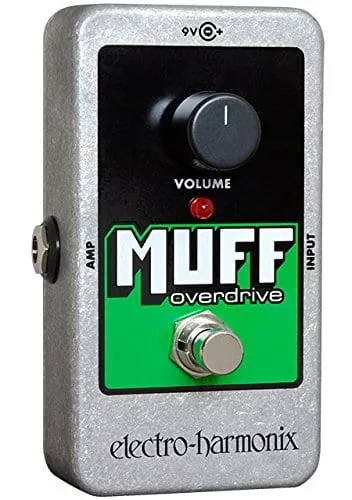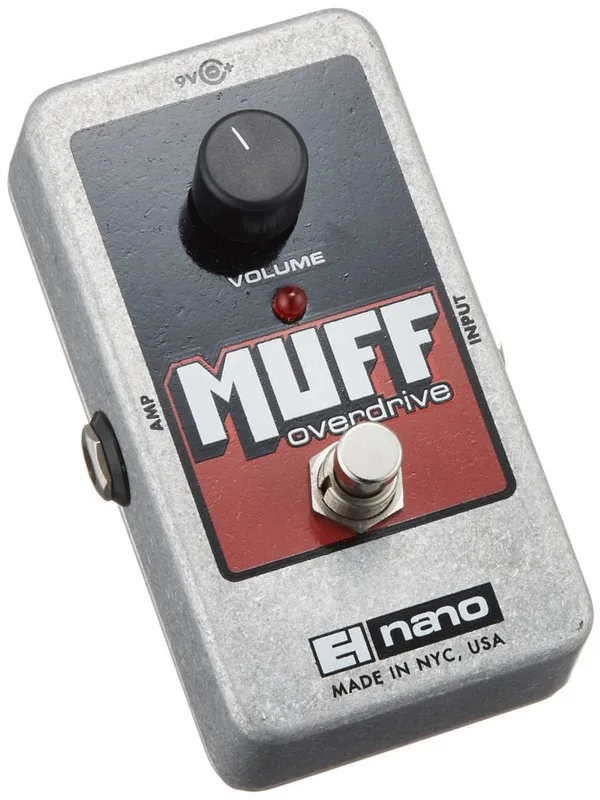


The Electro-Harmonix Muff Overdrive is a compact analog overdrive pedal from Electro-Harmonix, and it is a reissue of the original 1969 Muff Fuzz1. Despite the Muff name, it is not a Big Muff fuzz: Electro-Harmonix classifies it as an analog overdrive, and describes what it does as vintage tone that pushes your amp's natural drive1.
Electro-Harmonix's own description of the sound is specific: "Crank up your amp and dial back the guitar volume and you have the perfect rhythm overdrive. Adds just a touch of funky dirt with an edge. Sounds like a vintage tube amp with a worn but warm speaker."1 In other words, it is a low-gain pedal meant to sit on top of an amp that is already working, with the guitar's volume knob doing part of the job.
The Muff Overdrive is discontinued. Electro-Harmonix marks it as discontinued in 20231, so it is found on the used market rather than new from the maker.
What the Muff Overdrive does
The pedal is built around a simple idea: a light, vintage-flavored drive that stacks well with an amp's own break-up. Electro-Harmonix pitches it as "vintage tone that pushes your amp's natural drive"1, and its suggested use, running the amp hot and backing off the guitar volume for rhythm parts, is the classic low-gain overdrive approach1.
Where it fits in a bigger rig is documented too. Kit Rae's Big Muff history notes that a Big Muff Pi can be stacked with an overdrive pedal placed before or after it to create blended tones, and that "one of the best to use is the old Muff Fuzz/Little Muff from the 1970s, or the modern version, the Muff Overdrive"2. For a player who wants a fuzz with more midrange body, running the Muff Overdrive into a Big Muff is a documented pairing.
A reissue of the 1969 Muff Fuzz
The Muff Overdrive traces back to the Muff Fuzz, which Kit Rae's history describes as "an analog two transistor fuzz tone pedal" from Electro-Harmonix's early years3. The Stompbox Book's account by Derek See is more precise about what that circuit actually did: "the Muff Fuzz, which was a mild overdrive circuit in an LPB-1 box"4. So even in 1969, the Muff Fuzz was closer to a gentle boost-with-dirt than to the heavy fuzz the Big Muff name later became known for.
The timeline of the reissue runs as follows:
- 1960s: The original EHX-designed Muff Fuzz appears, the circuit the Muff Overdrive reissues5
- Circa 1979: Electro-Harmonix builds an op-amp version of the Muff Fuzz6
- 2008: The Nano Muff Overdrive is released, which Kit Rae identifies as "Reissue of the 1969 Muff Fuzz/Little Muff Pi"6
- 2023: The Muff Overdrive is discontinued1
The Muff Fuzz circuit has also lived on outside Electro-Harmonix. General Guitar Gadgets sells a DIY replica of it as a fuzz kit project7, and Jeds Peds offers the classic 1960s EHX-designed Muff Fuzz circuit as well5.
The Double Muff
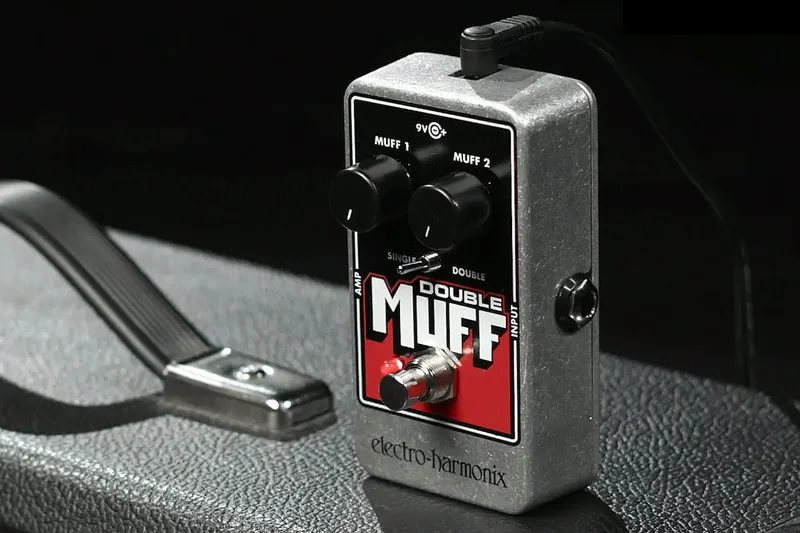
The closest relative in the EHX lineup was the Double Muff, which Electro-Harmonix described as a Fuzz & Overdrive pedal pairing two 1969 Muff Fuzz circuits in one box8. The maker's own words on the original circuit: "The original 1969 plug-in Muff Fuzz had just a touch of overdrive and sounded like a vintage amp with a slightly torn speaker"8. Kit Rae dates the Double Muff to around 2001 and records it as discontinued in 20086, while Electro-Harmonix's product page marks it discontinued in 20208; the two sources disagree on when it left the lineup.
Fuzz or overdrive?
The naming is the main source of confusion. The Muff Overdrive shares its name with the Big Muff Pi family, but Kit Rae's history is explicit that the Muff Fuzz, Metal Muff and Double Muff "are not actual Big Muff circuits, and none have any of the signature characteristics of a Big Muff's tone"2. The Muff Overdrive reissues the Muff Fuzz, so it belongs on the overdrive side of that line: a mild, two-transistor-derived drive rather than a sustaining fuzz34.
Videos
Art Tendency
GuitarFXMania
Wall of Sound
Questions
Is the Electro-Harmonix Muff Overdrive discontinued?
Yes. Electro-Harmonix lists the Muff Overdrive as discontinued in 2023. It first appeared in Nano form in 2008 as a reissue of the 1969 Muff Fuzz, and the used market is now the main way to find one.
Is the Muff Overdrive true bypass?
Yes. Electro-Harmonix lists true bypass among the pedal's features, so with the effect switched off the guitar signal passes through without active circuitry in the path.
Does the Muff Overdrive run on a battery?
Yes. A 9-volt battery is included with the pedal. Electro-Harmonix also offers an optional 96DC-200BI power supply for players who prefer to run it from a wall adapter.
What power supply does the EHX Muff Overdrive use?
The pedal runs on the included 9-volt battery, or on Electro-Harmonix's optional 96DC-200BI adapter, which is sold separately. No other power details are given by the maker.
Is the Muff Overdrive a fuzz or an overdrive?
It is an analog overdrive. It reissues the 1969 Muff Fuzz, which was itself a mild overdrive circuit rather than a full fuzz, and Electro-Harmonix describes it as adding a touch of dirt with an edge, like a vintage tube amp with a worn but warm speaker.
Sources (8)
- Muff Overdrive, Electro-Harmonix
- The Big Muff Pi Home Page, Kit Rae (kitrae.net), 2010
- The Big Muff History of All Versions Part 1, Kit Rae (kitrae.net), 2020-03
- Big Muff Pi, Stompbox Book, 2020-03-21
- Muff Fuzz, Jeds Peds
- A Fuzz and Muff pedal Timeline, Kit Rae (kitrae.net), 2014-07
- EHX™ Muff Fuzz™ Clone: DIY Kit, PCB & Schematic, General Guitar Gadgets, 2014-05-15
- Double Muff, Electro-Harmonix, 2020