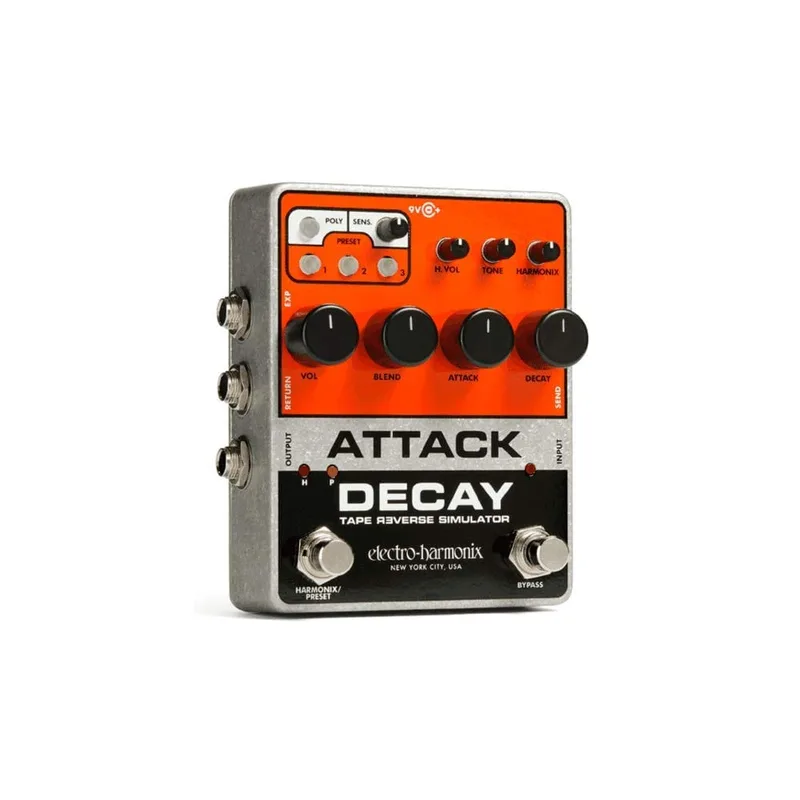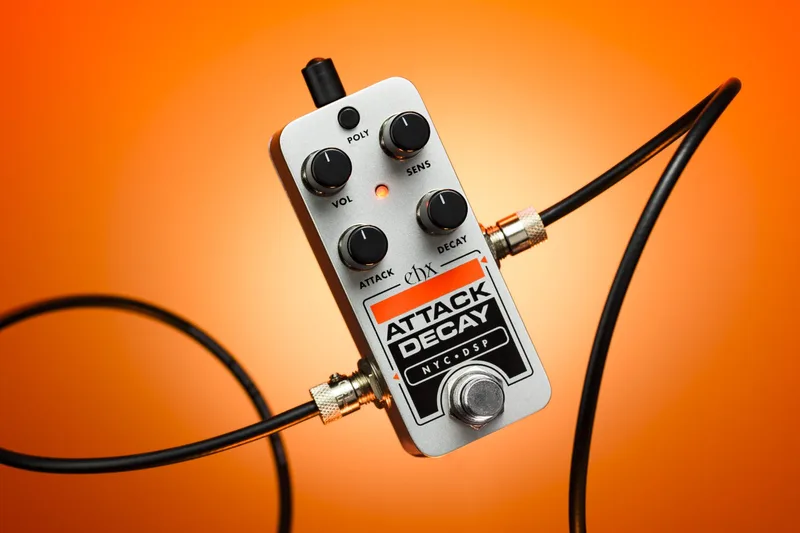


The Electro-Harmonix Pico Attack Decay is a compact digital volume envelope pedal that shapes the way each note rises and falls in volume, rather than the note's tone. Electro-Harmonix bills it as a Tape Reverse Simulator: instead of a note starting loud and decaying as it naturally would, the pedal can fade a note in from silence, swell it, cut it into staccato bursts, or make it sound like a bowed instrument or a piece of tape running backward.1
Released in 2023, it carries the volume envelope effects of the EHX Attack Decay Reissue into the company's smallest enclosure, the Pico chassis, measuring 3.65 x 2.0 x 2.0 inches.1 It is a return of a design that had been discontinued: Guitar.com called it "the return of EHX's gloriously odd 'tape reverse simulator' in Pico form."2 Where a conventional volume pedal puts your foot in charge of the swell, the Attack Decay triggers the swell automatically from your picking.
Where it came from
The Pico Attack Decay is the latest chapter of a design with a long history. The original Attack Decay Tape Reverse Simulator was known, as Guitar.com's news coverage put it, "for producing volume and reverse swells, backward tape sounds," and staccato and bowed effects.3 Premier Guitar notes that the Pico version "is derived from the digital reimagination of the effect that appeared in 2019."4 The Pico Attack Decay puts that digital circuit in the compact Pico chassis, measuring 3.65 x 2.0 x 2.0 inches.1
Mono and Poly modes
The pedal has two volume envelope modes, selected by the POLY button. The button's LED color shows which mode is active: green for Mono, orange for Poly.1
| Mode | What it does |
|---|---|
| Mono Mode | A single volume envelope applies to all notes you play, each time the envelope is triggered1 |
| Poly Mode | Each note played gets its own individual volume envelope1 |
The difference matters most for chords. In Mono Mode, a strummed chord swells as one block of sound. In Poly Mode, every note in that chord rises and falls on its own, which Guitar.com's launch coverage described as "the revolutionary Poly mode that gives each note its own attack envelope."3 Premier Guitar's reviewer found that Poly Mode "doesn't add oodles of additional textures, but it does often add a vowelly, mutant flange/filter effect" that suits alien envelope-filter tones.4
Controls
The control layout is deliberately simple: Volume, Sensitivity, Attack and Decay knobs, plus the Poly/Mono button and a footswitch.3
| Control | What it does |
|---|---|
| ATTACK | Sets the swell or fade-in speed of the volume envelope; turning clockwise increases attack time, and the minimum setting disables the attack portion1 |
| SENS | Sets the threshold volume that triggers the envelope; turning clockwise makes playing trigger and reset the envelope more easily1 |
| VOL | Adjusts overall output volume1 |
| POLY button | Selects the volume envelope mode; green is Mono, orange is Poly1 |
| Footswitch | Engages or bypasses the effect; the LED indicates the envelope type and is off in bypass1 |
| BLEND (hidden) | Blends wet and dry signals from 100% wet to 100% dry1 |
The BLEND control is not on the face of the pedal. Electro-Harmonix describes it as a "Hidden BLEND control" that adjusts from a fully effected signal to fully dry, letting you keep some of your original attack under the envelope.1 Delicious Audio's coverage highlighted the same feature when the pedal was announced.5
Power and connections
The pedal is simple to hook up: one audio input jack, one audio output jack, and a 9V power jack.1
The Pico Attack Decay has no battery option. It runs from the included 9.6VDC-200mA power adapter, attached to the 9V power jack, and draws 100mA at 9.0VDC.1
That 100mA draw is modest by digital pedal standards but worth knowing if you run a compact board from a single supply. The buffered bypass means the pedal's buffer stays in the signal path even when the effect is off.1
What reviewers said
Guitar World reviewed the pedal and found more in it than its size suggests6:
"the Pico Attack Delay is a pretty unassuming pedal, but delve deeper and it's got dozens of possibilities"
Guitar World's review listed its controls as Level, Attack, Decay, Sensitivity and Poly/Mono, and gave its price as $136 / £129, matching the $136.90 USD figure on Electro-Harmonix's own page.61 Gearnews reported the same $136.90 MSRP at the pedal's US launch in September 2023.7 Premier Guitar's review of the Pico series placed the Attack Decay in the context of the 2019 digital reissue and noted the vowelly, mutant flange and filter character Poly Mode can add.4
Videos
EHX
Musicmaker
Ambient Exploration
News
Questions
Is the Pico Attack Decay analog or digital?
It is digital. The Pico Attack Decay is derived from the digital reimagination of the Attack Decay effect that Electro-Harmonix released in 2019, which itself reinterpreted the circa-1980 analog Tape Reverse Simulator. The Pico version packs those volume envelope effects into the compact Pico chassis.
Does the Pico Attack Decay take a battery?
No. There is no battery option. The pedal runs from a 9.6VDC-200mA power adapter, which Electro-Harmonix includes in the box, plugged into the 9V power jack on the side of the unit. Its current draw is 100mA at 9.0VDC.
Is the Pico Attack Decay true bypass?
No. The Pico Attack Decay uses buffered bypass rather than true bypass. When the footswitch disengages the effect, the LED that indicates the envelope type switches off, but the signal still passes through the pedal's buffer.
How do you access the Blend control on the Pico Attack Decay?
The BLEND control is a hidden control, not one of the knobs on the face of the pedal. It adjusts the mix between the effected and clean signals, from 100% wet to 100% dry. Electro-Harmonix describes it as a hidden BLEND control that blends the wet and dry signals.
Can the Pico Attack Decay sound like reverse tape?
Yes. Electro-Harmonix calls it a Tape Reverse Simulator, and it produces volume and reverse swells and backward tape sounds, along with staccato notes and bowed instrument effects. Guitar.com described it as the return of EHX's gloriously odd tape reverse simulator in Pico form.
Sources (7)
- Pico Attack Decay, Electro-Harmonix
- 60 Seconds S1E11: Electro-Harmonix Pico Attack Decay, Guitar.com, 2023-12-08
- Electro-Harmonix unveils the NYC DSP Series: 9 ultra-compact stompboxes for your 'board, Guitar.com, 2023-09-22
- EHX Pico Attack Decay, Oceans 3-Verb, Canyon, Deep Freeze, Premier Guitar, 2024-03-04
- New Pedal: Electro-Harmonix Pico Attack Decay, Delicious Audio, 2023-10-02
- Electro-Harmonix Pico Attack Decay review, Guitar World, 2024-04-01
- Electro-Harmonix NYC DSP Series pedals unveiled, gearnews.com, 2023-09-21