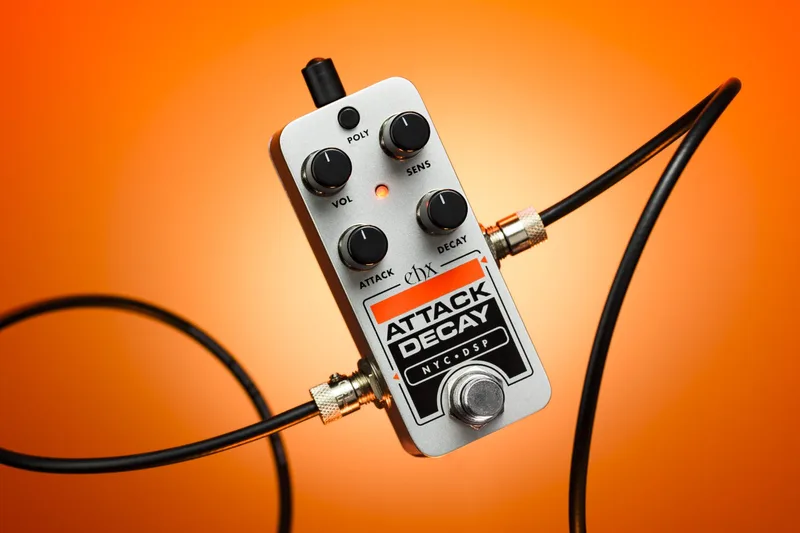


The Electro-Harmonix Attack Decay is a digital pedal that reshapes the volume envelope of your playing: how fast each note fades in and how fast it fades out. Instead of a filter that responds to your picking, like the envelope filters in EHX's Q-Tron line, it grabs the volume itself, which is why the original 1980 version was called a Tape Reverse Simulator. Slow the attack and every note swells up like a reverse-tape effect or a bowed violin; shorten the decay and notes get chopped into staccato blips1.
Electro-Harmonix says the pedal produces volume and reverse swells, backward tape sounds, artificially short staccato notes and bowed instrument effects1. The 2019 reissue adds a built-in Harmonix distortion section, an effects loop, presets, and expression or control-voltage control over every knob1.
What it does: volume envelopes and reverse-tape swells
A volume envelope is the shape of a note's loudness over time. The Attack Decay lets you set that shape yourself: the Attack knob sets the swell or fade-in speed of the envelope, and the Decay knob sets how fast the note fades out after it peaks. With a long attack, a picked note starts silent and blooms, the way a reversed tape loop or a violin bow behaves. With a short decay, sustained notes get clipped into short, percussive bursts1.
Premier Guitar's reviewer placed the pedal in the territory of classic reverse-guitar records, naming "the backwards guitars of 'Tomorrow Never Knows' or 'Are You Experienced,' the airy slide of 'Breathe,'" and describing the pedal as a volume envelope filter with onboard fuzz and compression, tape-reverse-style sounds and tremolo effects3. In poly mode with the sensitivity control maxed, the same reviewer found the pedal "will create bubbling note trails"3.
The controls
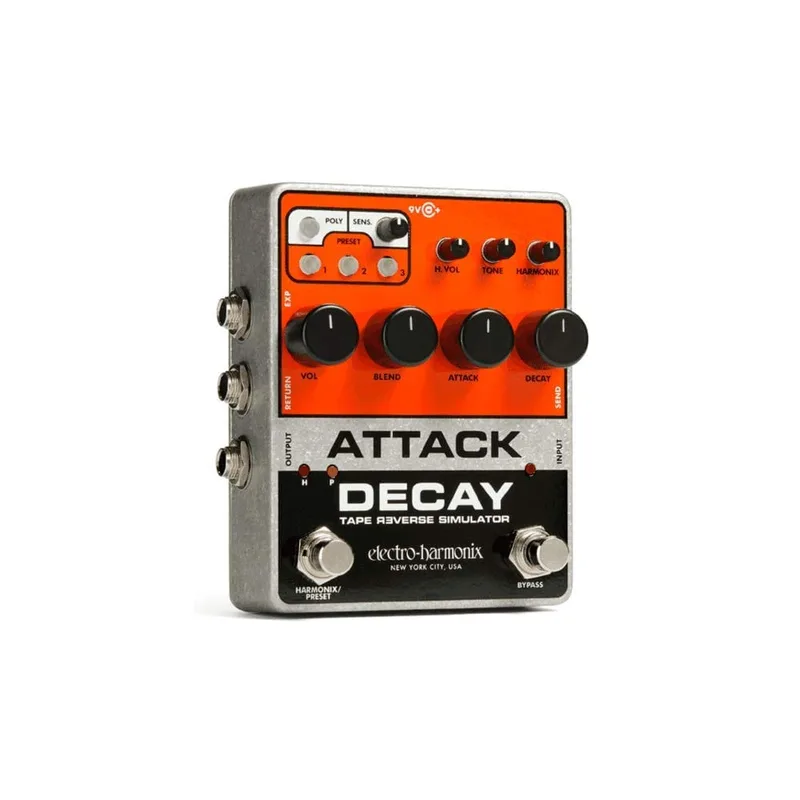
The front panel keeps the envelope shaping to a handful of knobs, with more depth available through button combinations and the manual14.
| Control | What it does |
|---|---|
| ATTACK | Sets the swell or fade-in speed of the volume envelopes1 |
| DECAY | Sets the fade-out speed of the volume envelopes5 |
| VOL | Sets the master output level1 |
| BLEND | Master wet/dry mix; can also mix dry against Harmonix signals before the envelopes, or mix the RETURN jack signal against the envelope output1 |
| SENS | Sets the threshold that triggers the envelope from your playing5 |
| HARMONIX (mini) | Adjusts the gain and saturation of the internal Harmonix distortion1 |
| TONE (mini) | Sets the tone of the Harmonix section1 |
| POLY button | Press and release to toggle between mono and poly modes1 |
The pedal has Harmonix/Preset and Bypass footswitches, and hidden functions are reached by holding down combinations of the pushbuttons and footswitches. Guitar World's reviewer found it important to read the manual to get the most out of the box4. You can save and recall up to three presets1.
The EXP jack takes an expression pedal or control voltage for external control over every knob, or a clock pulse to trigger the envelopes from an external source1. The SEND and RETURN jacks form an effects loop: SEND is the signal source for the loop, and RETURN receives the loop's output or another instrument, so you can place another pedal inside the envelope shaping1.
Mono, poly and continuous envelope modes
The pedal offers three ways to trigger envelopes12:
- Mono mode: one volume envelope at a time; the envelope resets when you play a new note1.
- Poly mode: each note you play gets its own envelope, so chords swell note by note1.
- Continuous Envelope mode: automatically restarts the attack envelope when the decay envelope finishes. MusicRadar's Trevor Curwen notes this results in a tremolo effect, with the Attack and Decay knobs setting the tremolo rate and waveshape2.
Premier Guitar's reviewer found "flipped-out tremolo effects, almost like a sequencer" available in continuous envelope mode3, and MusicRadar praised a "wide range of innovative effects in Poly mode"2.
Power and connections
The Attack Decay runs on the included EHX 9.6VDC-200mA power supply and draws 140mA1. There is no battery option: Premier Guitar's review notes "there's no room for a battery"3. Connections are 1/4" jacks for input, output, effects send and return, and expression3, and the pedal is mono only3. The enclosure is a sturdy metal shell, 4.75 x 4.13 x 2.25 in, assembled in the USA16.
At 140mA, this pedal draws more current than most analog stompboxes, so plan for a proper pedalboard power output rather than a small daisy chain, and expect to use the included adapter or a supply that matches its requirements.
History: from the Tape Reverse Simulator to the reissue
The original Attack Decay was an analog volume envelope pedal that first appeared around 1980, in a Deluxe Memory Man-sized enclosure7. Electro-Harmonix made it in 1980 and 1981, in very small quantities34. It was originally called the Tape Reverse Simulator for its ability to generate reverse-tape-like volume swells87.
Because so few were built, the original became a collector's item. Gearnews called it "a bit of a cult classic and so collectors go squirrely for them"8, and Delicious Audio described the circa-1980 pedal as "a sought after prize among vintage pedal aficionados"9. Premier Guitar reports that originals are rare and typically cost more than $1,0003.
The digital reissue was announced at Winter NAMM in 2019 and released that year158. JHS's Josh Scott noted a detail for collectors: the reissue spells "reverse" in reversed lettering10. On the JHS Show, Scott and Daniel Danger were blunt about the relationship between the two versions: "You've seen the re-issue on the JHS Show a bit, but it has presets and stuff. It's different. It's a completely different" pedal11. Guitar World's Chris summed up the value proposition: the new version "adds about 10 times more power at a street price that's about one tenth of the original pedal's price on the vintage market"4.
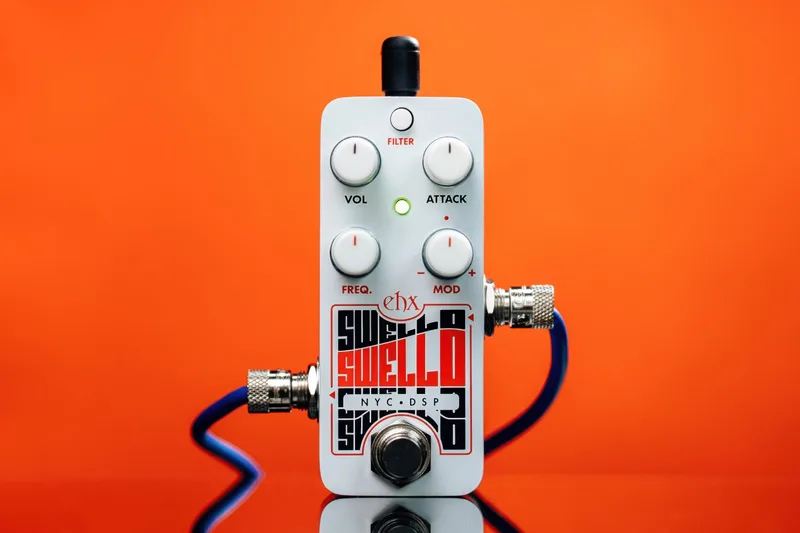
In 2023 Electro-Harmonix also released the Pico Attack Decay, which puts the reissue's volume envelope effects in a compact Pico chassis5. It keeps Mono and Poly modes with Level, Attack, Decay and Sensitivity controls, draws 100mA at 9.0VDC, and lists at $136.905. Guitar.com called it "the return of EHX's gloriously odd 'tape reverse simulator' in Pico form"12. A related 2025 release, the Pico Swello, covers similar swell territory in a fully polyphonic format.
What reviewers said
Reviews across the press were positive, with the common caveat that the pedal rewards time spent learning it13.
- MusicRadar's Trevor Curwen: "Does the backwards guitar thing very well," with the built-in fuzz, the ability to patch effects into the chain, and Poly mode all listed as reasons to buy. His verdict: "This is a pedalboard secret weapon that's a whole lot of fun." He also heard "Big Muff heritage (especially the Tone knob)" in the fuzz2.
- Guitar World's 2019 review found the pedal "delivers a vast universe of exciting new sounds to explore," while stressing that the manual matters for unlocking the hidden functions4.
- Guitar World's Charlie Wilkins later called it, for players willing to put in the time, "one of the most creative and inspiring pedals Electro-Harmonix has ever produced"13.
- Guitar.com's Michael Watts reviewed it in 2019 at £110, describing it as a reverse-tape simulator and more, assembled in the USA6.
- Of the Pico version, Guitar World's verdict was "A little niche for some, but you've got to try it"14.
Videos
Premier Guitar
EHX
Elliot Knapp
Questions
Is the EHX Attack Decay reissue the same as the original?
No. The original was an analog pedal made in 1980 and 1981 in a Deluxe Memory Man-sized enclosure. The 2019 reissue is digital, smaller, and adds presets, polyphonic envelope mode, a built-in fuzz with an effects loop, and expression or CV control over every knob. JHS describes it as a completely different pedal from the original.
Does the Attack Decay have a fuzz built in?
Yes. The reissue has an internal Harmonix distortion section with gain and tone controls, offering 13 dB of gain. MusicRadar's reviewer heard Big Muff heritage in it, especially in the Tone knob, and listed the built-in fuzz as a reason to buy the pedal.
Can the Attack Decay take a battery?
No. Premier Guitar's review notes there is no room for a battery. The pedal runs on the included EHX 9.6VDC-200mA power supply, with a current draw of 140mA, so it needs a power supply or an isolated pedalboard output.
Is the Attack Decay stereo?
No. Premier Guitar lists it as mono only. It has a single audio input and a single audio output, plus separate jacks for effects send and return and for an expression pedal or control voltage.
What is the difference between the Attack Decay and the Pico Attack Decay?
The Pico Attack Decay, released in 2023, puts the reissue's volume envelope effects in a compact Pico chassis at $136.90 list. It keeps Mono and Poly modes with Level, Attack, Decay and Sensitivity controls, but drops the full-size pedal's Harmonix fuzz, effects loop and presets. Its current draw is 100mA at 9.0VDC.
Why is the original Attack Decay so expensive?
Electro-Harmonix made the original in very small quantities in 1980 and 1981, and it has become a cult classic that collectors seek out. Premier Guitar reports that originals are rare and typically cost more than $1,000, roughly ten times the street price of the reissue.
Sources (14)
- Attack Decay, Electro-Harmonix
- Electro-Harmonix Attack Decay review, MusicRadar, 2019-10-04
- Electro-Harmonix Attack Decay Review, Premier Guitar, 2019-09-07
- Review: Electro-Harmonix's Attack Decay delivers a vast universe of exciting new sounds to explore, Guitar World, 2019-10-30
- Pico Attack Decay, Electro-Harmonix, 2019
- Review: Electro-Harmonix Attack Decay, Guitar.com, 2019-06-18
- EHX Pico Attack Decay, Oceans 3-Verb, Canyon, Deep Freeze, Premier Guitar, 2024-03-04
- NAMM 2019: Electro Harmonix Attack Decay, gearnews.com, 2019-01-25
- Electro-Harmonix Attack Decay Tape Reverse Simulator, Delicious Audio, 2020-01-06
- UNDERRATED ELECTRO-HARMONIX PEDALS, JHS Pedals
- RAREST ELECTRO-HARMONIX PEDALS EVER, JHS Pedals
- 60 Seconds S1E11: Electro-Harmonix Pico Attack Decay, Guitar.com, 2023-12-08
- 10 misunderstood guitar pedals that became modern classics, Guitar World, 2026-07-17
- Electro-Harmonix Pico Attack Decay review, Guitar World, 2024-04-01