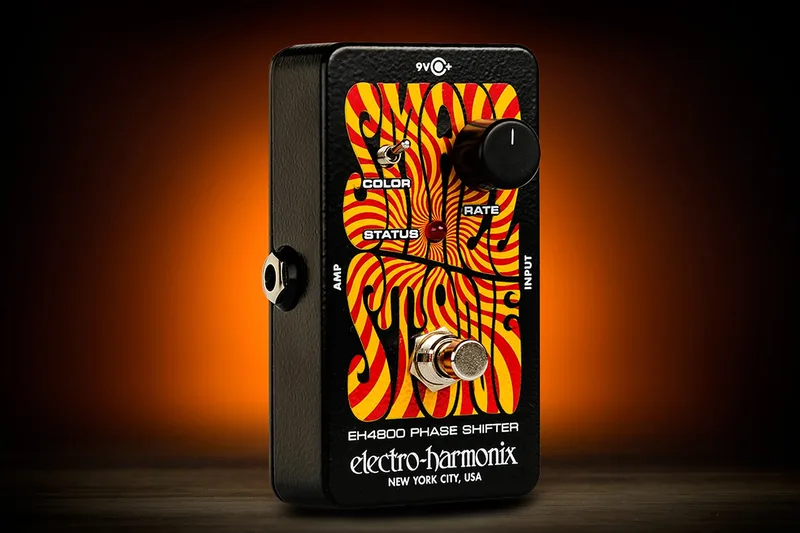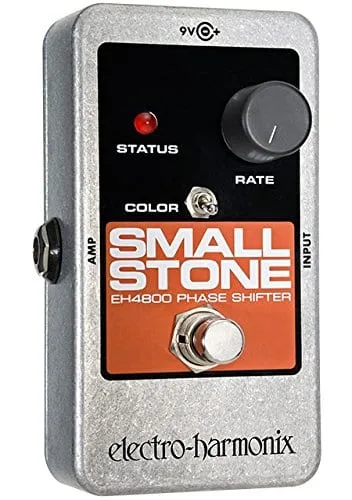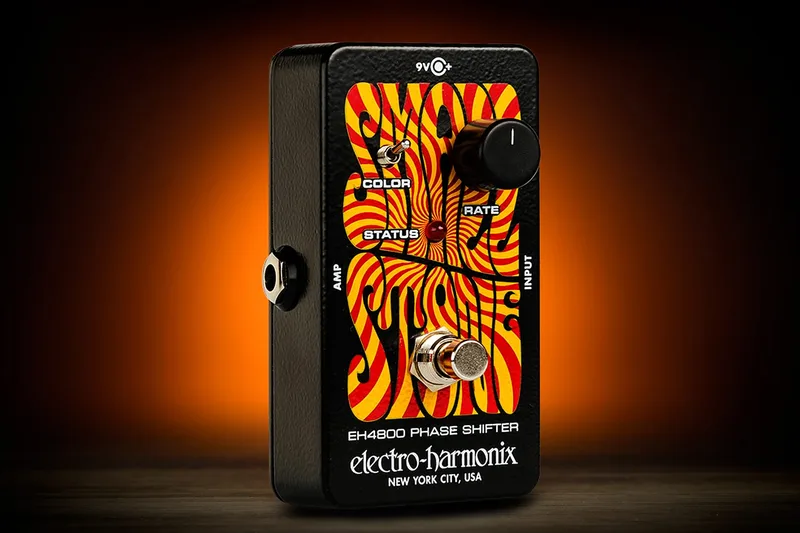


The Electro-Harmonix Small Stone is an analog phaser pedal with one of the simplest control layouts in the effect's history: a single Rate knob and a Color switch. Electro-Harmonix describes it as generating "thick sweeping phase shifting with liquid transparency"1. A phase shifter works by splitting the signal, shifting the phase of one copy across a range of frequencies, and recombining the two, which produces the characteristic moving, swirling sweep associated with the effect.
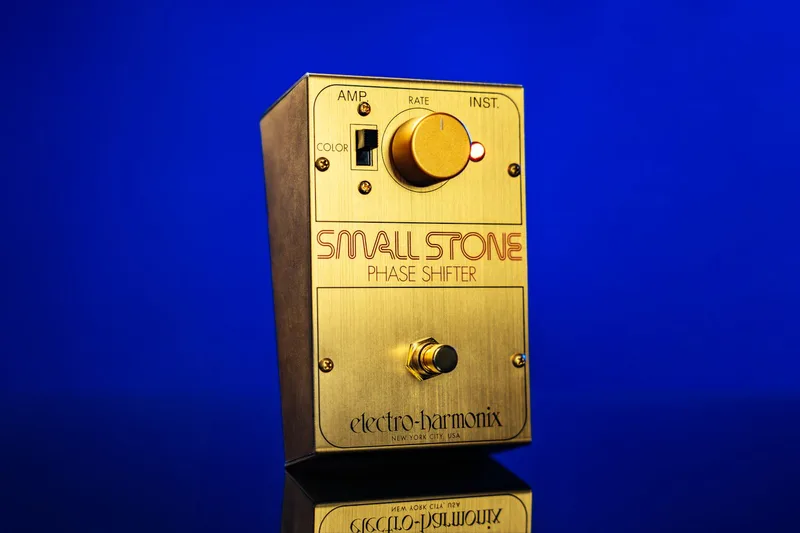
The pedal first appeared in 1975, built in New York City2, and reviewer Barry Rudolph calls it "the original New York City-made phase shifter"3. The original big-box versions are now vintage, discontinued pieces, but the design survives in modern reissues, including the compact Small Stone Nano and a limited Golden 50th Anniversary Edition released in 2025.
The controls: one knob and a Color switch
The Small Stone's entire user interface is a Rate knob and a Color switch, a layout that has stayed the same across every version of the pedal. EarthQuaker Devices' pedalboard guide singles it out as "another classic, simple pedal design with a switch to control the rate"5.
| Control | What it does |
|---|---|
| Rate knob | Adjusts the speed of the phasing sweep1 |
| Color switch (down) | A full and robust phase shift1 |
| Color switch (up) | A more pronounced phase shift1 |
The Color switch is the pedal's second voice. Flipping it changes the character of the phasing rather than its speed, and Pedal of the Day's advice is simply to "mix up your tone by flipping the Color switch"4. Under the hood, the switch engages a feedback path in the circuit: General Guitar Gadgets' technical analysis notes "oscillation when the color switch is on"6, and DIY builders tracing the circuit have found that the switch should disconnect that feedback path when disengaged, which is why a 2PDT switch is needed in faithful clones7.
JHS Pedals featured the Small Stone in its roundup of one-knob effects, joking that "it does have a switch, but I'm allowing that because it's not a knob and I love this effect"8.
Versions: v1, v2, the Nano and the Golden anniversary edition
The Small Stone's history breaks into four main chapters: the two original big-box versions, the compact Nano reissue, and the 2025 anniversary edition289.
| Version | Year | Notes |
|---|---|---|
| v1 | 1975 | Original, made in New York City2 |
| v2 | 1978 | Second big-box version2 |
| Nano | Redesigned 2019 | Compact reissue, same controls10 |
| Golden 50th Anniversary | 2025 | Limited 600-run golden reissue of the Small Stone9 |
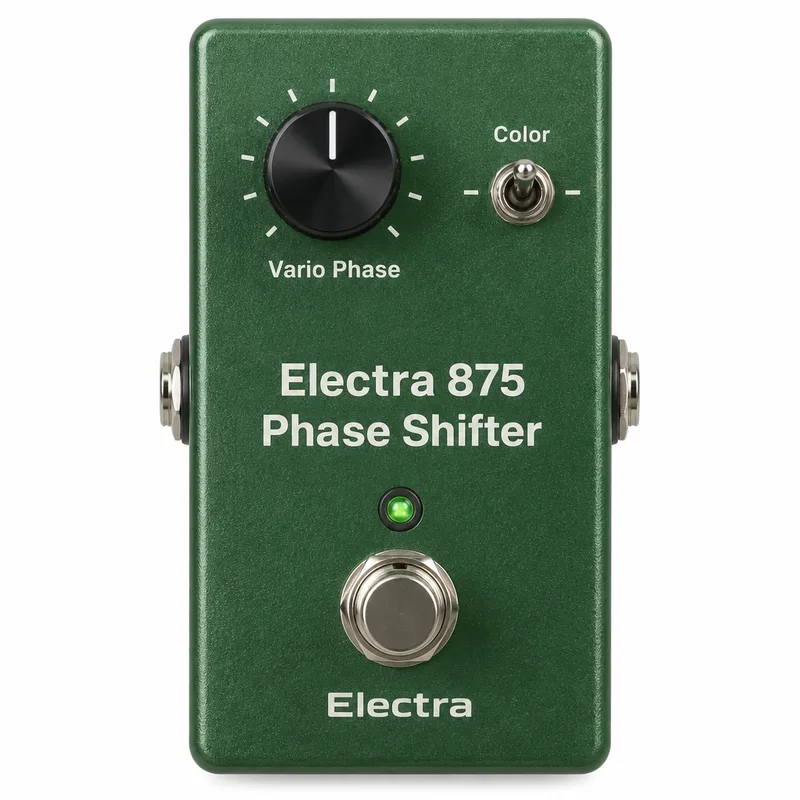
The v1 and v2 are the vintage originals. TONEHOME's reference pages list the v1 at 1975 and the v2 at 1978, both made in New York City2. Barry Rudolph's review covers the original 1975 unit and its bypass footswitch3. A related curiosity of the era: the Electra 875 Phase Shifter was "essentially a rebranded Electro-Harmonix Small Stone," produced for a short time in the late 1970s11.
The circuit itself is what Aion FX calls "a classic OTA phaser"12, a multi-stage design with an extra stage for feedback4. DIY builders have traced it widely; the schematic circulating in the builder community is based on a pedal called the Small Tone, itself a clone of the Small Stone7.
The modern line continues the same design in smaller housing. JHS Pedals compares the "original big box and newer nano reissue" and reports that "these two pedals sound pretty much identical"8. MusicRadar's review of the Nano confirms it "has the same controls as the original: a Rate knob and a Color switch that changes the character of the phasing"13. In March 2019 Electro-Harmonix gave the Nano a redesigned powder-coated enclosure, with the rate knob and color switch unchanged10. Guitar World's 2026 phaser buying guide lists the Nano Small Stone as its budget pick, describing "genuine analog phase tones"14.
The Golden Small Stone was a limited edition of 600 units and has sold out, so it is no longer available new from Electro-Harmonix.
The Golden 50th Anniversary Edition is a limited 600-run golden reissue of the Small Stone Phase Shifter9. Electro-Harmonix says it came about when the company "unearthed a stock of now-ob" chips as the 50th anniversary of the original compact phaser approached15. The company describes it as a way to "celebrate 50 years of iconic phase shifting"16. ===
What reviewers said
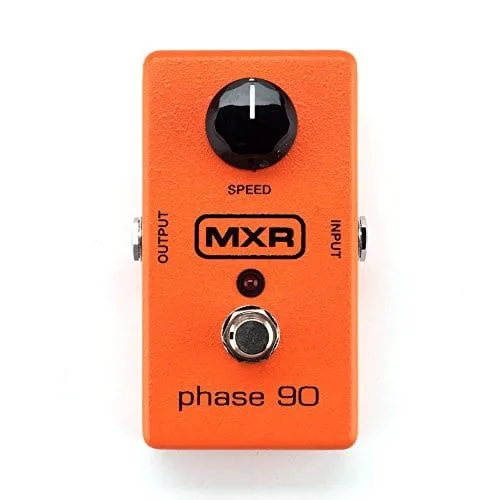
Published opinions on the Small Stone have been consistently positive about its sound while noting its simplicity. A builder writing at Tagboardeffects, having built and played the circuit, reported: "I had never played a Small Stone before but it sounds amazing and I prefer it over my Phase 90 style phaser"7. That comparison to the MXR Phase 90, the other classic four-stage phaser of the 1970s, comes up naturally: the reviewer found both sound great but different7.
Pedal of the Day, reviewing the Russian Sovtek-era version, calls it "a simple but powerful phaser" and a multi-stage design with an extra stage for feedback4. MusicRadar's Nano review frames the pedal's appeal for modern boards: the same controls and sound as the original in a board-friendly size13.
Videos
ProGuitarShopDemos
EHX
Woven Chaos
Questions
Is the Small Stone a phaser or a phase shifter?
Both names describe the same thing. Electro-Harmonix's product page calls it the Small Stone Analog Phase Shifter, while players and reviewers commonly shorten that to phaser. It is an analog phase shifter that sweeps the signal to create its moving, modulated sound.
What does the Color switch do on the Small Stone?
The Color switch changes the character of the phase shift. In the down position it gives what Electro-Harmonix describes as a full and robust phase shift; in the up position the phase shift becomes more pronounced. It works alongside the Rate knob, which sets the speed of the phasing sweep.
Do the original Small Stone and the Nano sound the same?
According to JHS Pedals, which compared the original big-box version with the newer Nano reissue, the two sound pretty much identical. The Nano carries the same control set, a Rate knob and a Color switch, in a smaller enclosure.
When did Electro-Harmonix release the Small Stone?
The original Small Stone was released in 1975, made in New York City. A second version followed in 1978. The current Electro-Harmonix product page lists the modern reissue with a 2006 release year, and a limited Golden 50th Anniversary Edition arrived in 2025.
What is the difference between the Small Stone v1 and v2?
The two vintage versions are separated by date and enclosure era rather than by a change in the basic design: TONEHOME lists the v1 from 1975 and the v2 from 1978. Both are multi-stage analog phase shifters, and the core Rate and Color control scheme carried across the line.
Where was the original Small Stone made?
The original 1975 Small Stone was made in New York City, USA, in the era before Electro-Harmonix production moved overseas. Later versions, including the Russian Sovtek-era Small Stone and the current Nano, were built elsewhere.
Sources (16)
- Small Stone, Electro-Harmonix (www.ehx.com)
- TONEHOME, TONEHOME
- Electro-Harmonix Small Stone Reissue, barryrudolph.com, 2021
- Electro-Harmonix Russian Small Stone Phaser, Pedal of the Day, 2021-03-24
- A Beginners Guide To Pedalboards Pt. 1: Choosing Your Pedals, EarthQuaker Devices, 2021-12-06
- EHX™ Small Stone™ Phaser: Circuit Information & Schematic, General Guitar Gadgets, 2014-05-18
- Guitar FX Layouts: Electro Harmonix Small Stone, Tagboardeffects (tagboardeffects.blogspot.com), 2026-07-13
- ONE KNOB WONDERS, JHS Pedals
- Guitar Pedal X, Guitar Pedal X, 2025-01-22
- Electro-Harmonix Unveils Redesigned Small Stone Nano Pedal, Guitar World, 2019-03-29
- Electra 875 Phase Shifter Phaser, Pedal of the Day, 2019-10-29
- Redshift Deluxe Phaser / Blackout Whetstone, Aion FX, 2020-06-19
- Electro-Harmonix Small Stone Nano review, MusicRadar, 2017-01-23
- Best phaser pedals 2026: swirling guitar tones, Guitar World, 2022-04-08
- Golden Small Stone, Electro-Harmonix (www.ehx.com)
- Golden Small Stone, Electro-Harmonix (www.ehx.com)