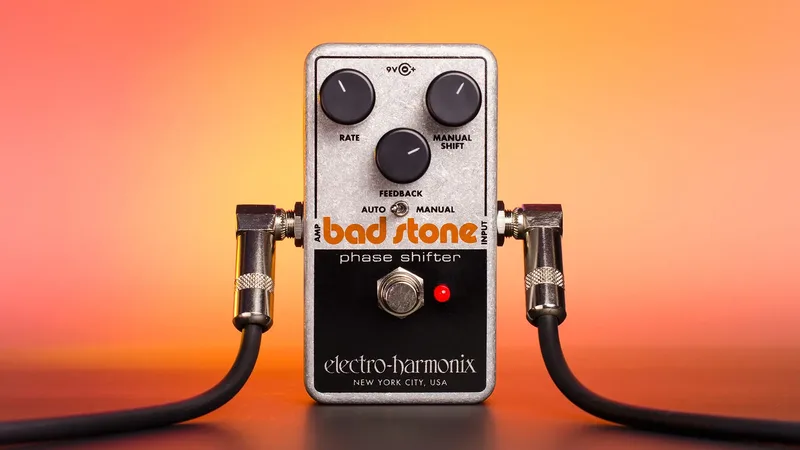


The Electro-Harmonix Bad Stone is an analog phaser pedal with six stages of phase shifting, made by Electro-Harmonix. A phase shifter splits your signal, shifts the phase of one copy across a range of frequencies, and recombines the two, which produces the moving notches in the frequency spectrum that players hear as a sweep or whoosh. The Bad Stone's claim to history is that it was the first phase shifter to employ variable feedback, a control that lets the player shape how intense that sweep becomes1.
The current pedal is a reissue, released in 2015, of a Bad Stone first introduced in the late '70s. Electro-Harmonix describes it as faithful to the original circuit design and three-knob control layout, now in a compact, rugged die-cast package12. It carries a list price of $88.901.
A six-stage phaser with variable feedback
Six stages means six phase-shifting sections in series, which sets how many notches the effect carves into your tone and how pronounced the phasing sounds. More stages generally give a richer, more dramatic sweep than a four-stage design. The Bad Stone was, by Electro-Harmonix's account, the first phase shifter to employ variable feedback1, and Premier Guitar's 2015 announcement repeated that claim when the reissue arrived3.
Feedback, sometimes called regeneration on other phasers, controls how much of the shifted signal is fed back through the circuit. Turned up, it emphasizes the resonant peaks at each notch and makes the sweep more vocal and intense. Premier Guitar's review of the pedal listed its wide-range rate and feedback controls among the pedal's pluses4.
The other half of the Bad Stone's character is its Manual mode, which disconnects the internal low frequency oscillator (LFO) and lets you park the sweep wherever you want it with your hand on a knob. That gives a static, filtered tone rather than a moving one, which Electro-Harmonix compares to a cocked wah1.
The controls
The reissue keeps the same three-knob design as the original2, plus a toggle switch and a bypass footswitch.
| Control | What it does |
|---|---|
| Rate knob | Sets the frequency of the internal LFO, controlling modulation speed. The range goes from a very slow swoosh to a rapid, oscillating warble1. |
| Feedback knob | Controls the amount of signal fed back from the output of the phase shifter circuit into its input. Premier Guitar's announcement described it as determining the depth of the phase effect3. |
| Manual Shift knob | Sweeps through the phase shifter's range, creating a sort of "cocked wah" sound. Used in Manual mode1. |
| Auto/Manual toggle | Selects Auto or Manual mode. In Auto mode the LFO modulates the phase shifter; in Manual mode the LFO is disconnected and the Manual Shift knob sweeps the full range13. |
| Bypass footswitch | Toggles between Bypass and Effect mode; the status LED lights in Effect mode1. |
Gearnews' phaser buying guide summarized the control set as rate, feedback, and manual sweep, noting that the Auto/Manual switch allows both classic whooshing motion and static filter effects5.
History and versions
The original Bad Stone dates to the late '70s, when MusicRadar reports it was introduced as the world's first six-stage phase shifter2. Premier Guitar's vintage Electro-Harmonix gallery includes a US-made late-'70s Bad Stone among the company's classic pedals6.
The circuit itself changed over the original's run. Function f(x)'s technical analysis of phaser circuit types lists an early version of the Bad Stone among JFET-based phase shifters, and a later version as the only commercial example they are aware of using logic inverter-based phase shifting7. For most players the practical point is that two different Bad Stone circuits existed in the 1970s, and the 2015 reissue is described by its maker as faithful to the original circuit design1.
Electro-Harmonix reintroduced the pedal in 20152, with Premier Guitar noting the move came as prices of 1970s vintage Bad Stones soared3. The reissue keeps the three-knob layout of the original but moves it into nano-size housing with true bypass switching2.
How it differs from the Small Stone
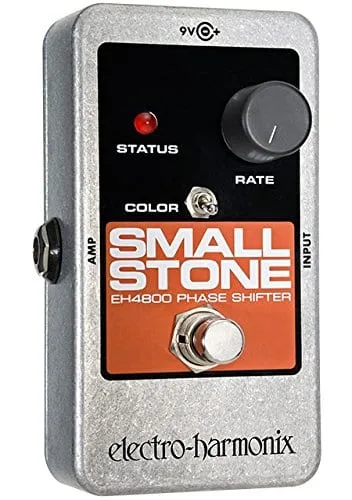
The Bad Stone's sibling in the Electro-Harmonix lineup is the Small Stone, the four-stage phaser the company is best known for. MusicRadar's Alex Lynham described the Bad Stone as a six-stage version of the Small Stone, but cautioned that the sound is somewhat different8. Beyond the stage count, the Bad Stone's Feedback knob and Manual mode are controls the classic Small Stone does not offer, which makes it the more flexible of the two circuits on paper.
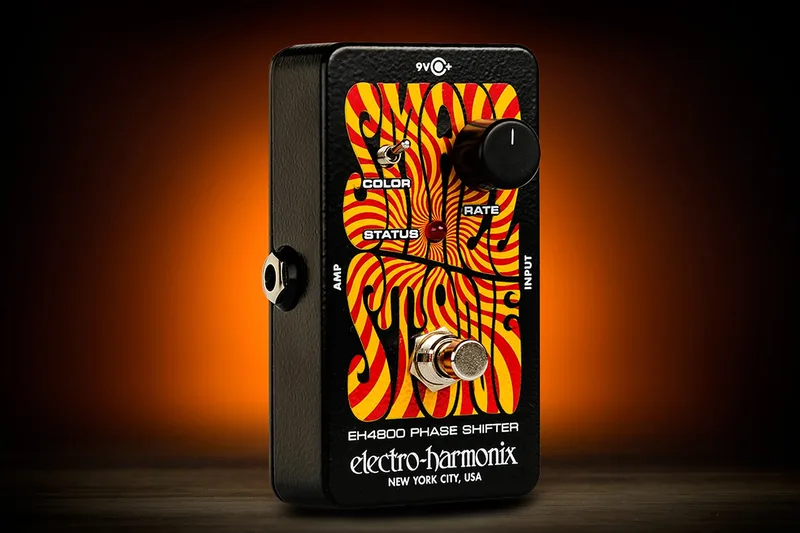
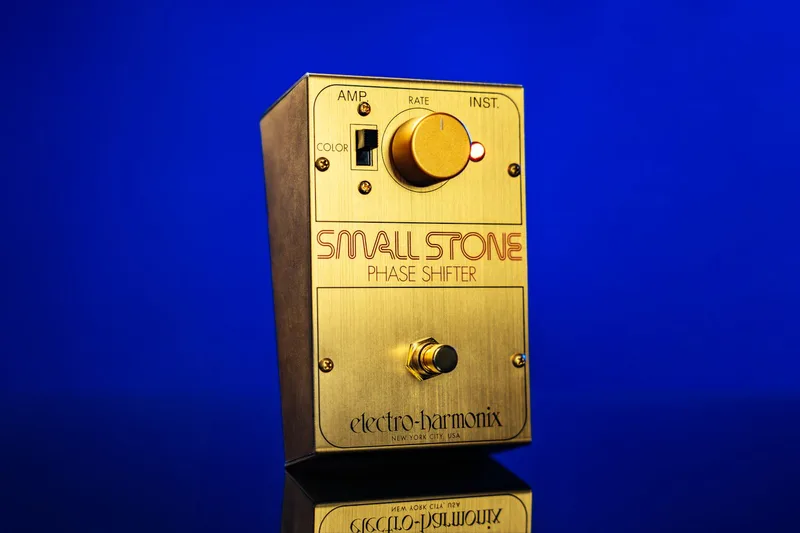
Players comparing phasers today can also look at the Small Stone Nano, the compact version of the four-stage design, and the limited-edition Golden Small Stone built with NOS CA3094 chips for the phaser's 50th anniversary.
Videos
Premier Guitar
EHX
Reverb
Questions
Does the Bad Stone take a battery?
Yes. The pedal ships with a 9V battery included, and it can also run from an optional 9.6VDC-200mA power adapter, which is not included. The AC jack accepts a standard EHX9.6DC power supply, so most players power it from an EHX adapter or a compatible supply.
Is the Bad Stone true bypass?
Yes. Electro-Harmonix lists the Bad Stone as true bypass, and press coverage of the 2015 reissue described it as true bypass for maximum signal path integrity when the effect is not engaged. A status LED lights when the pedal is in Effect mode.
What power supply does the Bad Stone use?
It runs on the included 9V battery or an optional 9.6VDC-200mA adapter, which is not included. The AC jack accepts a standard EHX9.6DC power supply. Current draw is 18mA, so it is easy on a pedalboard power supply.
What is the difference between the Bad Stone and the Small Stone?
The Bad Stone is a six-stage phaser, while the classic Small Stone uses fewer stages. MusicRadar's reviewer described the Bad Stone as a six-stage version of the Small Stone, but noted that the sound is somewhat different. The Bad Stone also adds a Feedback knob and a Manual mode, controls the Small Stone does not have.
What does Manual mode do on the Bad Stone?
In Manual mode the internal LFO is disconnected and the Manual Shift knob sweeps through the full range of the phase shifter by hand. Electro-Harmonix says this creates a sort of cocked wah sound, a static filter effect rather than the classic whooshing motion of Auto mode.
Sources (8)
- Bad Stone, Electro-Harmonix
- Electro-Harmonix reissues Bad Stone phaser, MusicRadar, 2015-03-12
- Electro-Harmonix Releases the Bad Stone, Premier Guitar, 2015-03-11
- Electro-Harmonix Bad Stone Review, Premier Guitar, 2015-08-11
- Best Phaser Pedal Guide: From Affordable Effects to Classics and Beyond, www.gearnews.com, 2025-11-10
- GALLERY: Vintage Electro-Harmonix Pedals, Premier Guitar, 2010-11-04
- Guitar Phaser Pedal Types: JFET, Optical, OTA, and Others, Function f(x), 2022-03-18
- 5 great phaser pedals guitar players need to try, MusicRadar, 2021-05-17