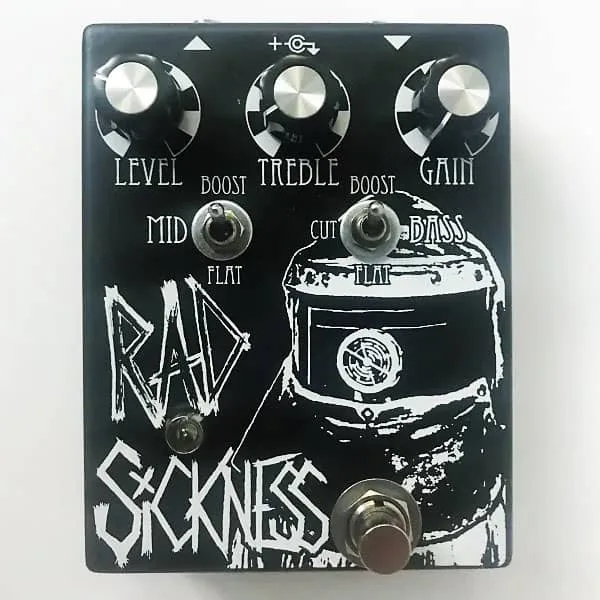


The Electrofoods Rad Sickness is a boost pedal with a flexible three band EQ, presented by the manufacturer as a boost and EQ utility pedal. It is built to sit in front of other pedals and reshape what they receive: shaping your EQ heading into a one-knob fuzz, perking up a dark overdrive, breathing new life into a favorite dirtbox, or adding zing to time and modulation effects.1
Controls
The Rad Sickness carries five controls: Level, Gain, Bass, Mids, and Treble1.
| Control | What it does |
|---|---|
| Level | Volume control. The pedal is loud, so start low and dial up to the level you need. |
| Gain | Clockwise for a high gain boost that eases into a hint of nasty silicon overdrive at the top of the scale; counterclockwise for a clean, high fidelity boost. |
| Bass | Three-position switch: Flat passes the full level of the input bass signal, Cut rolls off some bass frequencies for a tighter sound, Boost adds gain in the lows for extra dirt and a nastier low end. |
| Mids | Toggle to Boost for a precisely-placed, just-right gain boost in the midrange, giving increased presence and helping slice through the mix. |
| Treble | Clockwise blasts the amp with high frequency gain, old-school treble booster style with a nasty silicon cut; counterclockwise rolls off treble; flat, unity treble sits at approximately 9 o'clock. |
The Treble control's clockwise range means the pedal can double as a treble booster, and the Gain control's top end adds a touch of silicon overdrive character on top of pure volume.1
On bass and in a rig
Delicious Audio's reviewer found the Rad Sickness works well on bass too, not only guitar.1
The reviewer's verdict on the pedal as a whole:
"The RAD SICKNESS is an incredible utility pedal. The piles of volume and treble, as well as the EQ, make it a handy solo boost."1
Delicious Audio, Paolo De Gregorio1
That points to two ways of using it: as a solo boost with plenty of volume and treble on tap, or as a fixed tone-shaping stage that improves everything downstream of it. For more pedals in this family, see the boost pedals page. Electrofoods also makes the ULTD Germ Warfare, a germanium boost with Soviet NOS transistors and active EQ, and the Nepenthes V2 distortion.1
Videos
collector//emitter
Noise Generator
Beholden To The Riff | Heavy Bass & Guitar
Questions
Does the Electrofoods Rad Sickness work on bass?
Yes. Delicious Audio's reviewer found it works well on bass too, alongside guitar. The Bass switch helps here: the Flat position passes the full level of the input bass signal, while Cut rolls off some bass frequencies for a tighter sound. With its three band EQ and plenty of volume on tap, it can shape a bass signal heading into another pedal or push an amp.
Is the Electrofoods Rad Sickness loud?
Yes. Delicious Audio's review describes the pedal as loud and advises starting with the Level control low and dialing up to the level you need. The same review calls out the piles of volume on offer, which is part of what makes it useful as a solo boost.
What does the Bass switch do on the Rad Sickness?
The Bass control is a three-position switch. Flat allows the full level of your input bass signal through. Cut rolls off some of the bass frequencies for a tighter sound. Boost adds gain in the lows, for extra dirt and a nastier low end.
Can the Rad Sickness work as a treble booster?
It can. Turning the Treble control clockwise blasts the amp with gain in the high frequencies, which Delicious Audio describes as old-school treble booster style but with a nasty silicon cut. Rolling the Treble counterclockwise rolls off treble instead, and unity treble sits at roughly 9 o'clock.
Sources (1)
- Electrofoods Rad Sickness Boost + EQ, Delicious Audio, 2019-10-24