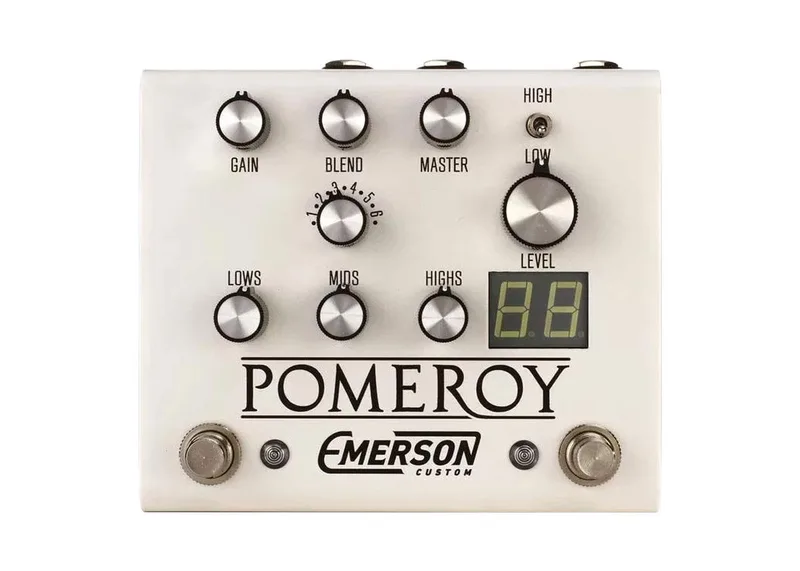


The Emerson Custom Pomeroy is a boost, overdrive and distortion pedal with a 100% analog signal path, built as two independent channels in one box1. One side is a clean boost with up to 24 dB on tap; the other is a drive circuit with a blend control and six clipping options selected by a rotary switch1. The channels can be used on their own or together, which makes the pedal work as a simple volume lift, a standalone drive, or a drive with a boost waiting behind it2.
The pedal was reviewed as Emerson Custom's first overdrive and distortion pedal3. It was offered in white or black finishes1; the black version is covered on its own page, the Emerson Custom Pomeroy Black.
How the two channels are arranged
The Pomeroy's boost and drive circuits are independent, but their order is fixed: the boost sits after the overdrive/distortion circuit, and there is no order toggle to swap them. Emerson Custom's stated reason is that the boost sounds best after the drive circuit2. On That Pedal Show, the presenters walked through the layout, with the overdrive circuit on one side and the boost on the other, and noted the fixed order themselves3.
For a player coming from a two-pedal setup, this is the reverse of the common "boost into overdrive" arrangement, where a boost pushes the front of a drive to make it hotter and more compressed. Here the boost comes after the drive, so it raises volume rather than pushing the clipping stage harder. Players who want the other order would need to keep the boost as a separate pedal placed before the drive.
The boost side: Level, toggle and dB display
The boost side is deliberately simple: one control knob and one toggle switch1. The Level knob adjusts how much boost comes through, and the toggle sets the maximum output available1. A large LED display shows the dB level, so you can see exactly where the boost is set at any moment1.
| Control | What it does |
|---|---|
| Level knob | Sets how much boost comes through1 |
| Toggle (Low mode) | Boost ranges from 0 to 12 dB1 |
| Toggle (High mode) | Boost ranges from 12 to 24 dB1 |
| LED display | Shows the current dB level1 |
Pedal of the Day found the boost side extremely responsive, with a wide tonal response, and noted it was especially effective when combined with the drive side of the pedal1.
The drive side: Gain, Master, Blend and six clipping options
The drive side carries the pedal's flexibility. Gain sets how much dirt you get, and it works together with the clipping mode selected on the rotary switch; Master sets the output level for the drive side1. A Blend control mixes your original dry signal back in with the overdriven tone, which adds shaping and articulation, letting you keep some of your clean character under the drive1.
The six-position rotary switch selects different diode clipping configurations, and on That Pedal Show the presenters described the positions as running from the least amount of gain to the most3.
| Position | Clipping configuration |
|---|---|
| 1 | 2 germanium diodes, symmetrical clipping1 |
| 2 | 2 silicon diodes, symmetrical clipping1 |
| 3 | 3 silicon diodes, asymmetrical clipping1 |
| 4 | 1 silicon diode and 1 LED, asymmetrical clipping1 |
| 5 | 2 LEDs, symmetrical clipping1 |
| 6 | No clipping1 |
Those options cover the main clipping flavors players look for in an overdrive. Germanium diodes generally give a softer, lower-headroom clip; silicon diodes clip harder and tighter; LEDs have a higher forward voltage and clip later, which keeps more dynamics intact; and the no-clipping position removes diode clipping from the circuit entirely. Pedal of the Day's take was that with six options "there's truly something for everyone here"1.
On the Blend control, That Pedal Show's presenter was candid about his usual skepticism and what he found with the Pomeroy:
"to be fair I mean most the time I've tried that with with overdrive pedals I haven't liked it but with this it does work quite well"
Bypass and board fit
Both channels use soft touch, click-less true bypass footswitches, which Pedal of the Day described as making operation "quiet as can be"1. The same reviewer noted the pedal's layout helps it fit onto any pedalboard configuration1.
What reviewers said
The Pomeroy was reviewed by Pedal of the Day in September 2017, shortly after it reached the market1. The review called it "a combo pedal of epic proportions, loaded with options galore and tone for days" and summed it up as "one-stop shopping for all your amp-driving needs" thanks to its analog signal path and abundance of boost and drive options1.
A Living Room Gear demo, posted by Delicious Audio in July 2017, ran the pedal through a Tone King 20th Anniversary Imperial amp with Toaster Cables and Mulder Audio patch cables2.
That Pedal Show covered the pedal in October 2017, describing it as "jam-packed" with features giving the player control over their tonal palette, and highlighting the two independent channels and the six-position diode selector3.
In the video, Dan and Mick try the drive side with everything set around noon except the blend control, blend the original signal back in, and work through the diode configurations from least gain to most, with Mick concluding that the blend function works better here than on most overdrive pedals he has tried3.
Videos
Sweetwater
Peter “Danish Pete” Honoré
Reverb
Questions
Can the channel order be changed on the Emerson Pomeroy?
No. There is no order toggle on the pedal. The boost sits after the overdrive/distortion circuit in the signal path, and Emerson Custom's position is that the boost sounds best in that position. Players who want the boost first would need to run it as a separate pedal.
How much boost does the Emerson Pomeroy give?
The boost toggle has two modes. In Low mode it ranges from 0 to 12 dB, and in High mode it ranges from 12 to 24 dB. The Level knob sets how much of that range you use, and the current dB level is shown on a large LED display.
Is the Emerson Custom Pomeroy true bypass?
Yes. It uses soft touch, click-less true bypass footswitches, one for each channel, so switching is quiet and the pedal is out of the signal path when both channels are off.
Can the Pomeroy's boost and overdrive be used separately?
Yes. The two channels are fully independent, with a footswitch for each, so you can run the boost alone as a clean volume lift, the drive side alone, or both together.
Can you use the boost and overdrive on the Pomeroy at the same time?
Yes. The channels can be engaged together, and reviewers found the boost especially useful combined with the drive side, describing the combination as extremely responsive with a wide tonal response.
Is the boost before or after the drive on the Emerson Pomeroy?
The boost is after the overdrive/distortion circuit. There is no order toggle, because Emerson Custom believes the boost sounds best after the drive circuit rather than pushing into it.
Sources (3)
- Emerson Custom Pomeroy Boost Overdrive, Pedal of the Day, 2017-09-17
- Emerson Custom Pomeroy, Delicious Audio, 2017-07-10
- TPS Pick'N'Mix, That Pedal Show (YouTube), 2017-10-23