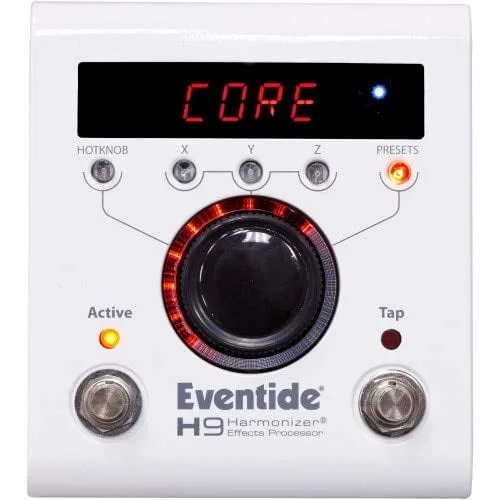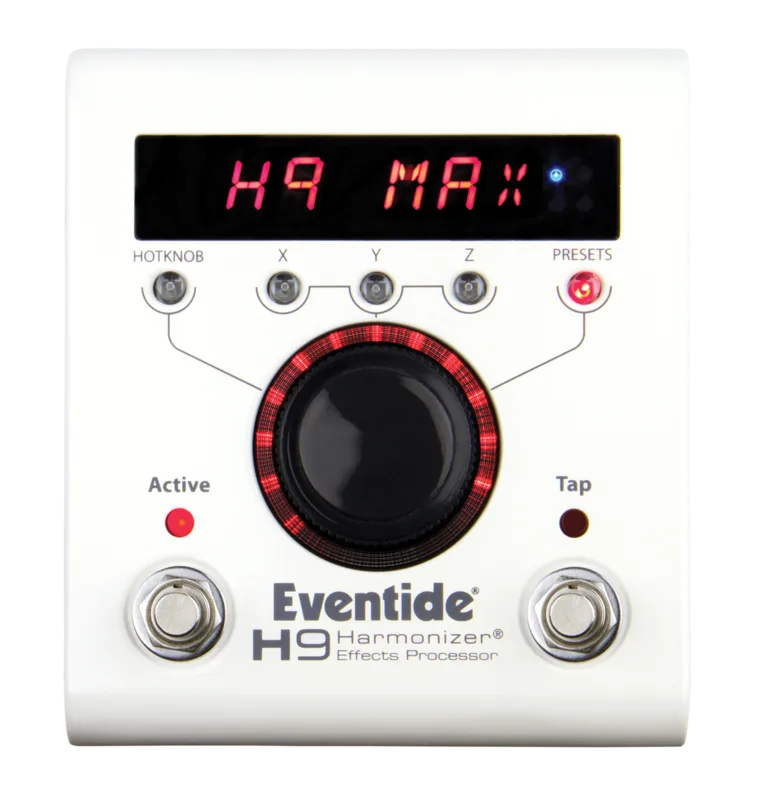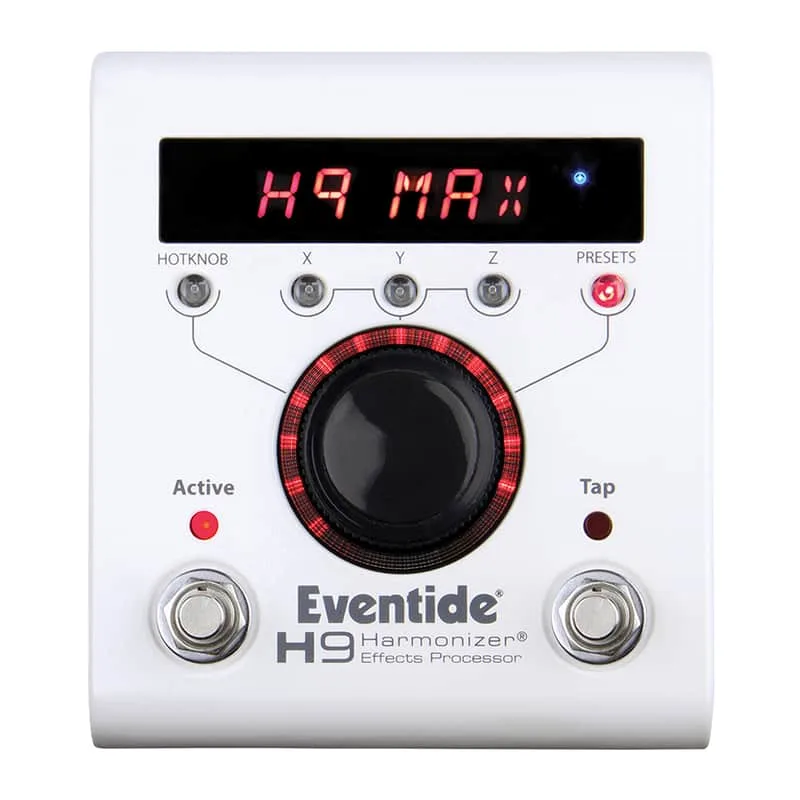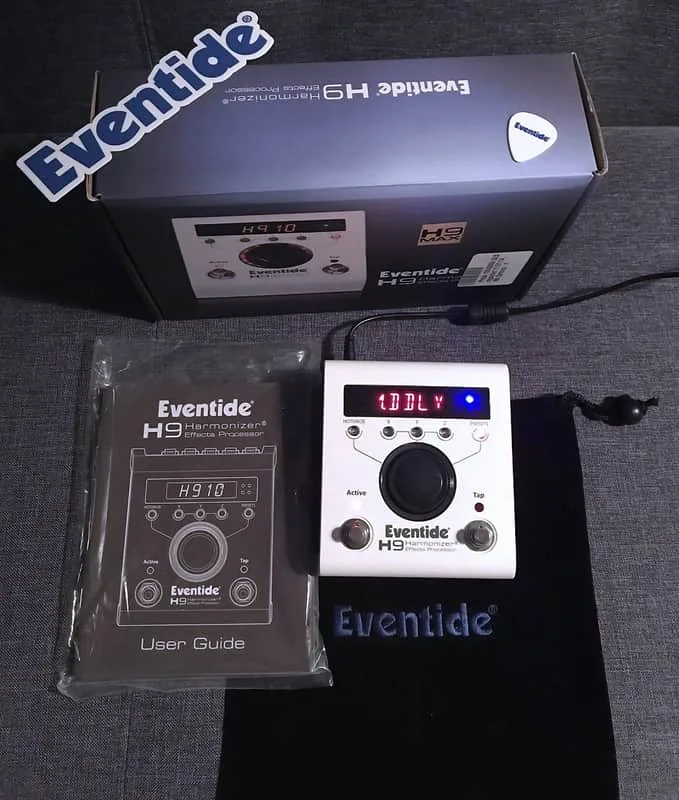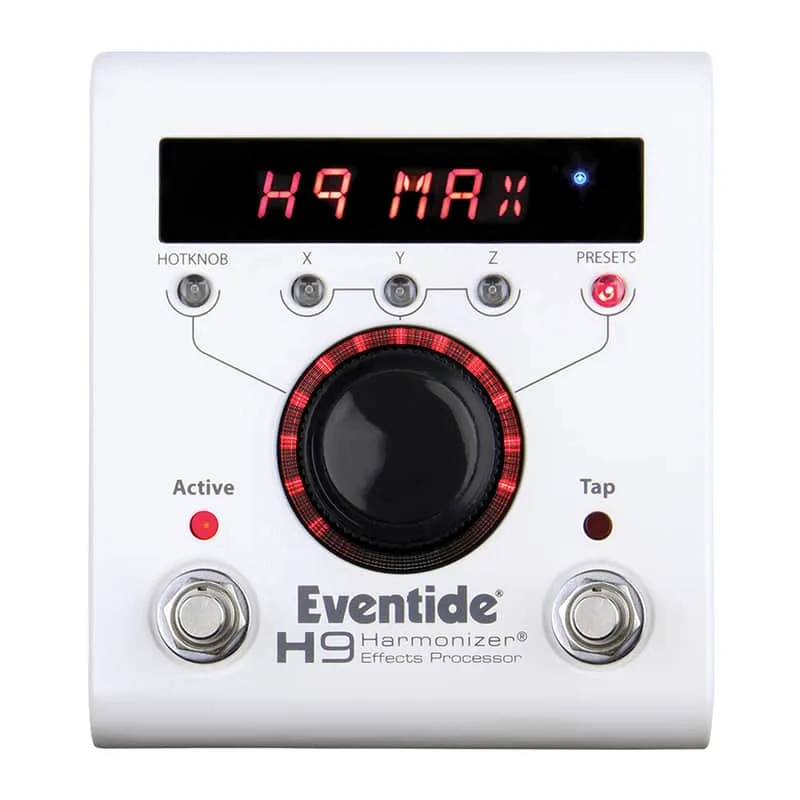


The H9 is controlled through a simple, one-knob user interface: X, Y and Z buttons and a large jog wheel/switch provide parameter access in place of dedicated parameter knobs1. It also connects wirelessly via Bluetooth to iPods, iPhones and iPads for editing, and can run all of Eventide's stompbox effects2. A built-in tuner provides better performance, accuracy and speed than most standalone tuners, in Guitar World's reviewer's experience1.
Power and connections
The original H9 runs on a 9 to 12VDC, 500mA center-positive power source and ships with a nine-volt adapter, so there is no battery option1. Note the center-positive polarity, which is the opposite of most pedals and rules out a standard daisy chain.
The H9's power jack is center-positive, not the center-negative standard of most guitar pedals. A conventional pedalboard daisy chain will not work without the right adapter.
Connections are generous for a stompbox. The pedal has pairs of stereo 1/4-inch input and output jacks, side-mounted MIDI in and out/thru jacks, an expression pedal jack, and USB for connecting to a computer17. Real-time controls and preset selection are controllable over MIDI, though Eventide's own guidance was that a few settings need to be changed for the pedal to work with an external MIDI controller8. The H9 Max adds assignable external switch functions (Tip, Ring or Tip+Ring) on its expression jack, so a two-button auxiliary switch can drive it9.
| Connection | What it does |
|---|---|
| Stereo 1/4-inch ins and outs | Stereo audio in and out1 |
| MIDI in and out/thru | Preset selection and real-time control from external controllers48 |
| Expression pedal jack | 1/4-inch jack for continuous control of parameters1 |
| Auxiliary switch input | For external footswitches10 |
| USB | Computer connection for editing7 |
| Bluetooth (original H9) | Wireless editing from iPods, iPhones and iPads2 |
The Gen 2 updates the connection set: 2x 1/4-inch TS inputs, 2x 1/4-inch TS outputs, USB-C for the Eventide Control app, 5-pin MIDI I/O and an expression pedal input111. It takes 12V power, so it can be incorporated into a board and used with any modern high-quality power source, as Premier Guitar's demo put it12.
H9 Max and the Gen 2
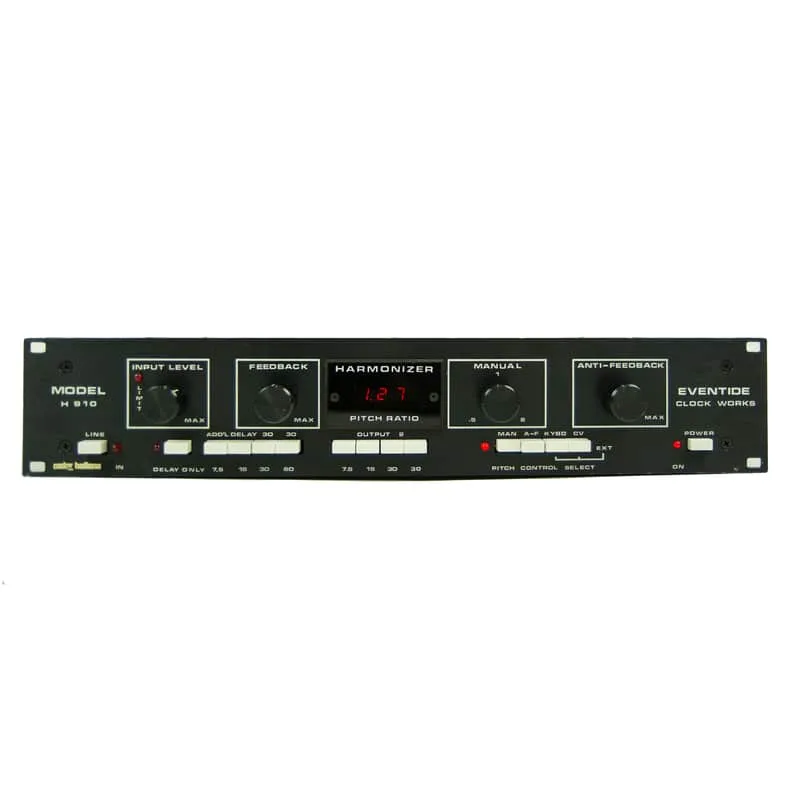
The H9 line came in three versions: the H9, the more economical H9 Core, and the H9 Max1347. The Core delivered the sounds of Eventide's H910 and H949 harmonizers at a lower entry price14. The Max came pre-loaded with everything from all four Eventide stompboxes plus the H9-exclusive algorithms, which Barry Rudolph described as "a studio processor in a stomp box" carrying "the seminal Eventide Harmonizer-based effect patches heard on hit records spanning the last four decades"15. Individual algorithms were priced at $19.99 for H9 and H9 Core owners and free for the H9 Max13.
In June 2026 Eventide upgraded all registered H9 Standard and H9 Core owners to the full H9 Max library for free via the H9 Control app, ending the tiered model.
The H9 Harmonizer Gen 2, announced in June 2026 and released globally on June 24, 2026 at $599 MSRP, is built on the same modern processing architecture as the H90 Harmonizer6. It carries 74 algorithms, including the full libraries from both the H9 Max and the H901617. Its outputs are labeled Left Out and Right Out16.
| Version | What it is |
|---|---|
| H9 (2013) | The original, $579, algorithms bought individually at $19.99113 |
| H9 Core | More economical version with the H910 and H949 sounds14 |
| H9 Max | Pre-loaded with all four Eventide stompbox algorithms plus H9 exclusives15 |
| H9 Gen 2 (2026) | 74 algorithms, H90 architecture, USB-C, $599 MSRP616 |
What reviewers said
Guitar World's original review found that "the H9 fully lives up to the company's well-deserved reputation, delivering pristine, noise-free effects with luxurious sheen, depth and detail"1. MusicPlayers.com's reviewer called it a complex digital signal processor that upholds Eventide's reputation, and reported excellent support: an email was answered in hours and a phone call in under five minutes, with an active support forum74. The same site noted a practical drawback of the original hardware: it took nearly a full second to load some of the algorithms7.
Of the Gen 2, Guitar World's reviewer rated the sounds five stars and called them "amongst the best quality effects of any multi-effects I've tried"18. MusicRadar's Gen 2 review lists its connectivity and algorithm count among its strengths11.
Premier Guitar's Tom Botwin demoed the Gen 2's perform mode, which "allows you to manipulate the effects in real time and you can customize this in a variety of different ways," with or without an expression pedal12.
Videos
Pete Thorn
Eventide Audio
Reverb
Questions
Does the Eventide H9 take a battery?
No. The original H9 runs on a 9 to 12VDC, 500mA center-positive power source and ships with a nine-volt adapter, so it needs a mains or pedalboard power supply rather than a battery. The Gen 2 takes 12V power and is designed to work with modern high-quality pedalboard power sources.
Does the Eventide H9 work in stereo?
Yes. The H9 has pairs of stereo 1/4-inch input and output jacks, and the Gen 2 keeps stereo audio I/O with left and right outputs. Stereo operation is available across the H9 line, along with stereo ins and outs on the multi-effects version.
Can the H9 be controlled with an expression pedal?
Yes. Every version of the H9 has an expression pedal input, a 1/4-inch jack on the pedal. The H9 also has an auxiliary switch input, and the H9 Max adds assignable external switch functions on the expression jack, so a two-button switch can be connected as well.
Does the Eventide H9 have MIDI?
Yes. The original H9 has side-mounted MIDI in and out/thru jacks, and the Gen 2 has 5-pin MIDI I/O. Real-time control and preset selection can be handled over MIDI, though a few settings need to be changed for the pedal to work with an external MIDI controller.
How big is the Eventide H9?
The original H9 measures 4 5/8 inches wide by 5 1/4 inches long, a compact footprint for a pedal that packs rack-style processing into a stompbox. The Gen 2 is a single-core version of the H90 and is only around 70% of that pedal's size.
What is the difference between the H9 and the H9 Max?
The H9 shipped with a set of algorithms and let you buy more individually at $19.99 each, while the H9 Max comes pre-loaded with everything from all four Eventide stompboxes plus the H9-exclusive algorithms. In June 2026 Eventide upgraded all registered H9 Standard and Core owners to the full H9 Max library for free, ending the tiered model.
What is the Eventide H9 Gen 2?
A 2026 reboot of the H9 built on the same processing architecture as the H90 Harmonizer. It carries 74 algorithms, including the full H9 Max and H90 libraries, over 1,000 presets, USB-C, MIDI and a redesigned on-pedal interface. It released globally on June 24, 2026 at $599 MSRP.
Sources (18)
- Review: Eventide H9 Harmonizer Effect Processor, Guitar World, 2013-09-17
- Video: Eventide H9 Harmonizer Effects Processor Demo, Guitar World, 2013-06-25
- Eventide H9 Review from Gearphoria, Delicious Audio, 2017-10-02
- Eventide H9 Harmonizer Effects Processor, MusicPlayers.com, 2014-11-11
- Rig tour: Live's resident "fuzz junkie", Chad Taylor, Guitar World, 2020-01-09
- Eventide Audio Introduces H9 Harmonizer® Gen 2, Premier Guitar, 2026-06-03
- Eventide H9 Harmonizer Effects Processor (Pedal), MusicPlayers.com, 2014-11-01
- MIDI PedalBoard Devices, Molten Voltage (blog.moltenvoltage.com), 2014-08-06
- Barn3 OX9 Auxiliary Switch System, Pedal of the Day, 2015-10-05
- Eventide Introduces the H9 Harmonizer Pedal, Premier Guitar, 2013-01-24
- Eventide H9 Harmonizer Gen 2 review, MusicRadar, 2026-09-22
- Eventide Made The H9 Even BETTER?!, Premier Guitar, 2026-06-30
- Eventide Announces the CrushStation Algorithm, Premier Guitar, 2015-07-15
- NAMM 2014: Eventide launches H9 Core, MusicRadar, 2014-01-21
- Eventide H9 Max, Barry Rudolph / Music Connection "New Toys" directory, 2024
- Guitar Pedal X, Guitar Pedal X, 2026-06-08
- Eventide unveils the H9 Harmonizer Gen 2, MusicRadar, 2026-06-09
- Eventide H9 Harmonizer Gen 2 review, Guitar World, 2026-09-03