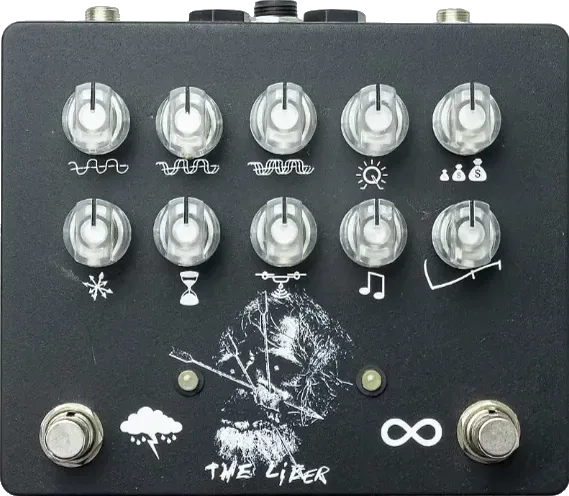


The Lifer is a signature pedal from Fowl Sounds built for Jon Campos of Primitive Man, and it is really two pedals in one box: a Caustic Distortion on one side and a Synth Drone on the other, running in parallel and independently1. The distortion side is designed to retain low end extremely well while preserving the high mids region to cut through any mix, which suits the heavy, down-tuned territory its signature player works in1.
Two circuits in parallel
The core idea is that the distortion and the synth drone are separate circuits that can be used together or apart. Each side does its own job1:
| Side | Circuit | What it does |
|---|---|---|
| Distortion | 2 op amp gain stages and a JFET stage | Retains low end and preserves high mids to cut through a mix1 |
| Synth Drone | Parallel, independent circuit | Can run as a stand-alone instrument when the Distortion volume is all the way down1 |
The distortion side uses 2 op amp gain stages and a JFET stage, and Fowl Sounds' own description of the result is blunt1:
"the amount of dirt and volume is insane"
The gain sweep is kept wide for versatility, so the circuit can be set anywhere across its range rather than pinned at one style of dirt1.
The drone side opens up uses a straight distortion pedal cannot manage. Turn the volume on the Distortion side all the way down, and the drone can be used as a stand-alone instrument1. Because the two circuits run independently, the drone keeps sounding while the distortion is silent, and both can be switched off together with the Distortion footswitch1.
The Caustic Distortion connection
The distortion half of The Lifer is a Caustic Distortion variant, described by RockBoard's PedalPedia as "a Caustic Distortion on one side"1. Players who know the standalone Caustic Distortion will recognize the architecture: op amp gain stages feeding a JFET stage, with the low end retained and the high mids preserved for cutting through a mix1.
The pedal's face carries art from Ethan Lee McCarthy, tying the visual identity to the same heavy-music circle the circuit is aimed at1.
Power and practical notes
The Lifer runs on 9V DC, center negative, and draws 100mA1.
At 100mA, The Lifer draws more current than many single analog pedals. A low-current daisy-chain output may not run it reliably; a dedicated supply output rated for at least 100mA is the safer setup.
For more on the wider category, see Distortion Pedals.
Videos
Fowl Sounds
Harsh Tones, Inc.
Fuzzed Drones
Questions
Can the Fowl Sounds The Lifer drone run on its own?
Yes. Turn the volume on the Distortion side all the way down, and the Synth Drone can be used as a stand-alone instrument, running independently of the distortion circuit. The two circuits run in parallel, so the drone keeps working while the distortion side is silent.
Is the Fowl Sounds The Lifer analog or digital?
The Lifer is an analog pedal. Its distortion side is built from two op amp gain stages and a JFET stage, the same general architecture Fowl Sounds describes for the Caustic Distortion circuit it is based on.
What power does The Lifer need?
The Lifer runs on 9V DC, center negative, and draws 100mA. That draw is higher than many single pedals, so a standard low-current daisy chain output may not be enough; a dedicated power supply output is the safer choice.
Who is The Lifer signature pedal for?
The Lifer is a signature pedal for Jon Campos of Primitive Man. It combines a distortion circuit with a synth drone, a pairing aimed at players working in heavy, down-tuned styles.
What does the Distortion footswitch do on The Lifer?
The Distortion footswitch turns both circuits off. Since the distortion and synth drone circuits run in parallel and independently, that footswitch acts as a master on and off for the whole pedal.
Sources (1)
- The Lifer by Fowl Sounds, RockBoard PedalPedia, 2026