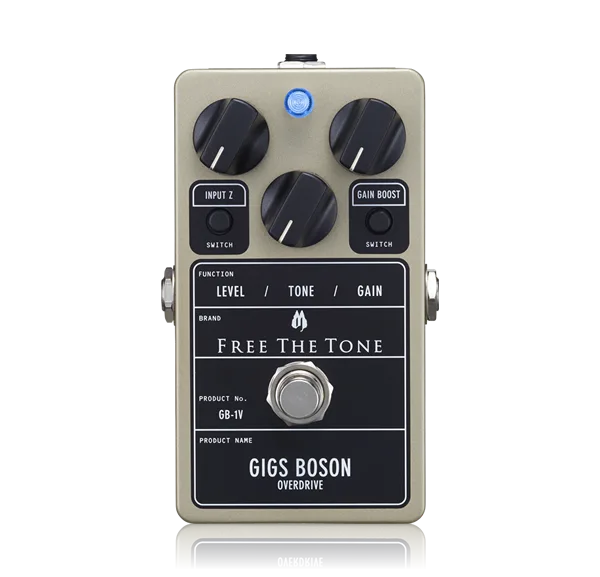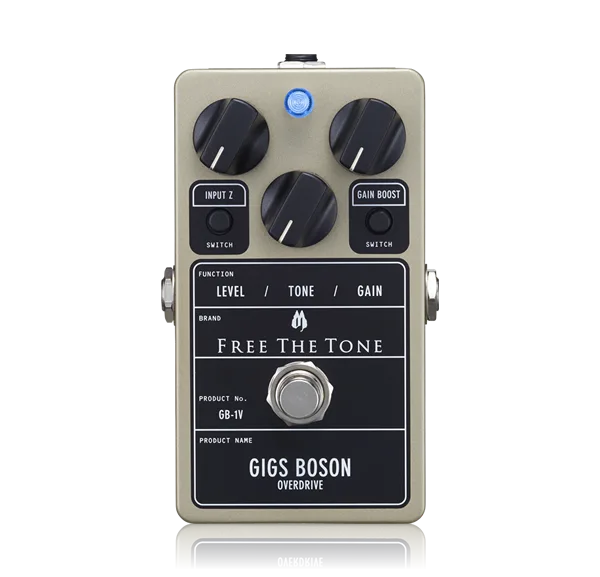


The Free The Tone Gigs Boson Overdrive GB-1V is a compact overdrive pedal from Japanese maker Free The Tone, released on 20 October 20121. Free The Tone designed it around a wide gain range that the maker says covers blues, jazz and rock2, and it carries an input circuit the company calls HTS (Holistic Tonal Solution), which MusicRadar reported prevents signal degradation even when the pedal is bypassed3.
The Gigs Boson GB-1V is discontinued: Free The Tone lists it as production ended. Its Japanese list price was 25,300 yen including tax23, and MusicRadar reported a UK retail price of £222 in 20123.
What it does: overdrive for blues, jazz and rock
Free The Tone says the GB-1V's wide gain range lets it cover a broad span of genres, from blues through jazz to rock2. MusicRadar's review put that in concrete terms: the reviewer found the pedal "caters for most tones a blues rock guitarist would wish for", from a sound essentially the same as if the pedal were bypassed, through edgy crunchy tones, to thick overdrive with impressive sustain3.
The same review drew one clear boundary. In the reviewer's view, "Other than modern metal tones with a hard percussive edge, this pedal will cater for all manner of classic blues and rock" styles3. So a player shopping for high-gain distortion should look elsewhere, while blues and classic rock players get a pedal that spans clean-ish boost through full overdrive.
"the GB-1V caters for most tones a blues rock guitarist would wish for, from same-as if bypassed (gain at zero, tone at m..."
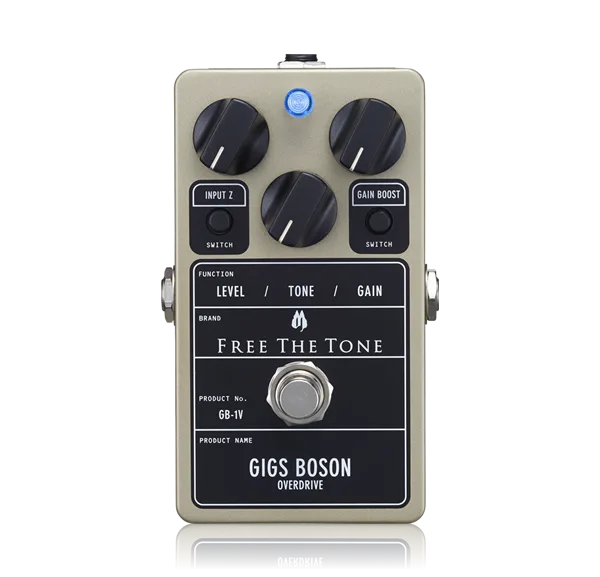
MusicRadar also noted the pedal's build and appearance: "the black rotary dials and main panel married to the matte silver/gold coloured metal casing simply exudes class"3.
Controls
The GB-1V keeps its control set simple: three knobs and two small switches32.
| Control | What it does |
|---|---|
| GAIN | Sets the amount of gain2 |
| TONE | Shapes the frequency response2 |
| LEVEL | Sets the output level2 |
| INPUT Z switch | Selects input impedance, 1MΩ or 100kΩ1 |
| GAIN BOOST switch | Raises gain; MusicRadar found engaging it increases volume and saturation23 |
MusicRadar described the layout from the player's point of view: "At the top of the pedal are three rotary dials (level/tone/gain) which effect your choice of tones", with the small switches sitting underneath the first and last dials3.
The gain boost is the pedal's second gain stage in effect. MusicRadar's reviewer found that "Engaging the gain boost increases volume and saturation"3, so it works as a lead push on top of whatever rhythm sound the GAIN knob is set to.
Power and connections: HTS input and switchable impedance
Power comes from DC9V, either a 9V type 006P battery or an AC adapter through the DC9V input jack21. Current draw is approximately 9mA2, low enough that battery use is practical. MusicRadar called it "a minimal 9mA draw" and reported the pedal delivering "a broader dynamic range than usually associated with DC9V power supplies"3.
The more unusual feature is the INPUT Z switch. It selects between 1MΩ and 100kΩ input impedance, and Free The Tone states the function works even with the effect off, changing high-frequency nuance beyond what the tone circuit does1. In practice this lets a player match how the pedal loads the guitar's pickups, which affects top-end character whether the overdrive is engaged or bypassed.
The HTS circuit is the other connection-side feature. MusicRadar reported that "the pedal features a newly developed input circuitry called the HTS circuit (HTS = Holistic Tonal Solution) that prevent" signal degradation even when bypassed3. Output load impedance is rated at 10kΩ or higher1.
Who plays it
MusicRadar reported in 2012 that "At present, Japanese guitar hero, Hotei is using two on his live pedal board - recommendation indeed"3. Two units on a live board suggests the pedal was being used for both rhythm and lead gain stages.
Videos
FreeTheToneMovie
Brett Kingman
Pedal of the Day
Questions
Does the Free The Tone Gigs Boson run on a battery?
Yes. The GB-1V runs on DC9V, either from a 9V type 006P battery or from an AC adapter through its DC9V input jack. Current draw is approximately 9mA, so a battery lasts a long time in normal use.
Is the Gigs Boson GB-1V discontinued?
Yes. Free The Tone lists the Gigs Boson GB-1V as production ended, so it is no longer made. It was released on 20 October 2012 and sold in Japan for 25,300 yen including tax.
What does the gain boost switch do on the GB-1V?
The gain boost switch raises the pedal's gain stage. MusicRadar's reviewer found that engaging it increases both volume and saturation, giving more thickness and sustain on top of what the GAIN knob alone provides.
Can the Gigs Boson do metal tones?
Not really. MusicRadar's reviewer found it covers classic blues and rock styles well, but not modern metal tones with a hard percussive edge. Free The Tone positions it toward blues, jazz and rock rather than high-gain metal.
What guitarist uses the Free The Tone Gigs Boson?
According to MusicRadar in 2012, Japanese guitarist Hotei was using two Gigs Boson units on his live pedal board at the time. The pedal was reviewed alongside Free The Tone's Iron Forest distortion.
Sources (3)
- GIGS BOSON / GB-1V|Products 商品紹介|Free The Tone, Free The Tone
- GIGS BOSON / GB-1V|Products 商品紹介|Free The Tone, Free The Tone
- Hands on with the Free The Tone Gigs Boson Overdrive and Iron Forest Distortion pedals, MusicRadar, 2012-11-30