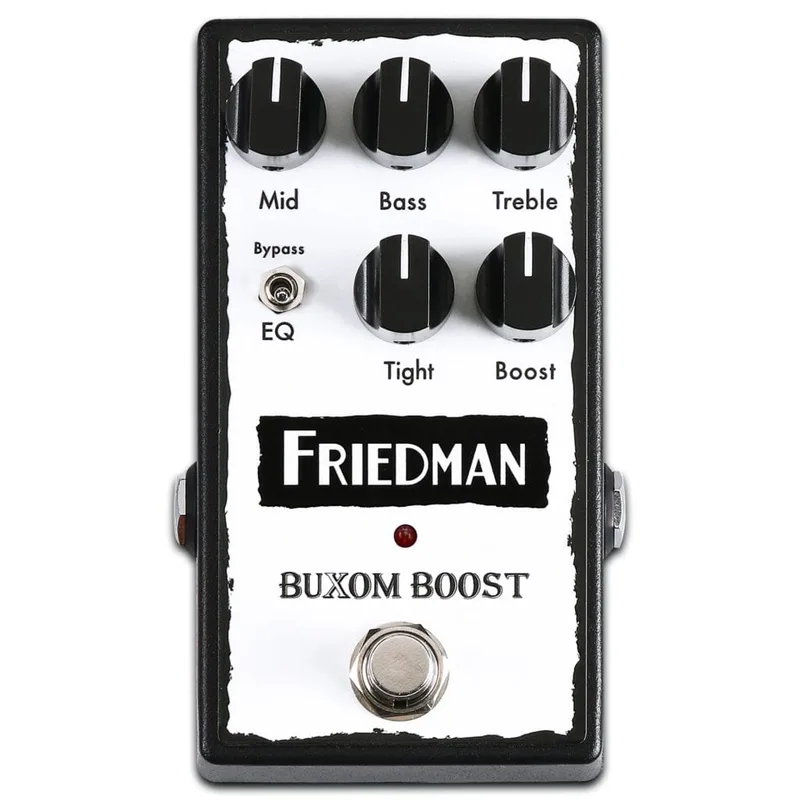


The Friedman Amplification Buxom Boost is a clean boost pedal that takes its name and its character from the Friedman Buxom Betty amp head. Friedman describes it as pushing "a pure, clean signal to conjure the absolute most from your tone," with a completely clean tone that makes every nuance of your performance come through1. Where an overdrive or distortion pedal adds its own clipping, a clean boost like this one raises the level of what you already play: more volume, more push into the front of the amp, and, when you drive an amp hard with it, thick harmonic overdrive from the amp itself rather than the pedal2.
The pedal was announced in September 2017 as the Buxom Clean Boost, a new, flexible clean boost derived from the Buxom Betty amp head2. Delicious Audio summed up the idea behind it in five words:
"Your tone, just more of it."
Where it came from
The Buxom Boost is a pedal offshoot of the Friedman Buxom Betty amp head, sharing that amp's completely clean character13. Dave Friedman, whose workshop has shaped signature tones for players including Eddie Van Halen, Steve Stevens and Jerry Cantrell, is the designer behind it, and Friedman says every Buxom Boost is built with the attention to detail and fine ear for tone that comes with his name21.
Delicious Audio reported the launch on 20 September 2017, describing it as "a new, flexible clean boost with a lot of tonal options"2. The flexibility comes from the EQ section: while a basic clean boost offers only a level knob, the Buxom Boost adds an active three-band EQ and a Tight control, which the same review called powerful enough to make the pedal "anything but" a plain boost2.
The controls
| Control | What it does |
|---|---|
| Boost | Volume increase, pushing the front of your amp for thick harmonic overdrive, or balancing two guitars with differing output21 |
| Bass | Boost control, part of the active 3-band EQ1 |
| Mid | Boost control, part of the active 3-band EQ1 |
| Treble | Boost/cut control, part of the active 3-band EQ1 |
| Tight | Tames your boosted amp's low end1 |
| EQ Bypass | Removes the 3-band EQ from the signal for a truly transparent tone1 |
The Boost knob is the heart of the pedal. Friedman describes it as your ticket to volume increase, to pushing the front of your amp for thick harmonic overdrive, or to balancing between two guitars with varying output2. That last use is worth noting for players who switch instruments on a gig: a single-knob level trim can even out a low-output guitar against a hot one without touching the amp.
The three EQ bands are active rather than passive, so they can add level in their band, not just cut it. Bass and mid are boost-only controls, while treble offers boost or cut1. If you want none of that shaping, the EQ Bypass switch removes the whole EQ from the signal path, which Friedman says gives a truly transparent tone1.
The Tight control addresses a specific problem with boosted amps. When you push an amp's front end hard, the low end can loosen up; Tight tames it1. Between Tight and the bass control, the pedal gives you two separate ways to manage the bottom end of a boosted signal.
Power, headroom and acoustic use
The Buxom Boost accepts 9V or 18V power, which Friedman says gives higher-headroom performance1. Headroom is the room a circuit has before the signal starts to clip, and Friedman positions the pedal as having plenty of it, enough for getting above a mix or driving the front end of an amp1. For a player who wants pure volume lift with no breakup from the pedal itself, the 18V option is the relevant one.
Friedman also says the high-quality circuit keeps the pedal quiet enough for use with acoustic-electric instruments1. Low noise matters more in front of an acoustic rig than an electric one, since there is no amp distortion to hide hiss, and the EQ Bypass switch means an acoustic player can use the boost without the EQ coloring the signal1.
The 18V option means the pedal is not limited to a standard 9V supply, but it also means you need a power source that can deliver 18V if you want the extra headroom. A standard daisy chain set to 9V will run the pedal at its lower setting.
The circuit inside
Videos
Pete Thorn
Shawn Tubbs
EytschPi42
Questions
Can you run the Friedman Buxom Boost at 18V?
Yes. Friedman says the pedal accepts 9V or 18V power for higher-headroom performance. Running it at 18V gives the clean boost more room before the signal breaks up, which suits players who want to push volume without adding grit. The maker also describes the pedal as having plenty of headroom for getting above a mix or driving the front end of an amp.
Does the Buxom Boost work with acoustic guitar?
Friedman says the high-quality circuit keeps the pedal quiet enough for use with acoustic-electric instruments. That low noise floor is what matters for acoustic players, since a boost placed before an acoustic amp or PA can otherwise bring up hiss along with the signal. The EQ Bypass switch also lets you take the three-band EQ out of the signal path entirely.
What does the Tight knob do on the Buxom Boost?
The Tight control tames your boosted amp's low end, according to Friedman. When you use the Boost control to push the front of your amp into thick harmonic overdrive, the low frequencies can get flubby. Tight trims that back so the boosted sound stays firmer. Delicious Audio called it a powerful control that lets the pedal be more than a plain boost.
What op-amps are in the Friedman Buxom Boost?
The circuit is built with TL072 op-amps. A commenter on the Guitar FX Layouts blog, comparing the DIY stripboard version to the PedalPCB take, noted it looks like it was made with 3 TL072 chips, or equivalently 1 TL072 and 1 TL074. That is from the DIY community rather than Friedman's own documentation.
Sources (3)
- BUXOM BOOST, Friedman Amplification, 2026-06-01
- Friedman Amplification Buxom Clean Boost, Delicious Audio, 2017-09-20
- Guitar FX Layouts: Friedman Buxom Boost, Guitar FX Layouts (tagboardeffects.blogspot.com), 2018-01-14