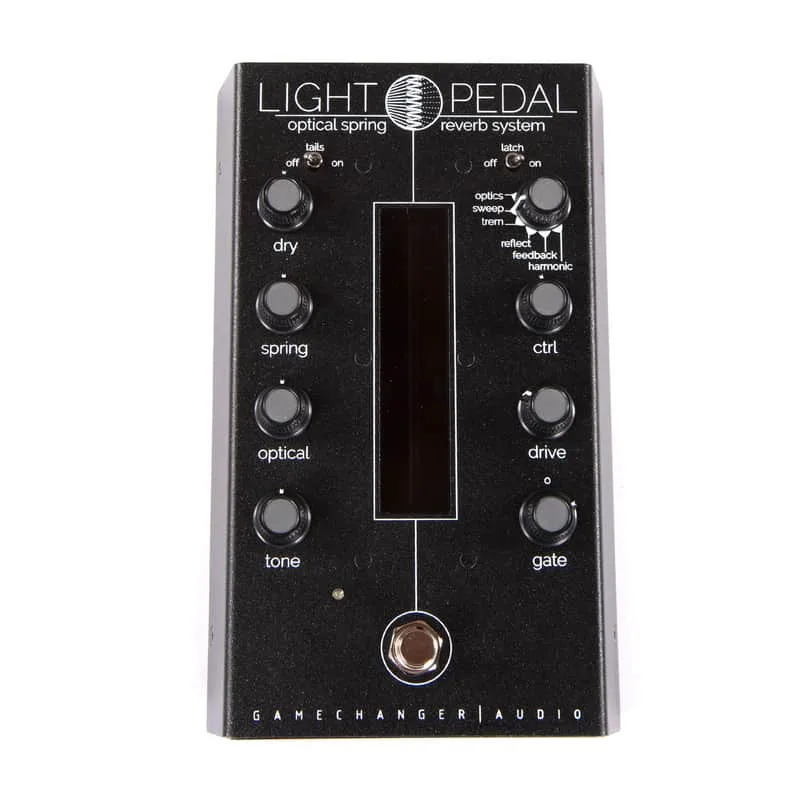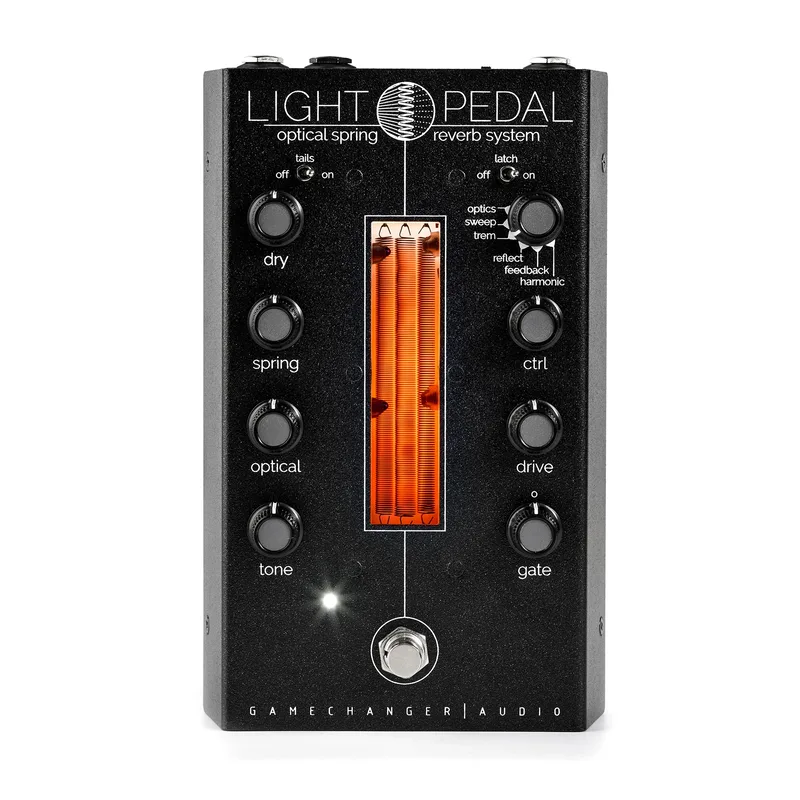


The Gamechanger Audio Light is a spring reverb pedal built around a real spring tank, but with a twist: instead of only picking up the springs with the usual electromagnetic transducer, it also reads them with multiple sets of infrared optical sensors aimed at different points along the springs. Gamechanger Audio calls it the world's first analog optical spring reverb system1. The result, in the maker's words, is "a wide variety of reverb sounds ranging from classic to experimental to pure magic"1.
The idea came from Teodors Kerimovs, the head development engineer of the Light Pedal and the inventor of the optical reverb system2. The claim behind the design is that traditional spring reverbs lose much of the audio signal's harmonic nuance when converting audio into mechanical energy, while the Light's optical pairs capture a considerably wider range of frequencies, harmonics, overtones and textures3. The pedal was first shown at NAMM 2020, where MusicRadar named it a winner in the innovation category4, and it went on sale in March 202145.
A real spring tank read by infrared sensors
Inside the Light Pedal is a traditional spring reverb tank: an input transducer (the spring exciter), the springs themselves, and an output transducer (the pickup). What makes it different is the multiple sets of infrared optical sensors that act as photoelectric pickups directed at different points on the spring1. Guitar.com described the arrangement as infra-red optical sensors placed at intervals along the springs that measure and record the frequencies of the reverb tank, resulting in a greater amount of harmonics and overtones in the signal10.
The tank is a three-spring type, 100 mm long1, and the springs sit in the open, visible through a viewing window on top of the enclosure. Guitar.com's reverb buying guide noted the "real springs, proudly on show through a viewing window on the top of the pedal enclosure"11. The open-spring tank design was carried through to the final production version, as Guitar World reported at release7.
The optical sensors also open doors to effects that are new to spring reverbs, such as tremolo, modulation, feedback and added harmonics1. Delicious Audio's spring reverb buying guide listed these as Optical Reverb Tremolo, Optical Reverb Modulation and Optical Harmonic Shimmer, calling the Light the first "analog optical spring reverb"12.
The controls
The front panel is built around a 6-way effect selector knob and a handful of knobs with primary and secondary functions1.
| Control | What it does |
|---|---|
| Effect selector | 6-way knob choosing the effect mode1 |
| drive | Spring tank's input signal level, adjusting the spring "drip"1 |
| tone | Shared between the spring and optical sounds; does not apply to the dry signal; ranges from rumbling lows to piercing highs1 |
| ctrl | Adjusts the parameter of the selected effect mode; in optics mode it scrolls between combinations of optical sensor pairs2 |
| gate | Primary function: gated and ducking reverb control; secondary: ctrl knob envelope response control1 |
| Soft footswitch | Primary: toggling bypass; secondary: effects stacking, envelope control over the effects, and footswitch assignment mode1 |
The six effect modes work like this1:
- optics lets you choose a specific combination of optical sensors, each with a slightly different texture and timbral quality. There is also an optics calibration mode in which the CTRL knob scrolls between different combinations of optical sensor pairs2.
- sweep is a modulation mode that rhythmically scrolls back and forth through the different optical sensor pairs.
- trem is a tremolo effect produced by rhythmically switching the optical sensors on and off; it can be applied to the spring output together with the optical signal or separately.
- reflect is a lo-fi delay that sends the instrument's signal back into the reverb tank several times; long delay times can create powerful, lengthy reverb decays.
- feedback sets the spring tank into self-oscillation, letting you produce drones and wall-of-sound-type pads.
- harmonic adds harmonics to the signal.
The first three effects (optics, sweep, trem) can be stacked with one of the remaining three effects1. The pedal also has an assignable expression pedal input7 that accepts 1/4" TS and TRS jacks, works with all expression pedal types, and also accepts a CV signal with an active range to 3.3 V1.
Analog or digital, mono or stereo
Gamechanger Audio describes the Light Pedal as a true analog mono reverb system2, but the full picture is more specific: it is an analog device that uses digital signal processing on a few effect modes, namely the reflect, feedback and harmonic modes6. The core spring sound and the optical reading of the springs stay analog.
It is a mono pedal with a 1/4" jack input and output1. Input impedance is 1 MΩ with a maximum input level of +6.8 dBu, and output impedance is 100 Ω with a maximum output level of +6.8 dBu1. The pedal was designed with guitar, bass and synth players in mind, operating across the full EQ spectrum6.
The Light Pedal draws real current: 500 mA minimum at 9 V DC, with peak power consumption of 4 W and mean consumption of 0.9 W16. There is no battery option6, and the power supply is not included1, so it needs a supply that can deliver at least half an amp, not a shared daisy chain.
Can you stomp on the spring tank?
The open springs invite the classic spring-reverb trick of kicking the tank for a crash, and the pedal is built with that in mind. MusicRadar reported at NAMM 2020 that users can "put the sensor switch to 'Hard' and stomp it all day long with no harmful consequences"3.
Where it came from
The Light Pedal was first talked about at NAMM 2020, where it won MusicRadar's innovation award4 and appeared in Guitar.com's roundup of the best effects pedals of the show45. At that point the plan was a launch in autumn of 202013, but development took an extra year13. The final production version arrived in March 2021, priced at £319/$3498, with the first batch of one thousand units distributed to the backers who supported the preorder campaign14. Gearnews noted it could be ordered directly from the Gamechanger Audio site5. The pedal is made in Latvia, as Guitar.com's review records15.
What reviewers said
The LIGHT Pedal has been described as a multi-mode spring reverb pedal made in Latvia15. A published review listed "genius concept, great range of immersive sounds" among its pros12. The pedal was first talked about at NAMM 2020, a year before it went on sale514, with the first batch of one thousand units distributed to preorder backers514.
MusicRadar's Alex Lynham took a more measured view:
"For a genuinely 'modern' take on a spring reverb tank, the off-the-wall-sounding Light is worth a look, but it's not for everyone"9
That split, between reviewers who prize its new sounds and those who find it specialized, is the honest summary of where the Light Pedal sits: a real spring tank with an optical reading system that no other pedal replicates, at the cost of a 500 mA power demand and a sound that leans experimental9121.
Videos
Andertons Music Co
Andertons Music Co
Ricky Tinez
News
Questions
Is the Gamechanger Audio Light pedal stereo?
No. The Light Pedal is a mono pedal with a single quarter-inch jack input and output. Gamechanger Audio describes it as a true analog mono reverb system, so players wanting stereo reverb would need to look at other pedals in the maker's range.
Does the Light pedal have real springs?
Yes. The pedal is built around a traditional spring reverb tank with three springs, 100 mm long, visible through a viewing window on top of the enclosure. The springs are the main sound source, read by infrared optical sensors placed along them.
Can you stomp on the Light pedal's spring tank?
The tank itself is not meant to be stomped, but the sensor switch can be set to Hard. Gamechanger Audio says users can put the sensor switch to Hard and stomp it all day long with no harmful consequences, which is a way to trigger spring crash effects deliberately.
Is the Gamechanger Light pedal analog or digital?
It is an analog device that uses digital signal processing on a few effect modes, namely the reflect, feedback and harmonic modes. The core spring reverb sound and the optical sensor reading of the springs are analog.
Does the Light pedal come with a power supply?
No, the power supply is not included. The pedal needs a 9 V DC center-negative supply delivering at least 500 mA through a 2.1 x 5.5 mm plug, and there is no battery option, so a suitable isolated or high-current supply has to be sourced separately.
Where is the Gamechanger Audio Light made?
It is made in Latvia. Guitar.com's review of the pedal lists it as a multi-mode spring reverb pedal made in Latvia, and the maker is the Riga-based Gamechanger Audio.
Sources (15)
- LIGHT PEDAL, Gamechanger Audio, 2026-09-23
- LIGHT Pedal, Gamechanger Audio, 2026-08-28
- NAMM 2020 VIDEO: Gamechanger Audio unveils its Light Pedal, the first ever 'optical spring reverb', MusicRadar, 2020-01-17
- The best new effects pedals of NAMM 2020, MusicRadar, 2020-01-24
- The new Gamechanger Audio Light Pedal is ready to shine, gearnews.com, 2021-03-02
- LIGHT PEDAL Support, Gamechanger Audio, 2025-11-12
- Gamechanger Audio's hugely innovative Light Analog Optical Spring Reverb pedal is finally available, Guitar World, 2021-03-03
- Gamechanger Audio officially launches Light Pedal, MusicRadar, 2021-03-02
- Crazy Tube Circuits White Whale Junior review, MusicRadar, 2026-08-21
- Nine best effects pedals of NAMM 2020, Guitar.com, 2020-01-21
- The best reverb pedals for all styles and budgets, from classic springs to stereo soundscapes, Guitar.com, 2024-10-04
- 2025 UPDATE: Best Spring Reverb Pedals, Delicious Audio, 2025-01-01
- Watch: Gamechanger Audio reveals the Light Pedal’s workings, Guitar.com, 2020-02-10
- Gamechanger Audio launches the Light Pedal, guitar.com, 2021-03-01
- Gamechanger Audio Light Pedal review: is this analogue spring reverb reinvented?, Guitar.com, 2021-07-07