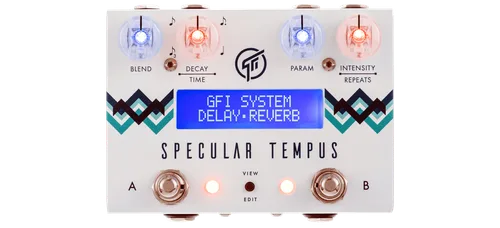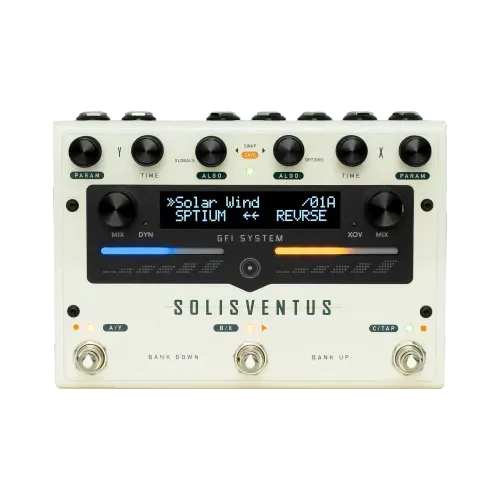


The GFI System Solis Ventus is a dual-engine digital delay and reverb pedal that runs two algorithms at once, in any pairing and either order. You can stack delay into reverb, run them in parallel, or use them independently in dual mono channels, and swap the engines around on the fly1. It replaced the Specular Tempus in GFI System's lineup in December 2024, in a larger workstation format2.
GFI System's product page lists 16 delay algorithms, 11 reverbs and 96 presets1. When the pedal launched, Guitar Pedal X counted 15 delay algorithms and 9 reverbs3, so the algorithm count has grown since release. The pedal carries a list price of USD 549.00 on GFI System's page as of October 2026, with a Solis Ventus and Triple Switch bundle at USD 599.001; at launch in December 2024 the price was $4993.
The controls and footswitches
The pedal has three footswitches: A/Y (Bank Down), B/X (Bank Up) and Control / Tap Tempo2. Each side of the pedal has its own control set. The Y side carries Param, Time, Algo (with Globals, Swap and Save functions) and Mix / Dynamics. The X side carries Algo (with Options, Swap and Save), Time, Param, the XOV crossover control and Mix2.
A special Stompbox Mode dedicates one footswitch to the on/off state of each engine, effectively turning the pedal into two separate stompboxes, while Preset Mode is aimed at live use, flipping between presets with your favorite delay and reverb pairings15.
| Control | Side | Function |
|---|---|---|
| Param | Y and X | Parameter for the selected algorithm |
| Time | Y and X | Delay time or reverb time |
| Algo | Y and X | Algorithm selection, plus Swap and Save |
| Mix / Dynamics | Y | Mix level and dynamics engine settings |
| XOV | X | Crossover filter frequency |
| A/Y, B/X | Footswitches | Bank down / bank up, engine control |
| Control / Tap Tempo | Footswitch | Tap tempo and menu control |
For players who want more physical control, the pedal accepts up to 3 external aux switches for functions like bank up and down and tap tempo1, and there are two expression pedal inputs with CV compatibility1.
Power and connections
The Solis Ventus runs on 9V DC at under 350mA with a center-negative plug, and the power supply is not included1. That current draw is well above what a typical 9V battery or a low-current daisy chain output can supply, so it needs a dedicated isolated output or a supply rated for it.
At under 350mA, the Solis Ventus draws far more current than its predecessor, the Specular Tempus, which needed only 100mA14. Check that your power supply has an output rated for the draw before adding it to a board.
Connections are 1/4 inch TS for both input and output, with MIDI Input and MIDI Thru on 1/4 inch TRS jacks1. Nearly all of the pedal's features and functions are opened to MIDI access1. The pedal handles both instrument and line level signals, with a maximum input level of +7.23 dBV (9.45 dBu, 6.5 Vpp), input impedance of 1 MOhm and output impedance of 500 Ohm14. Conversion is 24-bit at 40 KHz, with a typical signal-to-noise ratio of 115 dB and a volume trim of plus or minus 3dB1. The enclosure measures 17 x 12 cm (6.7 x 4.6 inch)1.
The two engines and the crossover filter
The two engines can be routed in series, parallel or dual mono54. Beyond simple routing, a switchable crossover filter splits the input signal into two frequency bands, one routed to DSP X and the other to DSP Y1. GFI System notes you can even modulate the crossover's cutoff frequency via MIDI1. Independent dynamics processing engines, placed after each DSP, apply ducking or gating to any delay or reverb algorithm1.
The delay algorithms listed at launch included Analog Delay, Lo-Fi Delay, 3-Heads Delay, Ambiental Delay, Dual: Digital-Pitch, Tape Echo, Modulated Delay, Ping-Pong Delay, Dual: Digital-Digital, Diffuse Delay, Digital Delay, Filter Delay, Android Delay, Dual: Digital-Analog and Reverse Delay2. The reverb list included Aether, Plate, Marble Room, Echo Chamber, Spatium, Modeled, Spring, Shimmer and Tremble reverbs2.
The looper
The Solis Ventus includes a 40-second stereo looper54, something the Specular Tempus never had4. The playback effects cover standard and experimental applications, from speed manipulation and sound reversal to an ever-increasing pitch transposition1. Delicious Audio describes an Ascend Dub mode that gradually increases the loop's pitch5.
From the Specular Tempus to the Solis Ventus
The Solis Ventus is GFI System's replacement for the Specular Tempus, launched in December 2024 in a larger workstation format2. GFI System says the entire algorithms library from the Specular Tempus was brought back, improved and expanded for the Solis Ventus1. The comparison is direct: where the Specular Tempus was a single-engine pedal with 32 presets, no looper and instrument-level-only inputs, the Solis Ventus is dual-engine with 96 presets, a looper and line-level compatibility4.
On That Pedal Show, the Specular Tempus was called "sounds amazing", with the pedal described as extremely cool, small, easy to edit and great for soundscape and movie-style sounds6. The Solis Ventus replaces the Specular Tempus in a larger workstation format, with much more onboard.
Firmware and the SV Studio editor
The current firmware is version 1.8.18, dated September 16, 2026, which improved the Lowpass mode in the FILTER delay algorithm7. Updating is a short process:
- Hold both the A and C footswitches and plug in power; the screen shows firmware update mode7.
- Connect the pedal to your computer with a USB Type C cable7.
- Update through the SV Studio editor7.
SV Studio is GFI System's editor software for Windows and macOS, offering an easier way to manage presets, assign expression parameters and adjust every detail of the pedal's settings1. Firmware v1.8.0 or newer requires SV Studio Editor 1.6.0 or newer7.
What reviewers said
Guitar Pedal X's Stefan Karlsson reviewed the pedal at launch and placed it in context against its competition23:
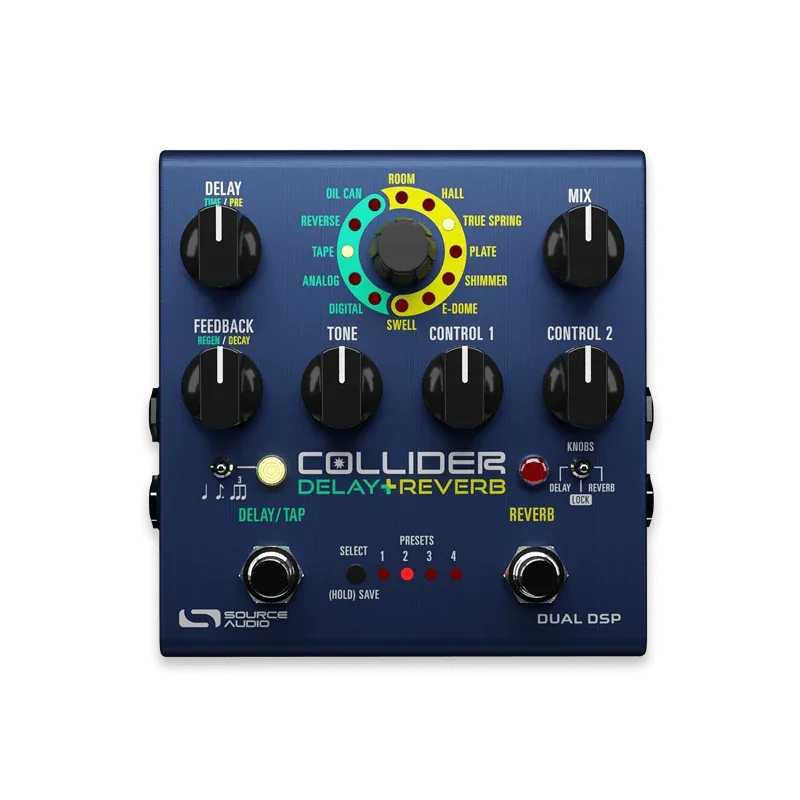
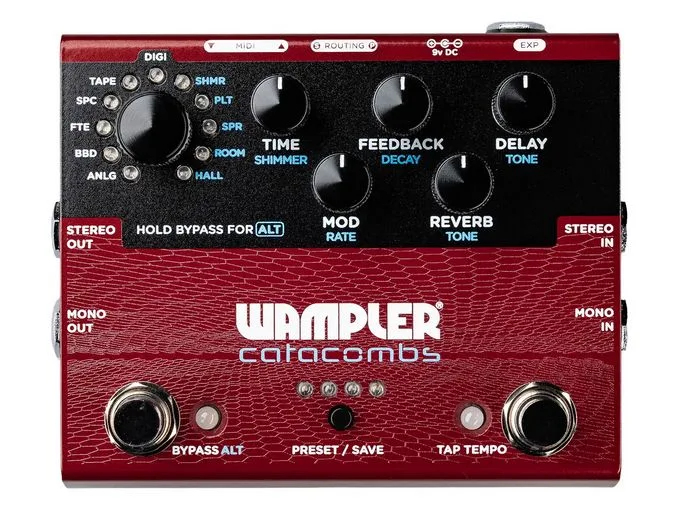
"It's in the same territory as the Source Audio Collider and Wampler Catacombs - but with much more onboard - and in a significantly larger enclosure"2
The reviewer placed the Solis Ventus in the same territory as the Source Audio Collider and Wampler Catacombs, but with much more onboard and in a significantly larger enclosure2. In Guitar Pedal X's selection of spatial and time-based effects, the Solis Ventus took the runner-up spot, with the reviewer calling it "well worth the wait, and a worthy runner-up winner for this selection"3.
Videos
Andertons Music Co
GFI System
GFI System
Questions
Is the Solis Ventus true bypass?
It can be. The bypass is selectable between buffered and true bypass, so you can choose which behavior suits your signal chain. It also has analog dry thru, which keeps your dry signal in the analog domain when the effect is engaged, and spillover, so tails continue when you bypass the effect.
How many delay and reverb algorithms does the Solis Ventus have?
GFI System's current product page lists 16 delay algorithms and 11 reverbs. When the pedal launched in December 2024, Guitar Pedal X counted 15 delay algorithms and 9 reverbs, so the count has grown through firmware updates. Either way, the delay side has substantially more algorithms than the reverb side.
Can the Solis Ventus run delay and reverb in parallel?
Yes. The two engines can be routed in series (delay into reverb or the reverse), in parallel, or independently in dual mono channels, and you can swap them around on the fly. A switchable crossover filter can also split the input into two frequency bands, sending one band to each engine.
How do you update the Solis Ventus firmware?
Hold both the A and C footswitches and plug in power; the screen shows firmware update mode. Then connect the pedal to your computer with a USB Type C cable and update through the SV Studio editor. Note that firmware v1.8.0 or newer requires SV Studio Editor 1.6.0 or newer.
Does the Solis Ventus have an editor app?
Yes. SV Studio is free editor software for Windows and macOS that manages presets, assigns expression parameters and adjusts every detail of the pedal's settings. It is also the tool used for firmware updates over the pedal's USB Type C connection.
Does the Solis Ventus accept line-level signals?
Yes. GFI System specifies instrument and line level compatibility, with a maximum input level of +7.23 dBV (9.45 dBu, 6.5 Vpp). That means it can sit in a studio or effects-loop context as well as on a pedalboard in front of an amp.
Sources (7)
- Solis Ventus, GFI System
- Guitar Pedal X, Guitar Pedal X, 2024-12-06
- Guitar Pedal X, Guitar Pedal X, 2024-12-20
- Specular Tempus, GFI System
- GFI System Solis Ventus Delay/Reverb, Delicious Audio, 2026-07-06
- TPS Pick'N'Mix, That Pedal Show (YouTube), 2017-10-09
- GFI System, GFI System, 2026