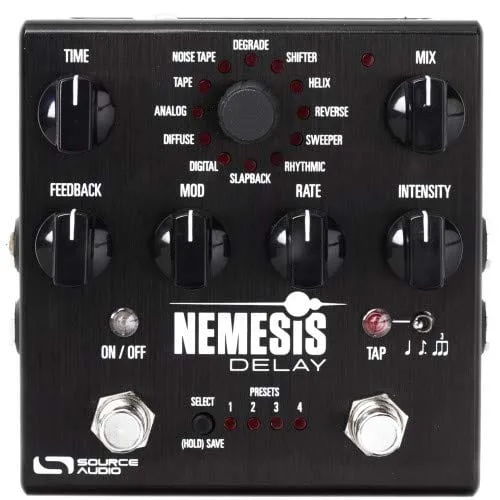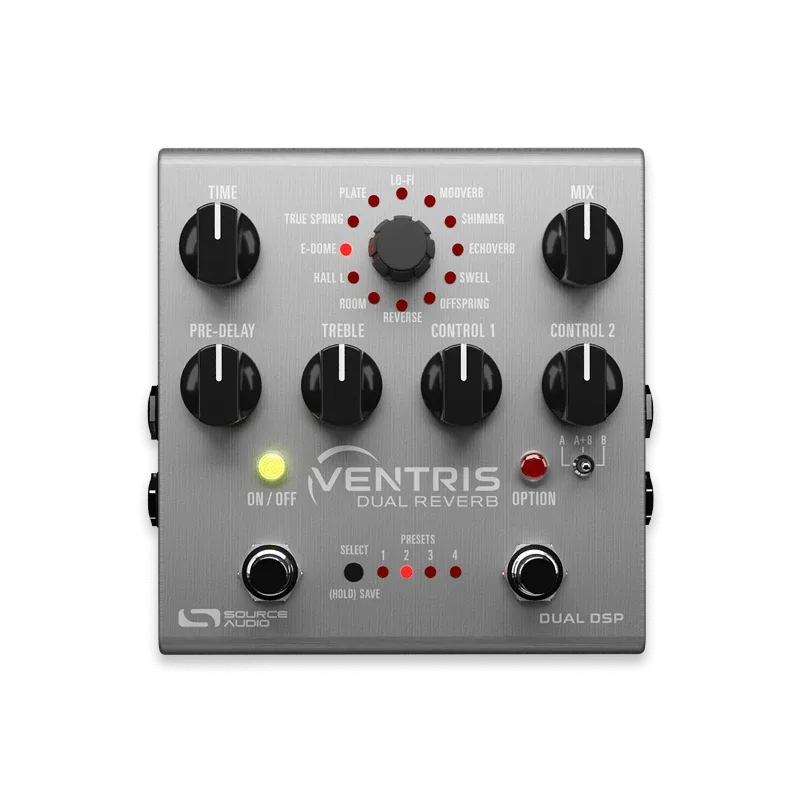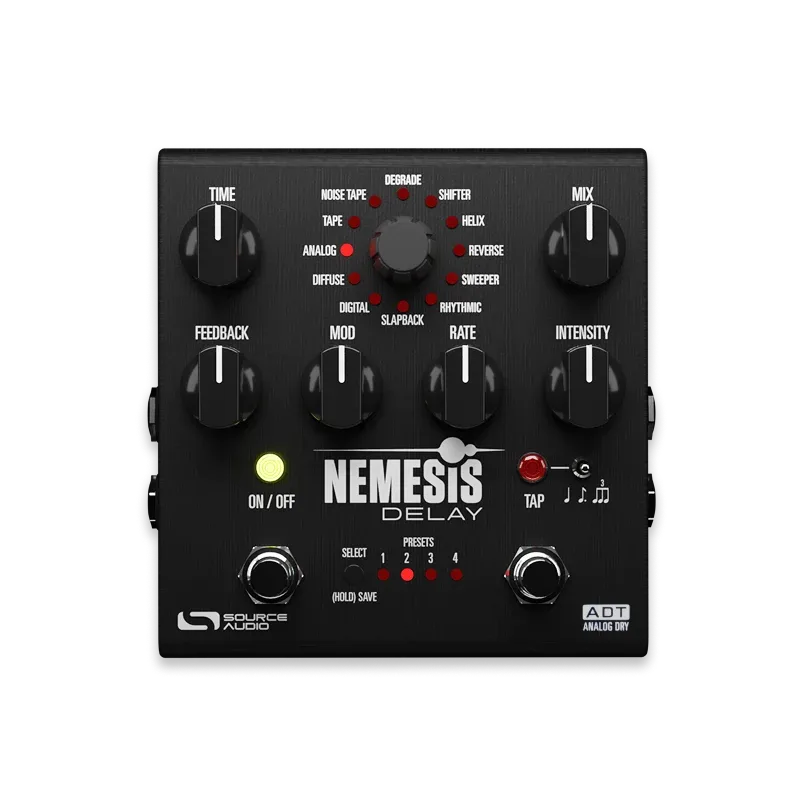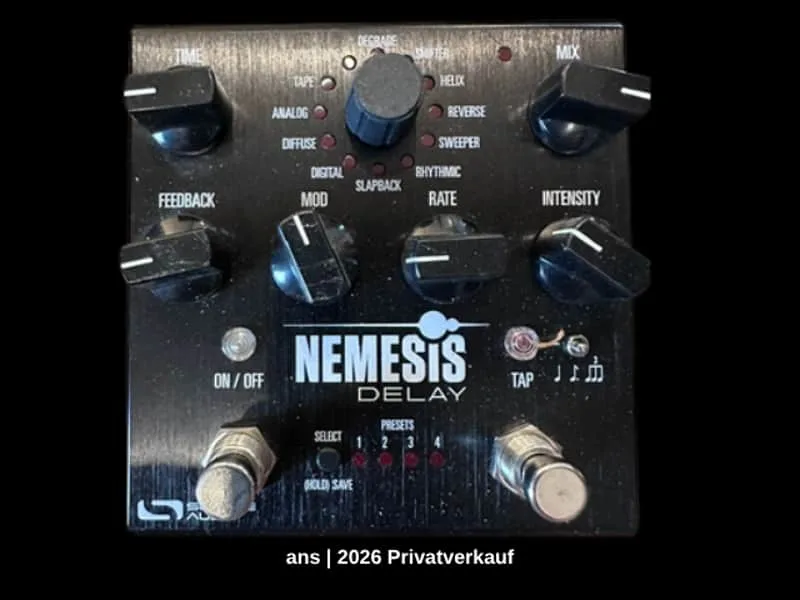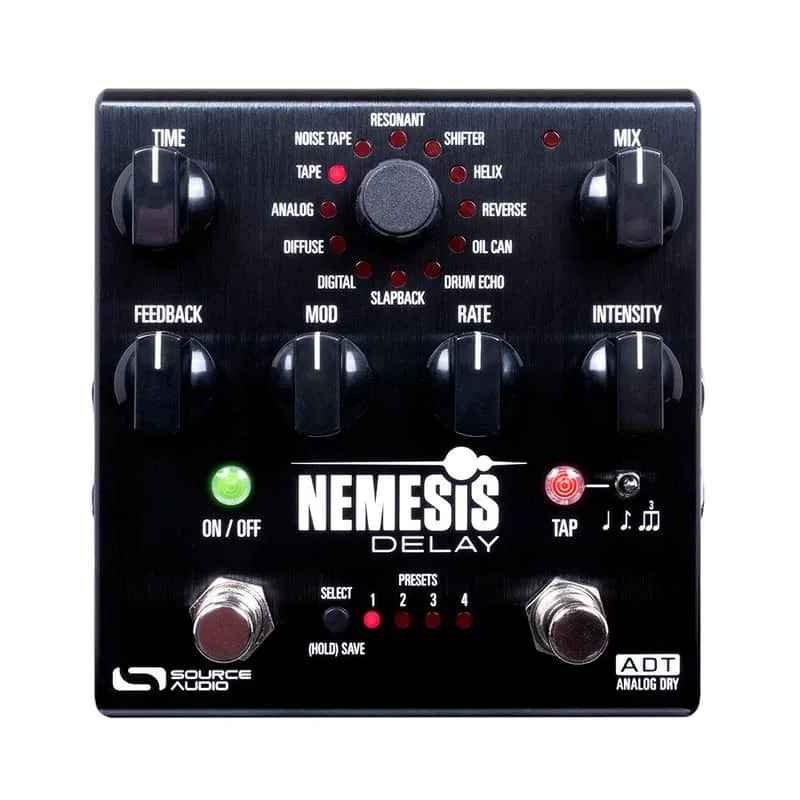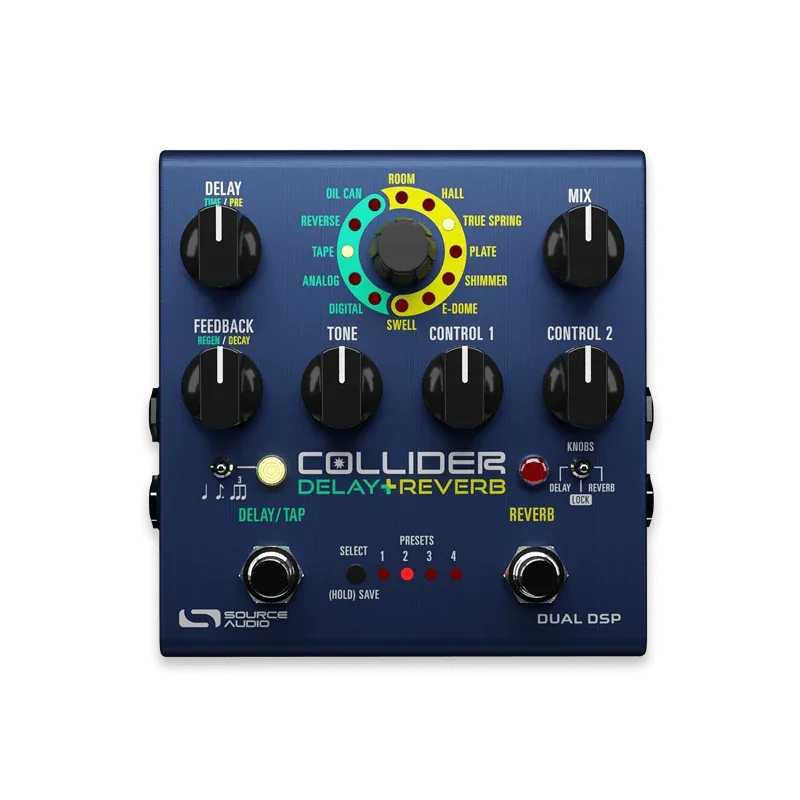


The Source Audio Collider Delay + Reverb is a dual-DSP delay and reverb pedal that packs the delay engines of the Nemesis Delay and the reverb engines of the Ventris Dual Reverb into a single compact enclosure123. Source Audio, based in the Boston area, hand-picked what it considered the most popular and useful engines from those two pedals when building the Collider, which launched in 2019 at a street price of $34942.
What the Collider does: Nemesis delays and Ventris reverbs in one box
The Collider's core idea is simple: take the engines from two well-regarded Source Audio pedals and let a player mix and match them in a single delay+reverb effect728. On the delay side it offers five algorithms: Digital, Analog, Tape, Reverse, and Oil Can, with the vintage tones inspired by the Maestro EP-3 Echoplex tape delay, the Oil Can delay design, and a classic analog bucket brigade circuit28. On the reverb side there are seven: Room, Hall, True Spring, Plate, Shimmer, E-Dome, and Swell, including models of Spring, Plate, and the Lexicon Hall alongside the more other-worldly Shimmer, Swell, and E-Dome23.
| Delay engines | Reverb engines |
|---|---|
| Digital | Room |
| Analog | Hall |
| Tape | True Spring |
| Reverse | Plate |
| Oil Can | Shimmer |
| E-Dome | |
| Swell |
Because the two processors are independent, the Collider is not limited to one delay feeding one reverb. You can stack two delays, two reverbs, or any delay/reverb pairing, with dual footswitches giving individual engage/bypass control over each effect, which Source Audio positioned as a practical choice for live performance2.
Two footswitches and a set of shared knobs control everything. A KNOBS mini toggle selects which effect the knobs address: set to DELAY, all knobs including the effect selector wheel control the delay; set to REVERB, they control the reverb; and a center LOCK position prevents accidental knob bumps from altering your sound48. The knobs themselves change function depending on the engine selected, so the same control may set different parameters for Tape delay than for Shimmer reverb8. A second mini toggle covers beat subdivision for the delays, with quarter, dotted eighths, and triplets, alongside integrated tap tempo via footswitch48.
Power and connections
The Collider runs on a supplied 9V DC adapter drawing 300 mA, through the standard 9V power jack538. It is full stereo, with stereo inputs and outputs, MIDI in and thru, USB, and an expression connection on the rear5389.
| Connection | What it does |
|---|---|
| Inputs 1 and 2 | Standard stereo inputs3 |
| Outputs 1 and 2 | Standard stereo outputs3 |
| EXP | Expression pedal, Neuro Hub, or Hot Hand8 |
| MIDI in / thru | Preset recall, parameter control, clock sync5 |
| USB | USB MIDI5 |
The 300 mA draw is worth noting for anyone planning a power supply: this is not a low-current analog pedal, so it needs a properly rated 9V output53.
Presets, MIDI and expression control
The Collider stores 128 presets: 8 are accessible from the pedal's own controls, and the full 128 are available via MIDI5. Performer Mag's review described the standalone experience as saving four presets of delay and reverb, with 128 storable and recallable once MIDI is connected8.
MIDI is deep rather than decorative. The pedal has 5-pin MIDI DIN and USB MIDI; program change messages recall up to 128 presets, control change messages control multiple knob parameters with independent depth and direction paths, and MIDI clock syncs delay time5. The expression connection works with Source Audio's Dual Expression Pedal, Neuro Hub, and Hot Hand Motion Controller, and through the Neuro Hub any TRS (tip hot) expression pedal can be assigned to control any combination of knob parameters58.
Bypass and trails
The footswitches can be set to true bypass, buffered bypass, or soft bypass with trails, so a delay or reverb tail can ring out naturally after you disengage the effect instead of being cut off38. MusicRadar's buying guide described the bypass as buffered or relay9.
What reviewers said
Guitar World's review found the Collider delivers the highlights of the Nemesis and Ventris in a compact enclosure, with a wide selection of high-quality delay and reverb3. Performer Mag's Chris Devine found that "the overall sound quality is fantastic," and that "the replication of the sonic inconsistencies of the tape and analog modes really blew our minds," with the Shimmer and Reverse modes producing "a super big synth like pad"8. MusicRadar's multi-function pedal roundup called it a digital reverb and delay combination of the company's top-of-the-line pedals, full stereo with five delay patches, seven reverb options, preset saving and full MIDI control9. Delicious Audio described it as an exceptional collection of rich, spacious tones, from realistic vintage delay reproductions to other-worldly Shimmer Reverb10.
Where it came from and where it went
The Collider was announced in October 2019, priced at $349 (£289, €319)11. Source Audio President Roger Smith's launch framing was direct: "Now you can have access to a collection of the best reverbs AND the best delays all in the same compact design"2.
Videos
Pete Thorn
Sweetwater
sourceaudioeffects
News
Questions
Can the Collider run two delays or two reverbs at once?
Yes. Its twin-processor design lets you run any two-effect combination: delay/reverb, delay/delay, or reverb/reverb. Each engine has its own engage/bypass footswitch, so you can stack two delays, two reverbs, or one of each.
Does the Source Audio Collider have reverb trails?
Yes, when you choose soft bypass. The pedal offers selectable true bypass, buffered bypass, or soft bypass with trails, so a reverb tail can continue ringing after you switch the effect off rather than cutting abruptly.
How many presets does the Collider store without MIDI?
Eight presets are accessible from the pedal's own controls, and the full 128-preset memory is reached via MIDI. Performer Mag's review noted that standalone you can save four delay and four reverb presets, with 128 available once MIDI is connected.
Is the Source Audio Collider still in production?
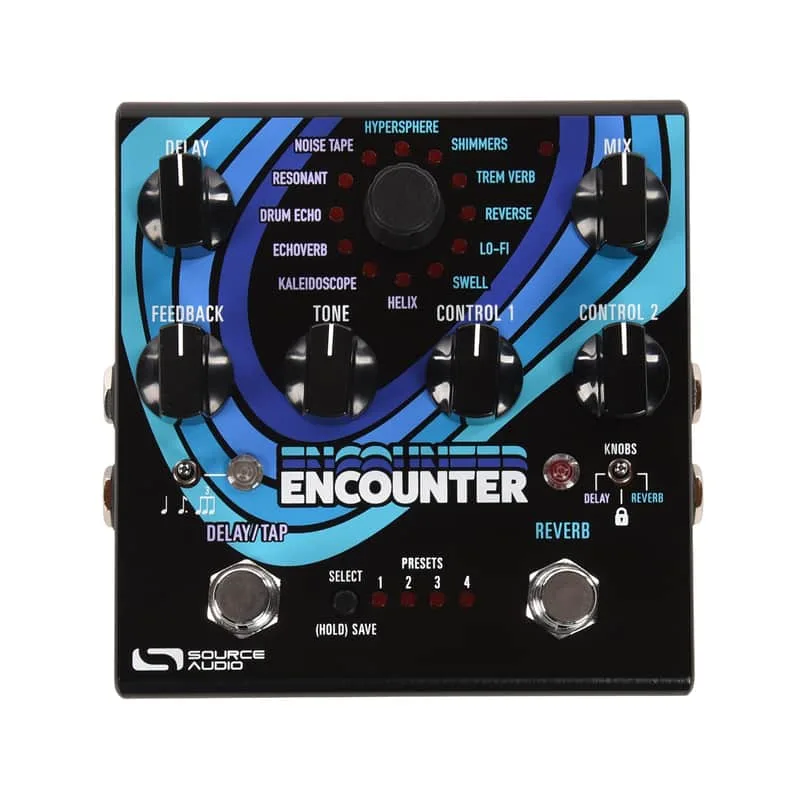
Source Audio's product page lists the Collider as sold out, and the company has since released the Encounter Delay + Reverb as its successor, announced in September 2025 with a new set of algorithms. The Collider may still be found second-hand or at remaining retailers.
Can I use the Collider with a Hot Hand or expression pedal?
Yes. The pedal has an expression connection that works with Source Audio's Dual Expression Pedal, Neuro Hub, and Hot Hand Motion Controller. Through the Neuro Hub, any TRS (tip hot) expression pedal can be assigned to control any combination of the pedal's knob parameters.
Sources (11)
- Source Audio's Collider packs a whole lot of delay and reverb into a single enclosure, Guitar World, 2019-10-09
- Introducing the Collider Delay+Reverb: A High-End Collection of Delay and Reverb Effects in a Single Pedal., MusicPlayers.com, 2019-10-09
- Source Audio Collider Delay+Reverb review, Guitar World, 2020-05-04
- Source Audio Unveils the Collider Delay+Reverb, Premier Guitar, 2019-10-08
- Collider Delay + Reverb, Source Audio
- “Players have asked us to push further, MusicRadar, 2025-09-17
- The Best Ambient-Shoegaze Reverb Pedals In 2024, Delicious Audio, 2024-11-15
- Source Audio Collider Pedal Review, Performer Mag, 2020-10-19
- 5 great multi-function guitar effects pedals you need to try, MusicRadar, 2022-01-05
- Source Audio Collider Delay + Reverb, Delicious Audio, 2023-09-19
- Source Audio launches the Collider Delay+Reverb pedal, MusicRadar, 2019-10-09