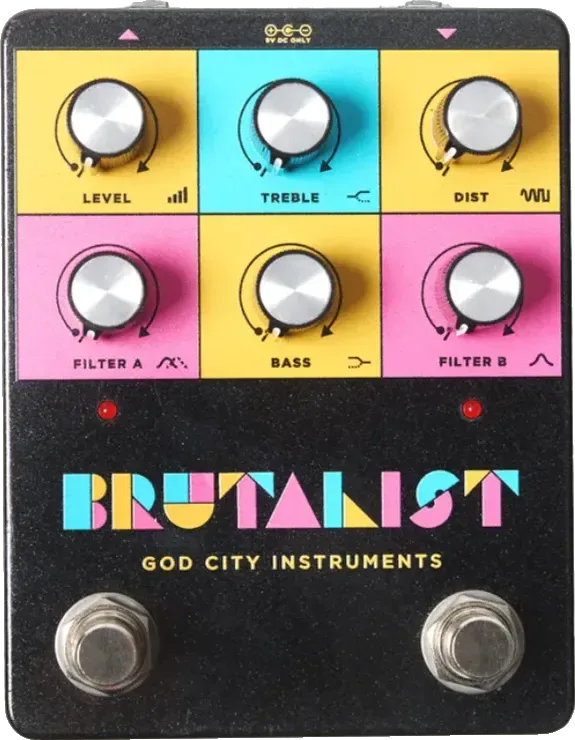


The God City Instruments Brutalist is a high-gain analog distortion pedal with a boost-only active Baxandall EQ and, unusually, a pair of filters: a band-pass filter and an all-pass filter that work together to reshape the distorted signal. RockBoard's PedalPedia describes the range those filters open up as "deeply affected distortion textures ranging from massively scooped brickwalls of fuzz, to cocked-wah lofi lead tones, to almost saw-like bass tones"1.
God City Instruments is the brainchild of Kurt Ballou2, and the Brutalist was designed in collaboration with Electronic Audio Experiments2. Guitar Pedal X's Stefan Karlsson reports it as another John Snyder designed circuit3. It is not Ballou's debut pedal, but the maker's page calls it the first creation to undergo over ten years of development1.
What it does
At its core the Brutalist is a high-gain distortion. Delicious Audio describes the main distortion as "akin to a cranked amp and provides excellent dynamics"2. On top of that sit the two filters, which Delicious Audio calls "the dynamic duo of band-pass and all-pass filters, working hand in hand to conjure up mind-bending distortion textures"2.
The two filters behave differently:
- Band-pass filter (Filter A): sits at the beginning of the circuit. Delicious Audio notes it "makes it possible to dial in cocked wah or aggressive chainsaw" voicings, and that its wide frequency range suits bassists as well as guitarists2. Guitar Pedal X calls the band-pass "a well worn element" on pedals of this kind3.
- All-pass filter (Filter B): sits at the output and affects the phase of the pedal's output. Guitar Pedal X explains that it "acts more like a fixed wah by positioning the phase," and notes that all-pass filtering is "rarely used on these kinds of pedals"3. Delicious Audio compares it to "a parked phaser," producing "extreme scooped sounds plus many unexpected synth" textures that interact with the band-pass settings2.
The controls
The control set mixes a conventional distortion layout with the two filter knobs3:
| Control | What it does |
|---|---|
| Level | Output volume |
| Distortion | Gain amount |
| Treble | High end of the 2-band Baxandall EQ |
| Bass | Low end of the 2-band Baxandall EQ |
| Filter A | Band-pass filter position |
| Filter B | All-pass / phase position |
| Filth footswitch | Engages the filters |
| Bypass footswitch | Main effect on/off |
The EQ is a 2-band Baxandall type, and the maker specifies it as boost-only, meaning the Treble and Bass controls add rather than cut3.
The Filth footswitch
The Filth footswitch is the pedal's second voice. Engaging it runs the distortion through the band-pass filter at the start of the circuit and the all-pass filter at the output2. Guitar Pedal X describes the result as "phasey, cocked-wah-style textures"3. With the filters off, the pedal is a straightforward high-gain distortion with the Baxandall EQ shaping the tone.
Power
The Brutalist runs on a 9V DC center-negative supply drawing 150mA1. Delicious Audio notes the circuit has "18v internal headroom from a standard 9V power supply," which it links to the pedal's dynamics2.
At 150mA the Brutalist draws noticeably more current than many analog distortion pedals. A standard 9V supply is fine, but check that the output can deliver the current before daisy-chaining it with other pedals.
Versions and history
The Brutalist is the latest in a family of effects that includes the earlier BJR Compact3. The maker is explicit that the full-size pedal is its own product: "Not Brutalist Jr., not BJR, this is BRUTALIST!"1. The pedal followed over ten years of development1.
What reviewers said
Guitar Pedal X reviewed the Brutalist in February 2024, calling it "beautifully textured throaty distortion" and concluding34:
"I really love the core voicing and texture on this - and the Filters / Filth element is surely just a matter of learning"3
Later that year, in Guitar Pedal X's roundup of the best new distortion pedals of 2024, Karlsson called it "Really unique and expansive Drive / Distortion pedal"4. He also noted availability: the pedals "are made in small batches which get snapped up very quickly," and the God City website showed them sold out as of December 20244. The price was listed at $259 in December 20244; the February 2024 review gave the UK price as £209, which it equated to roughly $2593.
Videos
God City Music
AndyDemos
Dome
News
Questions
What does the Filth footswitch do on the Brutalist?
The Filth footswitch engages the pedal's two filters: a band-pass filter at the beginning of the circuit and an all-pass filter at the output. With both active, the distortion takes on phasey, cocked-wah-style textures, from deeply scooped fuzz walls to lofi lead tones and synth-like sounds. The bypass footswitch handles the main distortion on its own.
What power supply does the God City Brutalist need?
It runs on a standard 9V DC center-negative power supply drawing 150mA. Internally the circuit has 18V of headroom, which the maker credits for the pedal's dynamics. At 150mA it draws more current than many analog distortion pedals, so a decent power supply is worth having.
What is the difference between the Brutalist and the BJR?
The BJR Compact is an earlier, smaller iteration of the same family of effects. The Brutalist is the full-size version that followed over ten years of development, and God City Instruments is explicit that it is a distinct product: not Brutalist Jr., not BJR.
Who designed the God City Instruments Brutalist?
God City Instruments is the brainchild of Kurt Ballou, guitarist of Converge. The Brutalist was designed in collaboration with Electronic Audio Experiments, and Guitar Pedal X reports it as another John Snyder designed circuit. It is not Ballou's debut pedal, but the first to undergo over a decade of development.
Is the God City Brutalist analog?
Yes. The maker lists the Brutalist as an analog circuit. It is a high-gain distortion with a boost-only active Baxandall EQ, plus analog band-pass and all-pass filters that shape the distortion textures.
Sources (4)
- Brutalist by God City Instruments, RockBoard PedalPedia, 2026
- New Pedal: CGI Brutalist Distortion, Delicious Audio, 2024-02-09
- Guitar Pedal X, Guitar Pedal X, 2024-02-08
- Guitar Pedal X, Guitar Pedal X, 2024-12-17