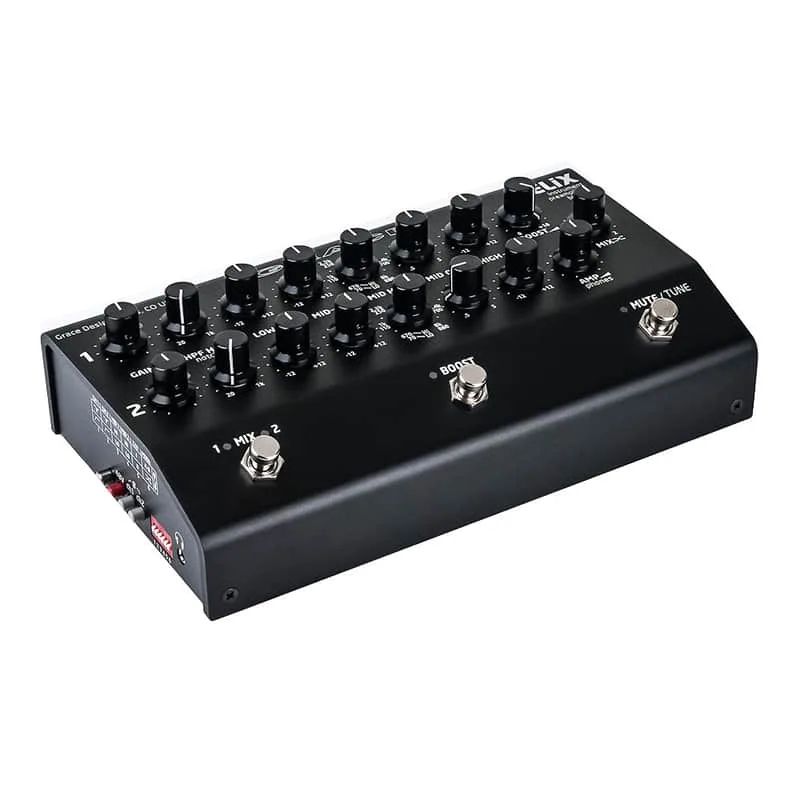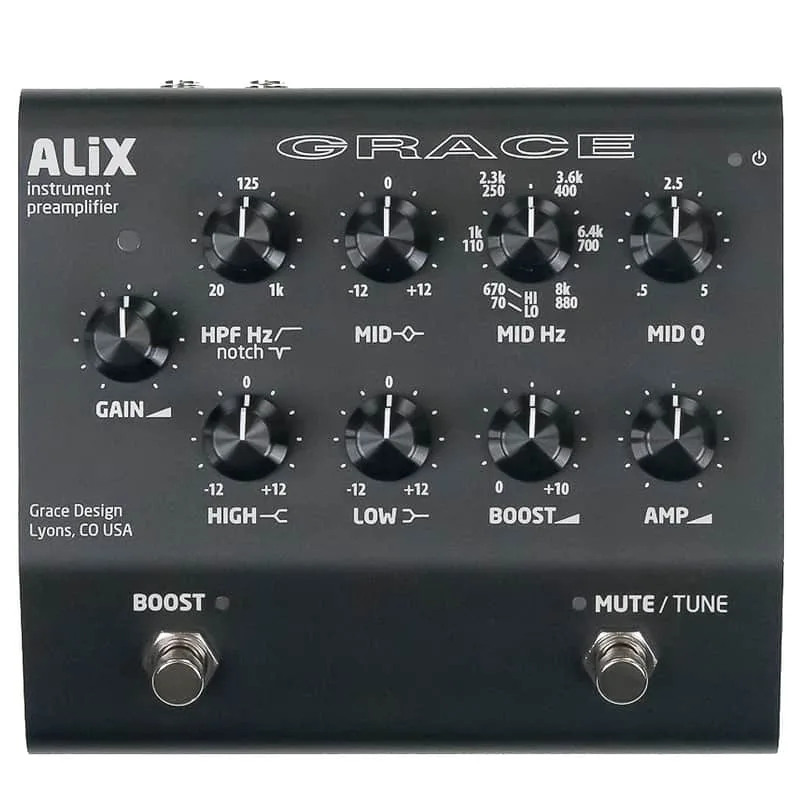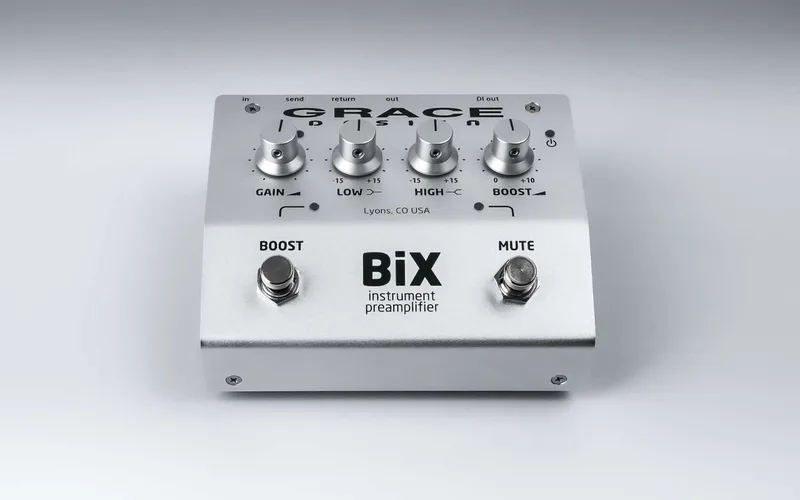


The Grace Design BiX is an instrument preamp, DI and boost pedal in one box. It takes an instrument signal through a high impedance input, gives it clean gain, high and low shelving EQ and a variable boost, and hands it back through an unbalanced line output plus a balanced DI output for feeding a mixer or PA. Grace Design positions it as the compact member of a family: it "shares the exact same DNA of its bigger siblings" FELiX and AliX, the company's larger preamp designs1.
Grace Design describes the BiX as "a carbon copy of its bigger siblings, with crystal clear, ultra-quiet audio performance," with highs that are smooth and open and lows that are deep and rock solid2. Those are the maker's words; the measured specifications behind them are listed below. The company also publishes an endorsement from Billy Strings:
Grace Design says the BiX is "a carbon copy of its bigger siblings, with crystal clear, ultra-quiet audio performance," with highs that are smooth and open and lows that are deep and rock solid2.
What it does and how you control it
The control set is small. Grace Design describes it plainly: "Controls are dead simple, input gain, high and low shelving EQ, and a 10dB variable boost circuit"2. Two footswitches handle Mute and Boost on the fly1.
| Control | What it does |
|---|---|
| Input gain | Sets the preamp gain; line output gain range is 0dB to +37dB1 |
| Low shelving EQ | +/-15dB of shelving cut or boost1 |
| High shelving EQ | +/-15dB of shelving cut or boost1 |
| Boost footswitch | Engages the boost circuit, 0dB to +12dB range1 |
| Mute footswitch | Silences the output1 |
| EQ DIP switches | Rear panel switches select between two transition frequencies for both High and Low controls2 |
The shelving EQ frequencies are switchable from the rear panel. The Low control can be set to hinge at 100Hz or 200Hz, and the High control at 2kHz or its high range alternative, giving four possible EQ voicings before you touch a knob1.
A signal/peak LED meter helps you set gain: the green threshold sits at -13dBu and the red threshold at +12dBu1.
The effects loop and outputs
The BiX has separate FX send and return jacks, so time-based or drive effects can sit in a loop after the preamp's gain stage rather than in front of it1. The insert input impedance is 200Ω and the insert output impedance is 150Ω, with a maximum insert output level of +22dBu into a 100k Ohm load at 0.1% THD1.
There are two main outputs:
- Line output: 1/4" unbalanced, 150Ω output impedance, +22dBu maximum level into a 100k Ohm load at 0.1% THD, with a gain range of 0dB to +37dB1
- DI output: balanced, 150Ω output impedance, -7dBu maximum level (mic level) into a 100k Ohm load at 0.1% THD, with a level range of -29dB to +8dB referenced to line1
The instrument input accepts up to +22dBu, and the insert return (with 0dB boost) also accepts +22dBu, so hot active pickups are not a problem1. On units with serial numbers 30000913 and above, the instrument input impedance is 1MΩ1.
Power and connections
The BiX runs on a 9VDC supply with a 2.1mm center negative connector, the same standard as most pedalboard power bricks, and draws a nominal 150mA1. It accepts an input voltage range of 6VDC to 12VDC1. There is no battery option in the specifications.
At 150mA nominal draw, the BiX pulls more current than many analog drive pedals. Players using isolated power supplies with low-current outputs should make sure the output can deliver at least 150mA at 9V.
How it measures
Grace Design publishes a full set of measurements for the BiX1:
| Specification | Value |
|---|---|
| THD+N, 1kHz, 0dB gain, +10dBu out | <0.002% |
| THD+N, 1kHz, 20dB gain, +10dBu out | <0.002% |
| THD+N, 1kHz, 36dB gain, +10dBu out | <0.005% |
| Intermodulation distortion, SMPTE/DIN 4:1, 50Hz and 7kHz, 36dB gain, +10dBu out | <0.008% |
| Frequency response, line output at 20dB gain, -3dB | 10Hz to 185kHz |
| Frequency response, DI output | 10Hz to 40kHz |
| Dynamic range, minimum gain, line out (22Hz to 22kHz) | 129dB |
| Dynamic range, minimum gain, DI out (22Hz to 22kHz) | 129dB |
| Output noise, minimum gain, line out (22Hz to 22kHz) | -107dBu |
| Output noise, minimum gain, DI out (22Hz to 22kHz) | <-120dBu |
| Output noise, maximum gain, line out (22Hz to 22kHz) | -78dBu |
| Weight | 1.2lbs (0.55kg) |
| Dimensions | H2.5" x W5.1" x D4.5" (H6.35cm x W13.0cm x D11.4cm) |
For a player, the numbers that matter most are the low distortion at low and moderate gain, the wide frequency response well beyond the audio band, and the very low output noise, which together describe a clean preamp rather than a color box. It is a different animal from an overdrive or distortion pedal: its job is to make the instrument louder and quieter, not to clip the signal.
Where it came from and how it differs from the FELiX and AliX
Grace Design built the BiX directly from the lineage of its larger preamps, the FELiX and the AliX. The maker says the BiX "shares the exact same DNA of its bigger siblings"1, and carries that circuit design into what it calls "a compact, rugged low-profile chassis" that is "pedalboard friendly, with a 9VDC power input"2. Sonically, Grace Design describes the BiX as "a carbon copy of its bigger siblings, with crystal clear, ultra-quiet audio performance"2.
In short: the FELiX and AliX are the bigger siblings, and the BiX is the single-channel, pedalboard-sized version of the same preamp circuit, aimed at players who want one clean channel, a DI and a boost on a board rather than a floor-standing two-channel unit12.
Who it suits
The BiX's 1MΩ instrument input (on units with serial numbers 30000913 and above) and balanced DI output make it a natural fit for acoustic players running piezo pickups straight to a PA, and Billy Strings uses it that way2. Its clean gain, EQ and effects loop also suit bass players building a bass pedalboard around a boost and EQ foundation, and its low noise floor matters most when a lot of gain is in play. It is made in the USA and covered by a 5 year transferable warranty1.
Videos
Premier Guitar
grace design
Peghead Nation
Questions
Can the Grace Design BiX be used on acoustic guitar?
Yes. Grace Design publishes an endorsement from Billy Strings, who says the BiX sounds natural and full on his acoustic guitar and catches the little nuances he loves about it. Its 1MΩ high impedance instrument input (on units with serial numbers 30000913 and above) suits piezo pickups, and the balanced DI output feeds a PA directly.
Does the Grace Design BiX have an effects loop?
Yes. The BiX has separate FX send and return jacks on its insert loop. The insert input impedance is 200Ω and the insert output impedance is 150Ω, with a maximum insert output level of +22dBu into a 100k Ohm load at 0.1% THD.
What is the input impedance of the Grace Design BiX?
The instrument input is 1MΩ on units with serial numbers 30000913 and above. The insert (FX return) input is 200Ω. The 1MΩ instrument impedance is high enough to preserve the top end of piezo and magnetic pickups.
What is the difference between the Grace Design BiX and the FELiX?
The BiX shares what Grace Design calls the exact same DNA of its bigger siblings FELiX and AliX, but packages it in a compact, rugged low-profile chassis that is pedalboard friendly, with a 9VDC power input. The FELiX is a larger two-channel preamp, while the BiX is a single-channel preamp, DI and boost.
Where is the Grace Design BiX made?
The BiX is made in the USA by Grace Design, and it carries a 5 year transferable warranty.
Sources (2)
- Grace Design BiX Instrument Preamp + DI + Boost, Grace Design
- BiX Instrument Preamp/DI: Reference-Grade Sound for Musicians, Grace Design