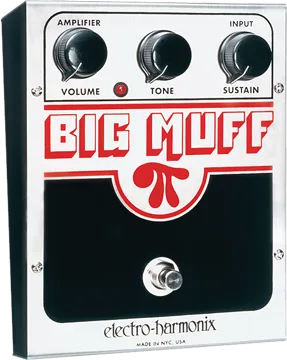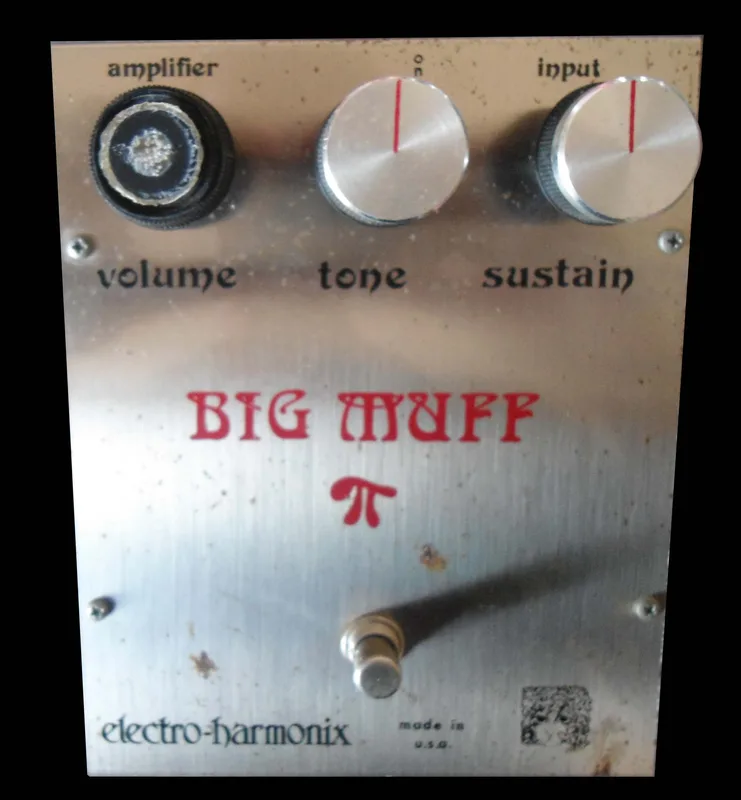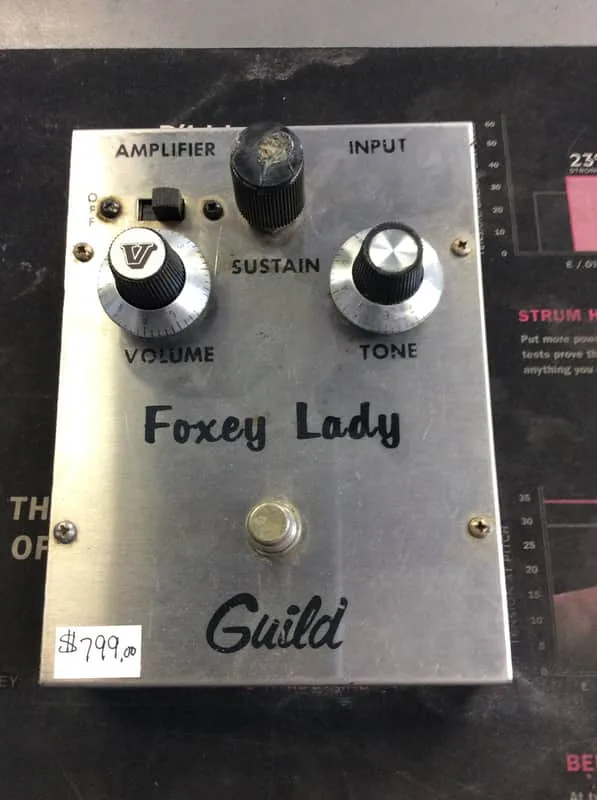

The Guild Foxey Lady is a fuzz pedal sold under the Guild guitar brand in the late 1960s and 1970s. The three-knob version that most players mean by the name is, inside the box, a Big Muff Pi: Kit Rae's research on original units found that the circa-1970 three-knob Foxey Lady "was the exact same pedal as the V1 Triangle Big Muff, only repackaged for the Guild OEM version"1, and Guitar World's history likewise describes it as "essentially a rebranded Big Muff Pi" that appeared in 19702. The original stompbox was manufactured by Electro-Harmonix3.
What that means for a player is the classic Big Muff experience: heavy, compressed distortion with long sustain, shaped by three knobs. The DIY community around the circuit is enthusiastic about exactly that quality. On the Guitar FX Layouts blog, mirosol wrote213:
"Man, if you like a fuzz with sustain until the end of time, this is your pedal!"4
A Big Muff Pi-derived fuzz with its own part values
The three-knob Foxey Lady belongs to the Big Muff family, but it is not a note-for-note copy of any one version. General Guitar Gadgets, whose project documentation is built from traced original units, states plainly that the pedal "is in fact a Big Muff Pi distortion," while noting that "the values on the units traced have some part value differences from any of the Big Muff versions"3. In other words: same topology, its own component values.
Kit Rae's history of the OEM Big Muffs adds a caveat worth knowing: "there was no one set schematic, or one sound that defines these OEM version, just as there was not one for the Big Muff"1. Units also shifted over time. A three-knob Foxey Lady from the V2 era, circa 1973 to 1975, was "the exact same production pedal as the V2 Big Muff, only with different silk screened graphics for the OEM version"1, and an example from around 1974 or 1975 traced to the "violet" Ram's Head Big Muff circuit of circa 1973-741. Stomp Under Foot's history of that era likewise calls the Foxey Lady "a rebranded Big Muff for Guild"5, and Guitar.com notes that for a time in the late '60s it came from the same production line and parts as the Electro-Harmonix Big Muff6.
The controls
Three knobs, matching the Big Muff layout. General Guitar Gadgets' bill of materials gives the taper of each pot3:
| Control | Pot value | Taper | What it does |
|---|---|---|---|
| Sustain | 100k | Log (audio) | Sets the amount of fuzz and compression |
| Tone | 100k | Linear | Tilts the tone between dark and bright |
| Volume | 100k | Log (audio) | Sets the output level |
The taper choice is not critical in practice. Mirosol, who built the circuit from a stripboard layout, used B100K pots for all three controls, noting "the muff always works fine with both, log and lin pots"4. He also substituted 8K2 resistors for the 7K5s in his build4.
Jacks, power and test voltages
The project documentation lists the connections as J1, a stereo quarter-inch input jack; J2, a mono quarter-inch output jack; and J3, a DC jack, with the circuit running from a 9 volt supply3. A 9 volt battery is on the parts list as B1, and the kit does not include one3. Switching is handled by a heavy duty 3PDT footswitch3.
For builders checking bias, the documentation gives transistor pin voltages measured at a 9V supply3:
| Transistor | Collector | Base | Emitter |
|---|---|---|---|
| Q1 | 8.8 V | 3.9 V | 0.6 V |
| Q2 | 3.8 V | ||
| Q3 | 4.0 V | ||
| Q4 | 2.5 V | 1.8 V | 0.03 V |
Transistors and clipping diodes
The circuit uses four NPN bipolar junction transistors (Q1 to Q4)3. The original units used 2N5088s, and the documentation lists 2N3904, 2N4401 and many others as substitutes3. Clipping comes from four 1N914 diodes (D1 to D4) plus an LED (D5)3.
Transistor choice shapes the character. Mirosol used 2N2222 transistors measuring 300 to 330 hFE, which he reported "makes it much smoother," and 1N60P clipping diodes in place of the stock types4.
Versions: three-knob and two-knob
The Foxey Lady name covers several different pedals, and the two-knob versions are not Big Muffs at all1.
- Mosrite two-knob (around 1967): Mosrite repackaged its own FUZZ-rite pedal for Guild, a germanium-transistor circuit designed by Ed Sanner. Mosrite made a small quantity until it went bankrupt1.
- Mike Matthews two-knob (from around 1967): At a NAMM show, Guild contracted Mike Matthews to take over production. The circuit was the Ed Sanner FUZZ-rite design slightly reworked by New York repairman William (Bill) Berko at his shop ABCO Sound, and the pedal was manufactured for Matthews by Aul Instruments in a simple, gray folded sheet metal box with two knobs1. A later E-H-made third version from 1968 switched to silicon transistors with extra biasing parts, in a thinner box with a more stylish Foxey Lady font1.
- Three-knob (circa 1970 onward): The Big Muff-derived version this page is about, produced alongside the Big Muff V2 until the middle of the 1970s1.
The two-knob pedal worked differently from the three-knob one: its FUZZ knob "was actually a blend knob that allowed you to mix the fuzz tone from one transistor to the fuzz tone from the other"1, rather than the three-knob pedal's sustain control.
Who made it, and where the name came from
The Foxey Lady story starts with Guild's president, Al Dronge. In Mike Matthews' own account, Dronge "contacted me and said he wanted to buy all the fuzz tones. He decided to call" them Foxey Ladys7, a name MusicRadar's interview records as Dronge's, chosen in the wake of Hendrix's success8. Matthews had the pedals built by a contractor in Long Island City, All Instruments7, and by 1968 he had taken over Foxey Lady production for Guild using variations of the original two-knob circuit2. JHS Pedals' history of the era likewise notes that "Mike was building fuzz pedals for Guild, and one of them was the Foxey Lady Fuzz"9. Matthews founded Electro-Harmonix in 19681, and the three-knob Foxey Lady that followed was manufactured by Electro-Harmonix3.
For players who want the circuit today, General Guitar Gadgets offers a Ready to Solder Circuit Board for the project3. The PCB is the same board used in its Big Muff Pi replica kit and carries the label "BMP" on it3, which tells you everything about how close the two pedals are; the kit maker's own page for the Big Muff project notes that the 3-knob Foxey Lady is among the circuits similar to the Big Muff10. The Stompbox Book's Big Muff history records that the Big Muff V1 "was also available as a Guild Foxy Lady"11, and a free stripboard layout for the three-knob circuit was published by the Guitar FX Layouts blog in September 20124.
Videos
devnulljp
Questions
Is the Guild Foxey Lady the same circuit as a Big Muff Pi?
Essentially yes. The three-knob Foxey Lady from around 1970 was the exact same pedal as the V1 Triangle Big Muff, only repackaged for Guild, and later units matched the V2 Big Muff production pedal. The traced units do show some part value differences from any documented Big Muff version, so it is a sibling rather than a carbon copy.
What do the three knobs on the Foxey Lady do?
Sustain sets the amount of fuzz and compression, Tone tilts the output between darker and brighter, and Volume sets the output level. All three are 100k pots: Sustain and Volume use log (audio) taper, Tone uses linear taper.
Who made the original Guild Foxey Lady?
The earliest two-knob version was made by Mosrite, based on Ed Sanner's FUZZ-rite circuit. Around 1967 Guild contracted Mike Matthews, who had the pedal built by Aul Instruments in Long Island City, and the three-knob version that followed was manufactured by Electro-Harmonix.
Does the Foxey Lady project kit include a battery?
No. The General Guitar Gadgets project documentation lists a 9 volt battery as part B1 and states it is not included in the kit. The circuit runs on a 9 volt supply, and the board also has a DC jack.
Sources (11)
- The Big Muff History, Kit Rae (kitrae.net), 2012-01
- Classic gear: the enduring legacy of the Electro-Harmonix Big Muff Pi, Guitar World, 2020-09-25
- Guild™ Foxey Lady™ Clone (3-Knob): Fuzz Schematic & Layout, General Guitar Gadgets, 2014-05-12
- Guitar FX Layouts: Guild Foxey Lady 3 Knob, tagboardeffects.blogspot.com, 2021-01-19
- 1974-1975 Ram's Head, Stomp Under Foot, 2026-07-18
- Epiphone’s new multi-effects pedal sure looks like a rebadged Joyo unit from 2020, Guitar.com, 2023-10-25
- “Jimi was staying at a hotel in Times Square. He had his hair set in pink curlers and we would just talk band drama”: Electro-Harmonix founder Mike Matthews on befriending Hendrix, booking Chuck Berry and the birth of pedal culture, Guitar World, 2025-04-24
- Interview: Mike Matthews (Electro-Harmonix founder), MusicRadar, 2012-05-28
- THE TECHNOLOGY OF JIMI HENDRIX, JHS Pedals
- Big Muff Pi™ Clone Kit: Triangle, Ram's Head & Russian Fuzz, General Guitar Gadgets, 2014-05-12
- Big Muff Pi, Stompbox Book, 2020-03-21
 Robert Fripp