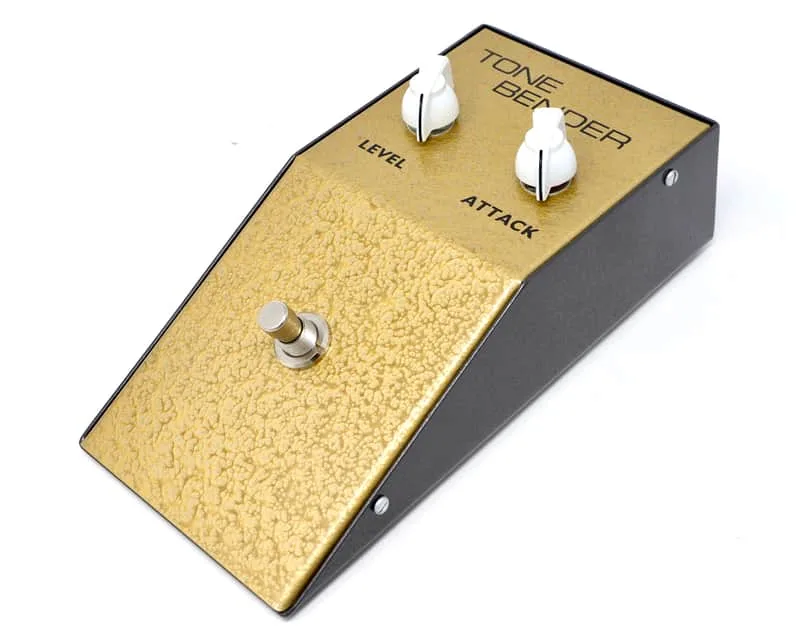
| Type | Fuzz pedal (circuit page)89 |
| Maker | Mosrite, Californian guitar company10 |
| Designer | Ed Sanner, designed in Bakersfield, CA1 |
| Production | 1966 to 19687411 |
| Status | Discontinued; Mosrite went bankrupt in late 1968 and ceased business by 196926 |
| Versions | Germanium (about 250 units) and silicon (more widespread)412 |
| Controls | Volume and Depth1310 |
The Mosrite Fuzzrite is a fuzz pedal designed by Ed Sanner and built by the Californian guitar company Mosrite from 1966 to 196812. It came about after a request from the rock instrumental group The Ventures, and it exists in two distinct circuits: an early germanium-transistor version of which only about 250 units were made, and a later silicon-transistor version that was much more widespread345. Mosrite went bankrupt in late 1968, formally ceasing business by 1969, which ended Fuzzrite production26.
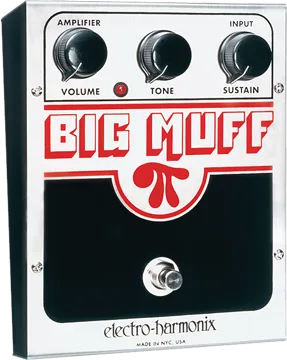
For a player, the Fuzzrite is one of the classic two-transistor fuzzes of the 1960s, sitting just behind the Tone Bender, Fuzz Face and Big Muff in historical popularity7. Its signature control is the Depth knob, which blends a second gain stage into the first, letting the pedal move from thin, trashy fuzz to a thicker, ripping tone. Premier Guitar's reviewer placed its character plainly: "it's not as flexible as a Fuzz Face, as meaty as a Muff, or as detailed and defined as a Tone Bender"5.
How it works: two transistors and a Depth control
Like any Fuzzrite circuit, it is a simple affair: apart from the two transistors at the heart of the circuit, there are probably no more than a dozen additional components on the board5. Catalinbread, whose recreations are traced from original units, describes the circuit as two simple, separate gain stages, with the Depth knob acting as a mix control between them14.
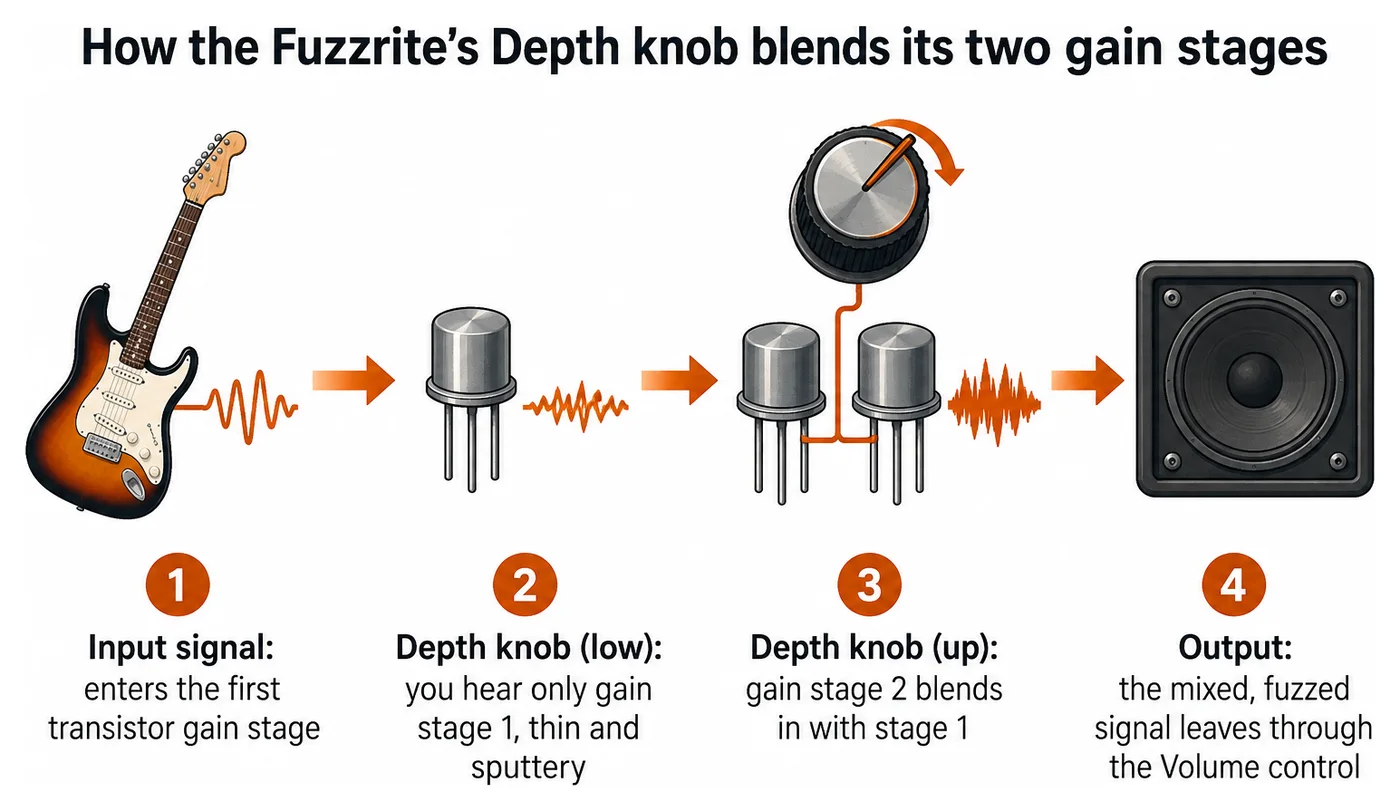
You never hear the second stage by itself; the knob sweeps between "1" and "1+2"14. Gearnews describes the same behavior in the Catalinbread recreation: "the Depth knob then mixes in a second transistor gain stage with the first"3. Delicious Audio's buying guide notes that this design let the original "go from trashy" thin fuzz to fuller drive as the second stage comes in10.
The Volume control sets the output level of the circuit. Catalinbread notes that higher Volume settings will begin to overdrive your amplifier, which can add body and smoothness to the fuzzed-out sounds15.
Two details of the tone are built into the circuit. First, the signal travels directly through a small capacitor which cuts the low end no matter where the Depth control is set, which is why original Fuzzrites sound thin by modern standards15. Second, at low Depth settings the fuzz turns sputtery and gated: Premier Guitar's reviewer found you "can enhance the cool, sputtery gated-fuzz effects by setting the depth (gain) control to lower levels"5. Catalinbread's Germanium Fuzzrite adds a Modern/Vintage toggle that switches both output capacitors from 2nF to 10nF, increasing the amount of low end passing through15.
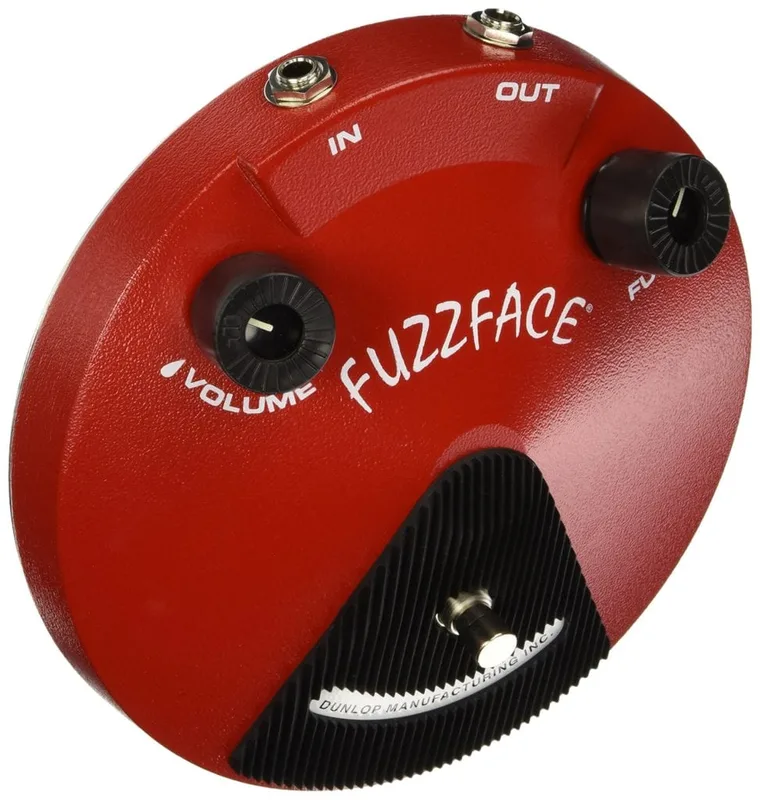
Compared with its contemporaries, the Fuzzrite is sparser than most. The Fuzz Face circuit uses two transistors, four resistors, three capacitors and two controls16, and the Fuzzrite's blend-based Depth control works differently from a Fuzz Face's Fuzz knob, which sets the amount of fuzz directly.
Germanium and silicon versions
From 1966 to 1968, Mosrite produced two distinct fuzz circuits, one outfitted with silicon transistors and the other with germanium components3. The germanium version came first, and the silicon version appeared in the late '60s, replacing it52.
The germanium version
Earlier Fuzzrites were built with a set of 2N2613 and 2N408 germanium transistors2. Travis, who traced an original germanium Fuzzrite for the Guitar FX Layouts site, suggests transistor gains of roughly 100 to 150 for the first transistor and 40 to 60 for the second17. He described the sound of his original pedal, quoting builder Don Baker: "it has a big, fat, musical sound at some of the lowest gain and lower volume settings. And of course it rips at full gain"17.
The germanium version went through several construction phases, documented by the Fuzzboxes history site2:
| Version | Period | Construction | Notable details |
|---|---|---|---|
| Perf board | c. 1966 | Point-to-point on perforated circuit board | Cornell Dubilier 100nF input, output and coupling capacitors2 |
| Phenolic board ("reversed") | 1966 | Parts facing inwards on phenolic board | Red molded 100nF capacitors; statistically the most common germanium version; pot date codes from weeks 15 to 47 of 19662 |
| Eyelet board | c. 1967 to 1968 | Assembled on a smaller eyelet board | 50nF ceramic capacitors for the remainder of the germanium run2 |
Ed Sanner estimated that around 250 germanium models were produced between 1966 and 1968, which makes the germanium Fuzzrite by far the rarer of the two circuits34. Premier Guitar reported the same figure, with "original designer and Mosrite employee Ed Sanner estimating that around 250 ever made it out the door"11.
The silicon version
In 1968 the germanium-transistor Fuzzrite was discontinued and replaced with a silicon-transistor version of the same circuit2. Aion FX, whose Orpheus projects document both circuits, notes that "the silicon version seems to have been much more widespread"12. In that final year of production, Mosrite shifted exclusively to silicon parts7. One 1968 variant was built by a combination of Mosrite and Sprague, with the circuits encased in orange Sprague "modules"; date codes show Sprague supplied them from July 1968 to at least October 19682.
Even among Fuzzrite fans, divisions over the merits of germanium and silicon versions persist5.
The Fuzzrite's afterlife: Guild, Foxey Lady and the Axis
The silicon Fuzzrite's circuit outlived Mosrite itself through OEM deals. Aion FX notes the silicon version "was whitelabeled or cloned as the Orpheum Fuzz, Guild Foxey Lady, and Electro-Harmonix Axis Fuzz"12.
Out of Mosrite's bankruptcy sprang Sierra Electronics, a partnership that released the Nu Fuzz, designed by Ed Sanner; the Nu Fuzz featured a tone filter control instead of the Depth control2.
Pedals based on the Fuzzrite
Because original Fuzzrites are rare, the circuit survives mainly through recreations and adaptations. Delicious Audio ranks the Mosrite Fuzzrite among the "second" most popular historical fuzzes, after the holy trinity of Tone Bender, Fuzz Face and Big Muff, which explains the number of builders who have taken it on7.
| Pedal | Maker | Basis |
|---|---|---|
| Fuzzrite | Catalinbread | The late-1960s silicon version18 |
| Fuzzrite Germanium | Catalinbread | The early germanium version, voiced after an original unit7 |
| Merkin Fuzz | Catalinbread (2010) | Adaptation of the silicon Fuzzrite19 |
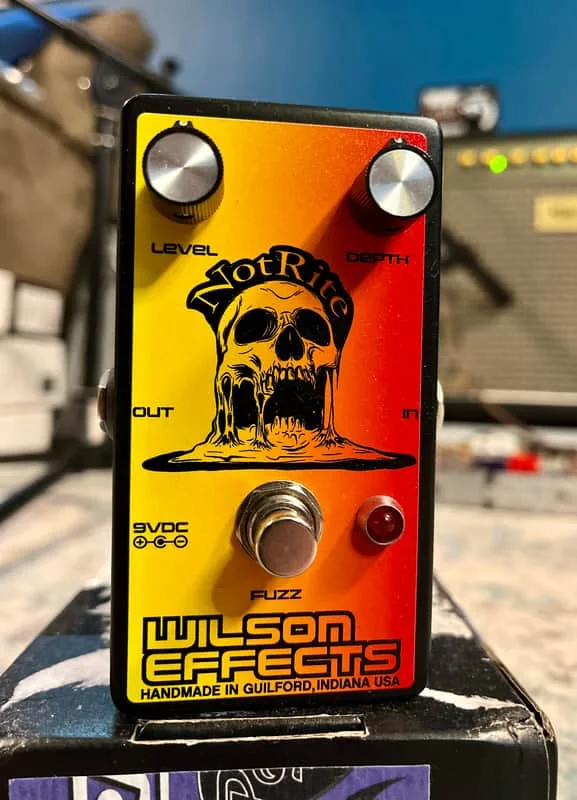
| NotRite | Wilson Effects | Originally based on the silicon FuzzRite; the current pedal is not a FuzzRite or Germanium Fuzzrite20 |
| Foxrite MKII | Fredric Effects | A modernised version of the late 60s silicon Mosrite Fuzzrite21 |
| Bluebird | Hudson Electronics | A hand-crafted recreation of the all-germanium Fuzzrite22 |
| F-1 Dual Germanium | Echopark | Based on the rare Mosrite Fuzzrite pedal23 |
| Starboard Fuzz | PedalPCB | A DIY build documented as comparable to the Mosrite FUZZrite24 |
| Fuzzrite Replica | General Guitar Gadgets | A replica of the Mosrite Fuzzrite25 |
| Orpheus Germanium / Silicon Fuzz | Aion FX | DIY projects based on the original and silicon versions121 |
Catalinbread's Germanium Fuzzrite, released in 2022, features two NOS PNP germanium semiconductors, like Mosrite's original germanium Fuzzrite4. Its M/V toggle's Modern position restores low end the original circuit cuts15. Wilson Effects' Kevin is candid about how far his pedal has drifted: "So originally the NotRight was based on the Silicon version of the FuzzRite pedal," while the current version is its own circuit, with a Depth knob he describes as "actually an intensity knob but hey depth also works right?"20.
For DIY builders, Travis's vero layout for the germanium Fuzzrite matches his original pedal's component values, with an added voltage inverter for easy daisy chaining; he specifies a nominally 350k reverse depth pot (a C500K pot with a 1M2 resistor between lugs 1 and 3 can be substituted) and a 500K volume pot17. One quirk he found in his own pedal: a 25uF cap soldered from one ground pad to another, doing nothing in the circuit17.
Who played one
The Fuzzrite's best-known user is Davie Allan, whose fuzz-era "hairy tones," in Dan Epstein's telling for EarthQuaker Devices, came from a Mosrite Fuzzrite26. General Guitar Gadgets' product page reports that the Fuzzrite was used by Eric Brann of Iron Butterfly on the classic song "In-A-Gadda-Da Vida"25; the claim is reported rather than confirmed.
Pedals on this page
News
Questions
Who designed the Mosrite Fuzzrite?
Ed Sanner, a Mosrite employee, designed the Fuzzrite in Bakersfield, California. Mosrite brought it to market in 1966 and built it through 1968, after which the company went bankrupt. Sanner later designed the Nu Fuzz for Sierra Electronics, the partnership that sprang out of Mosrite's bankruptcy.
Was In-A-Gadda-Da-Vida recorded with a Fuzzrite?
It is reported that Eric Brann of Iron Butterfly used the Fuzzrite on the classic song In-A-Gadda-Da-Vida. The claim comes from replica-maker General Guitar Gadgets' product page rather than from a first-hand account, so treat it as reported rather than confirmed.
What does the Depth knob do on a Fuzzrite?
The circuit has two separate gain stages, and the Depth knob is a mix control between them. At one end you hear only the first stage; as you turn it up, the second stage blends in, thickening the fuzz. You never hear the second stage by itself, and low settings give a sputtery, gated fuzz character.
How many germanium Fuzzrites were made?
Original designer and Mosrite employee Ed Sanner estimated that only about 250 germanium Fuzzrites were ever made, produced between 1966 and 1968. That makes the germanium version by far the rarer of the two circuits, since the silicon version that replaced it was much more widespread.
What is the Guild Foxey Lady's link to the Fuzzrite?
Mosrite supplied its silicon-transistor Fuzzrite to Guild as an OEM product, sold as the Guild Foxey Lady. Earlier two-knob Foxey Lady pedals made by Mosrite around 1967 used the same FUZZ-rite circuit with germanium transistors. After Mosrite went bankrupt, Guild contracted Mike Matthews, and later Electro-Harmonix built a silicon version.
What transistors are in a germanium Fuzzrite?
Earlier germanium Fuzzrites were built with a set of 2N2613 and 2N408 germanium transistors, both PNP types. Builders tracing the circuit suggest gains around 100 to 150 for the first transistor and 40 to 60 for the second. Catalinbread's recreation uses two NOS PNP germanium semiconductors.
Sources (26)
- Orpheus Germanium Fuzz / Mosrite Fuzzrite, Aion FX, 2024-07-04
- Mosrite Fuzzrite: A detailed history • Fuzzboxes, Fuzzboxes (fuzzboxes.org), 2023-07-20
- Catalinbread Fuzzrite Germanium: Rare '60s fuzz recreated, gearnews.com, 2022-08-11
- Catalinbread's all-new Fuzzrite Germanium recreates a highly sought-after Mosrite classic, Guitar World, 2022-08-11
- Catalinbread Fuzzrite Review, Premier Guitar, 2015-10-08
- Seminal, Vintage Pedals: The Rosac Nu Fuzz (from Gearphoria), Delicious Audio, 2017-05-24
- Catalinbread Germanium Fuzzrite, Delicious Audio, 2022-09-13
- Custom shop releases 60's Mosrite Fuzzrite recreation!, robertkeeley.com, 2012-01-25
- Fuzzrite, Catalinbread Effects
- Best Fuzzrite Clones And Evolutions In 2023, Delicious Audio, 2022-08-10
- Catalinbread Releases the Fuzzrite Germanium, Premier Guitar, 2022-08-11
- Orpheus Silicon Fuzz / Mosrite Fuzzrite, Aion FX, 2024-07-04
- The 3 Best Fuzz Pedals Per Type, In 2023, Delicious Audio, 2022-09-15
- Fuzzrite Germanium, Catalinbread Effects
- Fuzzrite Germanium (White), Catalinbread Effects
- Vintage, Influential Circuits: The Arbiter Fuzz Face by Gearphoria, Delicious Audio, 2017-08-01
- Guitar FX Layouts: Mosrite Fuzzrite germanium, Guitar FX Layouts (tagboardeffects.blogspot.com), 2023-03-29
- The 5 Most Pupular Fuzz Pedals Of All Time: Compare Five Classic Circuits, Delicious Audio, 2020-08-06
- Merkin by Catalinbread, RockBoard PedalPedia, 2026
- Not the NotRite, Wilson Effects
- Foxrite 60s Silicon Fuzz, Fredric Effects
- BLUEBIRD, Hudson Electronics UK
- Review: Echopark Guitars Soapbox and F-1 Dual Germanium Pedals, Guitar World, 2016-07-08
- Starboard Fuzz, PedalPCB.com
- Mosrite™ Fuzzrite™ Clone: DIY Fuzz Kit & Schematic, General Guitar Gadgets, 2014-05-14
- Six Songs You Can Use Zoar to Emulate, EarthQuaker Devices, 2023-12-07