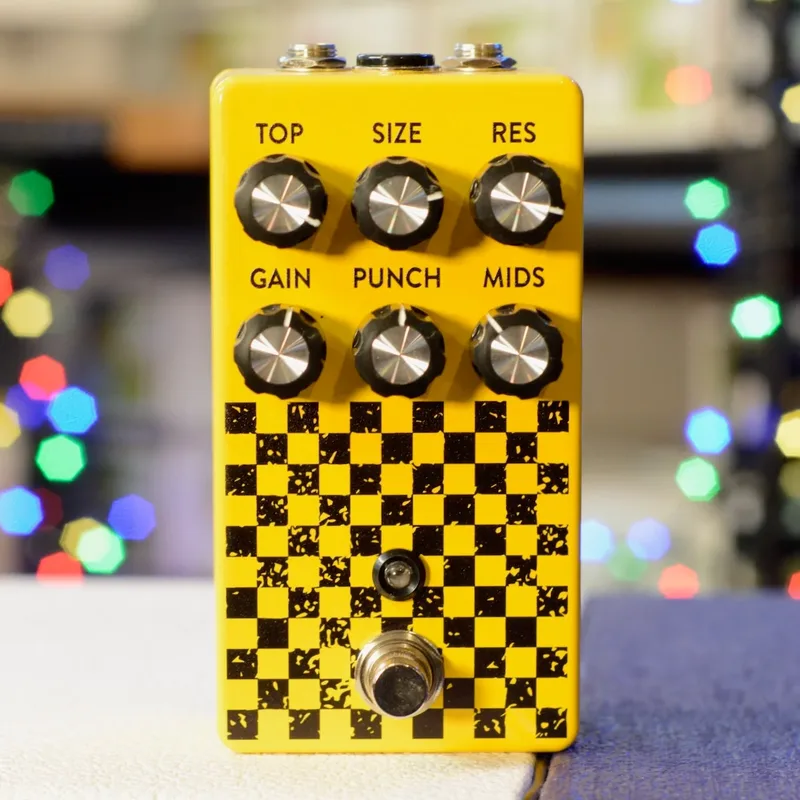
The GUP Tech Taxi Cab is a cab simulation pedal: it takes a pedalboard tone and shapes it into what GUP Tech calls a complete "Micked Cab Tone", the sound of a guitar cabinet as captured by a microphone. The maker also positions it as a second tool, saying "You can also use it as an EQ or preamp to twist your tone with more intuitive controls than a traditional band-EQ." That puts it in the same family as other speaker simulation pedals and preamp pedals, but with a simpler control set than a multi-band equalization pedal.1
What it does
A cab sim sits at the end of a chain and does the job a speaker cabinet does in a traditional rig: it rolls off the harsh top end and shapes the response so an amp-less or modeler-based setup still sounds like a miked guitar cab. GUP Tech describes the Taxi Cab's job as bringing "any pedalboard tone to a complete 'Micked Cab Tone'". For a player running pedals straight into an interface, a power amp or a modeler's return, that means the cab voicing is handled by the pedal rather than by a speaker.1
The same circuit can also serve as a tone shaper. The Top knob goes from Dark to Hi-fi level of Treble, so it can darken or brighten a signal rather than only cutting level. GUP Tech is clear about one limit: this is not an attenuator, its use is to simulate a cab on Line/Instrument level only, and it cannot be plugged between an amp and a speaker.1
Controls
The Taxi Cab keeps things simple. GUP Tech describes one control this way:
"Top knob goes from Dark to Hi-fi level of Treble."1
So the Top knob sweeps the treble content of the simulated cab from a dark, rolled-off voicing up to a hi-fi level of treble, letting the player dial in how bright the miked-cab sound sits in the chain.1
Power and use
The Taxi Cab runs on a 9Vdc center negative supply and draws 13mA, figures that fit a standard pedalboard supply.1
GUP Tech is explicit about what the Taxi Cab is not: "This is NOT an attenuator, its use is to simulate a cab on a Line/Instrument Level only. You cannot plug this pedal betw"1 In other words, it works at line or instrument level and must never be placed between an amplifier's output and a speaker. An attenuator is a device that handles amp-level signal and dumps power as heat; the Taxi Cab is not built for that, and connecting it that way is outside its intended use.1
Where it is made and what it costs
GUP Tech builds the Taxi Cab in-house: "All of our pedals are made by us in Saguenay, Québec, Canada", according to the maker's product page. The pedal comes in a yellow enclosure and was listed at £71.00 GBP on the maker's page as stated there on 26 October 2026.1
Questions
Can the GUP Tech Taxi Cab go between an amp and a speaker?
No. GUP Tech states plainly that the Taxi Cab is not an attenuator and is meant to simulate a cabinet at line or instrument level only. The pedal must never be plugged between an amplifier's output and a speaker, as that use is outside what it is built for. Keep it on a pedalboard or in a recording chain instead.
Does the Taxi Cab need a battery or a power supply?
The Taxi Cab runs on a 9Vdc center negative power supply and draws 13mA, according to GUP Tech's product page. The page does not list a battery option, so plan on using a standard 9V pedal supply with center negative polarity.
Is the Taxi Cab an attenuator?
No. GUP Tech is explicit that the Taxi Cab is not an attenuator. Its purpose is to simulate a guitar cabinet at line or instrument level, for example feeding a power amp, a recording interface or a modeler. It cannot be connected between an amp head and a speaker cabinet.
Where is the GUP Tech Taxi Cab made?
GUP Tech builds the Taxi Cab in Saguenay, Québec, Canada. The maker states that all of its pedals are made by the company there, so the Taxi Cab is a Canadian-built pedal rather than an imported mass-produced unit.
Sources (1)
- Taxi Cab (Cab Sim), GUP Tech (guptech.ca)