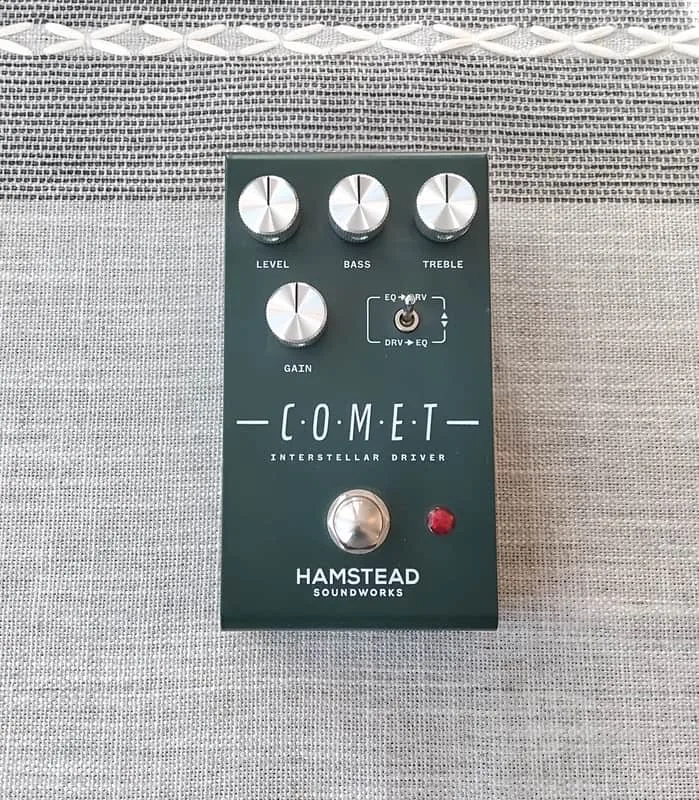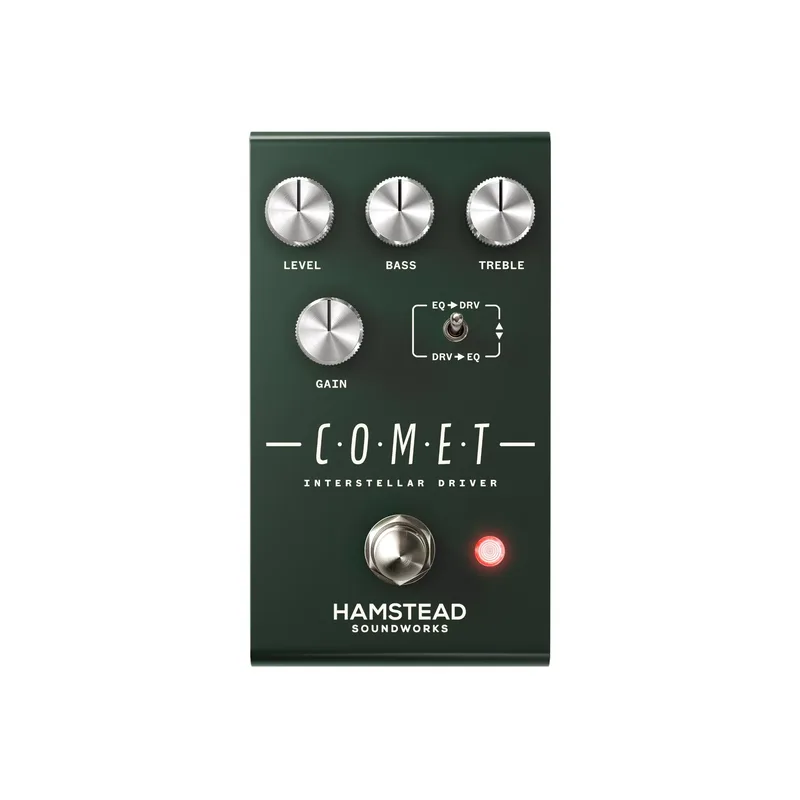


The Hamstead Soundworks Comet, also sold as the Comet Interstellar Driver, is an all-analog overdrive pedal designed by Peter Hamstead and built in Great Britain1. Hamstead describes it as a meticulously voiced overdrive that "opens up a whole world of tones from a simple control set," and says it "can be moulded from boutique sounding overdrive with a vocal midrange, right through to a rich and creamy fuzz"1. What sets it apart from most drives is a front-panel switch that flips the order of its EQ and drive circuits, which also changes the clipping type and gain structure1.
From vocal overdrive to creamy fuzz
The Comet's gain range is wide for a pedal with a simple control set. Guitar World's reviewer, Trevor Curwen, called it "a naturally dynamic drive with a gain range running from a cleanish boost right through to an amp with the valves running hot"4. At the extremes it crosses into fuzz territory: MusicRadar found that with the EQ placed before the drive section and the Gain maxed, "there is enough hair on it to be confused with a polite fuzz, a little woolly without altogether losing its composure"3.
How the pedal behaves depends heavily on which of its two signal paths you choose, but in both cases reviewers found the core drive characterful rather than flat. MusicRadar's review team summed up its reasons to buy as "two driving voicings and a lot of gain to play with," with the Bass and Treble controls offering "lots of tone-sculpting power"3.
Two paths: DRV>EQ and EQ>DRV
The Comet's defining feature is its EQ/Drive order switch, labeled DRV>EQ and EQ>DRV. Hamstead says that selecting one or the other "not only change[s] the order of the Drive and EQ circuits, but also the type of clipping and gain structure"1. Guitar World's reviewer noted the same thing: "it's not quite that simple," because the switch position also changes the clipping and gain structure circuitry4.
| Switch position | What it does | Character |
|---|---|---|
| DRV>EQ | EQ placed after the drive circuit; dynamic, transparent clipping | "Studio style EQ sculpting" of the driven tone1 |
| EQ>DRV | EQ placed before the drive circuit; raw, organic clipping with boosted input gain | "Character drive tones up to super-saturated fuzz tones"1 |
In practice, the two paths sound noticeably different. Guitar World found that "Drive before EQ offers a more open and transparent sound, while EQ before Drive gives you something gainier and denser in the midrange"4. MusicRadar agreed: with the EQ flat in the drive-first path, the Comet is "transparent as advertised," while running the EQ into the drive section gives "more aggressively shaped sounds"3.
Guitar.com's coverage framed the choice as a working tool: the DRV>EQ mode "is for when you need more precise, studio-like tone-sculpting, with a more dynamic and transparent character to the clipping," with the EQ after the clipping able to tame distorted high end and tighten loose low end2. Gearnews reported the same two positions, noting the drive-first setting gives a transparent clipping circuit with the EQ after the drive5.
Internal Hi Gain switch and Hi Cut trim
Two further adjustments live inside the enclosure:
- Hi Gain Mode: an internal switch that, in Hamstead's words, "can open up heavy crunch and distortion or even highly saturated fuzz tones"1. MusicRadar notes the Comet "is set at lo-gain when it leaves the shop floor," so players who want the extra saturation have to open the enclosure to flip it3. Guitar World found that Hi Gain mode "shifts everything up a gear and yields an increased level of saturation"4.
- Hi Cut pot: an internal trimmer for a global high-cut. Hamstead says that with it "you can tailor the high frequencies to suit any rig or tonal preference"1. Gearnews suggests adjusting it "to tailor the high frequencies of the Comet to fit in with your guitar or bass setup"5.
Both internal controls require opening the pedal's enclosure to adjust, and the Hi Gain switch ships in the lo-gain position3. If a Comet sounds tamer than expected out of the box, that is the factory setting, not a fault.
Controls, switching and power
The control set is deliberately small: Gain and Level knobs, Bass and Treble EQ controls, and the two-way DRV>EQ / EQ>DRV switch on the face of the pedal5. Connections are a standard input and standard output4.
The Comet uses buffered bypass rather than true bypass, with silent optical switching built on The GigRig's OptoKick footswitch, which Hamstead chose "for excellent reliability"13. Power comes from a 9V to 12V DC adapter only, center negative, drawing 65mA; no adapter is supplied143.
The Comet is DC only with a center negative plug, and its 65mA draw means it should be run from a proper power supply rather than assumed to share a battery-style supply1.
Where it came from and what it costs
As of October 2026, Hamstead lists the Comet at $295 USD for the US and worldwide through Reverb.com, with a UK price of £220 and a UK sale price of £155.83 (original £183.33)1.
Videos
Mike Hermans
Eirik Stordrange
Guitarist
Questions
Is the Hamstead Comet true bypass?
No. The Comet uses buffered bypass with silent optical switching, built around The GigRig's OptoKick footswitch, which Hamstead chose for reliability. It is not a true bypass pedal, so it will always present a buffered signal path when bypassed on your board.
Where is the Hamstead Comet made?
The Comet is designed and built in Great Britain. The all-analogue circuit was designed by Peter Hamstead, who also designed the company's earlier Odyssey and Subspace drive pedals. Guitar World lists the pedal's origin as the UK.
What warranty does Hamstead Soundworks give on the Comet?
Hamstead Soundworks covers the Comet with a 5 Year Limited Warranty. The company lists this warranty on the Comet's product page alongside the pedal's specifications, so coverage applies from the maker rather than a retailer.
Sources (5)
- Comet | Hamstead Soundworks, Hamstead Soundworks
- Hamstead Soundworks launches the Comet Interstellar Driver, a stompbox that ranges from creamy drive to thick fuzz, Guitar.com, 2021-06-10
- Hamstead Soundworks Comet Interstellar Driver review, MusicRadar, 2022-03-04
- Hamstead Soundworks Comet Interstellar Driver review, Guitar World, 2021-12-07
- The Hamstead Comet Interstellar Driver is both a preamp and an all-out fuzz in one pedal, gearnews.com, 2021-06-10