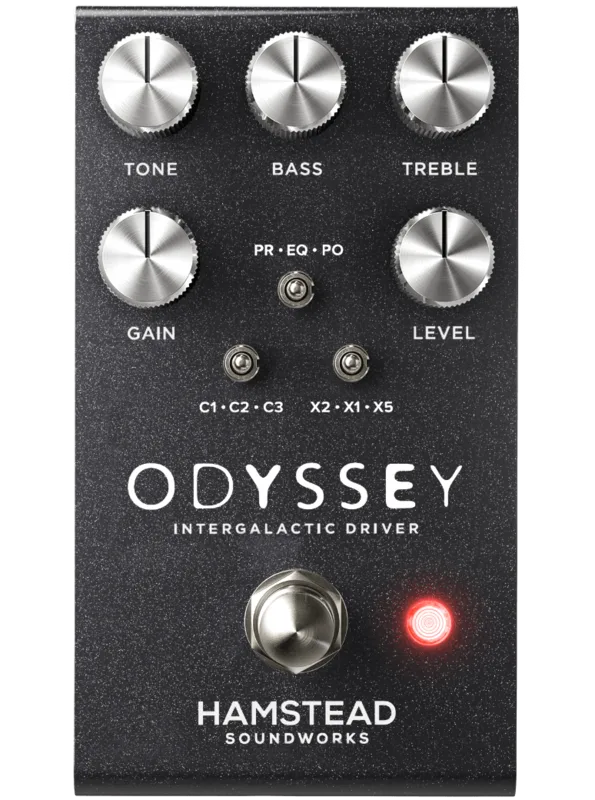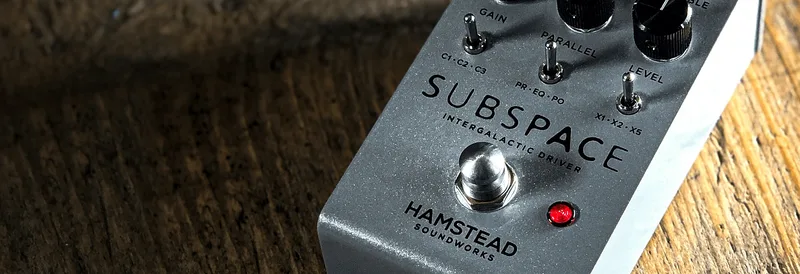


The Hamstead Soundworks Subspace Intergalactic Driver is a drive pedal from UK maker Hamstead Soundworks, available now for $3191. It is built on the all-analog circuitry of the company's Odyssey Intergalactic Driver, re-voiced with more focus on midrange and low-end frequencies1. Its parallel blend control works as a volume control for your unprocessed signal, so clean and driven levels can be balanced against each other2.
For a player, that means one box that can cover low-gain bluesy drive, more saturated tones, fuzz-adjacent sounds and a clean boost, with an EQ section flexible enough to shape the dirt before or after it is generated23.
Clipping, input gain and EQ placement switches
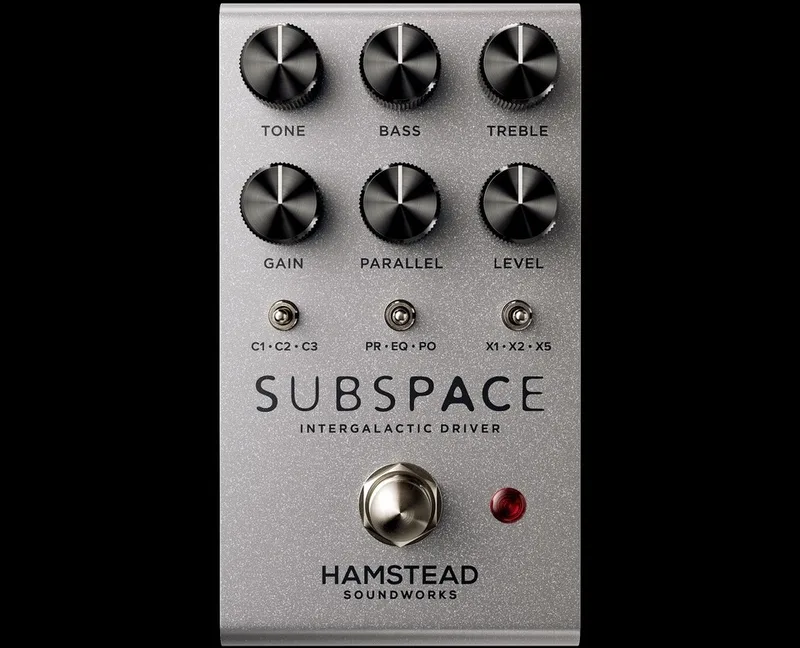
The Subspace's front panel carries Tone, Bass, Treble, Gain, Parallel and Level knobs, plus a bypass footswitch and three mini toggle switches: an EQ pre/post switch, a three-way Clipping switch (C1/C2/C3) and an Input Gain switch (X2/X1/X5), with an Input Pad switch on the rear and an internal dip-switch for power-up mode21.
The three-way clipping switch defines the basic character of the dirt and works together with the Gain and Tone controls3. MusicRadar breaks down what each position does:
| Clipping position | Behavior |
|---|---|
| C1 | Symmetrical clipping for classic drives2 |
| C2 | Asymmetrical, affecting only half of the signal; good for low-gain bluesy drives, adding definition to saturated tones, and fun fuzz tones2 |
| C3 | Multiple clipping circuits1 |
The Input Gain switch offers three settings with increasing amounts of input gain, up to five-fold3. The rear pad switch cuts input gain by -10dB, which MusicRadar calls useful with a high-level instrument such as an active bass2.
The Treble and Bass controls each offer 18dB of cut or boost and can be placed either before or after the drive circuit3. That placement choice is the pedal's other big tonal lever: MusicRadar describes it as offering the choice between amp-like drive and what Hamstead calls "studio-style EQ control"2.
"The ability to place this before or after the drive circuit offers the choice between amp-like drive and what Hamstead describes as 'studio-style EQ control'."
Parallel blend and clean boost
The Parallel knob is a blend control that works as a volume control for your unprocessed signal2. Combined with the re-tooled low-end response, it lets a bass player keep clean low frequencies under the driven sound, and it gives a guitarist the same clean/dirty mixing option.
There is also a Clean Boost setting that bypasses the drive circuitry, leaving only the EQ, input gain level and volume knob in the path3. MusicRadar measured the headroom there as considerable:
"It bypasses the pedal's tone, gain and clipping controls and can dial in a hefty amount of transparent boost. There's +38dB to play with."
How it differs from the Odyssey
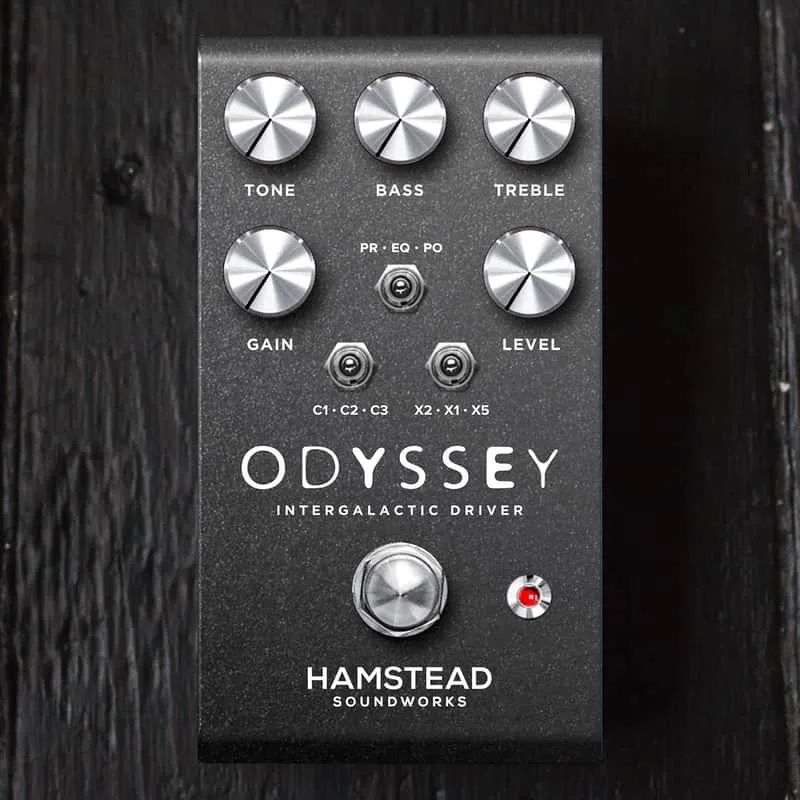
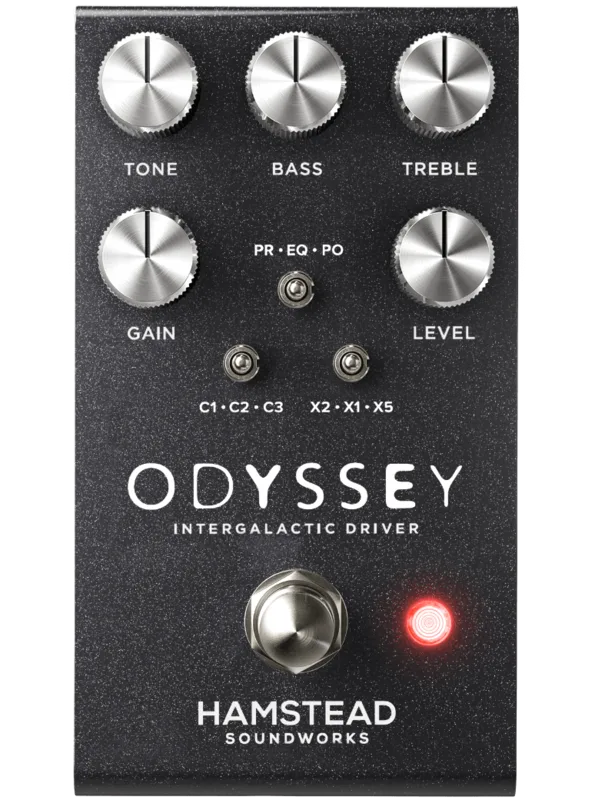
The Odyssey came first, and the Subspace is based on its all-analog circuitry, re-voiced with more focus on midrange and low-end frequencies1. That re-voicing is the core difference between the two pedals: same circuit family, different frequency emphasis. The Subspace adds a parallel blend control that works as a volume control for the unprocessed signal2, and it carries over the OptoKick footswitch and buffered bypass2.
In practice, the Odyssey is the guitar-focused do-it-all drive and the Subspace is the low-end-focused sibling, though nothing stops a guitarist from using the Subspace for its fuller low-mid voicing214.
What reviewers said
MusicRadar's review concluded that the range on offer covers a lot of ground2:
"Offering a huge range of drive tones, a clean boost and blend controls, the Subspace is quite possibly the only drive pedal you'd ever need."
Guitar World's review, priced at £249 in its listing, highlighted the same flexibility from the control set: the three-way clipping switch, the up to five-fold input gain options and the 18dB two-band EQ with pre/post placement3.
Videos
Nate Navarro
Guitarist
Do Noise
Questions
What is the difference between the Hamstead Subspace and the Odyssey?
The Subspace uses the same all-analog circuit as the Odyssey Intergalactic Driver but is re-voiced with more focus on midrange and low-end frequencies, and it adds a parallel blend knob for mixing clean and driven signals14. MusicRadar describes it as occupying the same do-it-all drive pedal role on a pedalboard, with a re-tooled low-end response that keeps bass-heavy frequencies in the mix2.
Does the Hamstead Subspace work with bass guitar?
Yes. Guitar Pedal X describes the Subspace as designed for bass around the same circuit as the Odyssey, with the addition of a blend knob4, and MusicRadar notes a re-tooled low-end response to keep bass-heavier frequencies in the mix2. The rear pad switch, which cuts input gain by -10dB, is described as useful with a high-level instrument such as an active bass2.
Is the Hamstead Subspace true bypass?
No. The Subspace uses a buffered bypass, paired with Hamstead's OptoKick optical footswitch2. The same buffered bypass arrangement is listed for the Odyssey in Guitar World's overdrive pedal buying guide5.
Does the Subspace have a clean boost mode?
Yes. A Clean Boost setting bypasses the drive circuitry entirely, so you are using only the EQ, the input gain level and the volume knob3. MusicRadar reports it bypasses the tone, gain and clipping controls and offers +38dB of transparent boost2.
Sources (5)
- NAMM 2020: Explore the cosmos with Hamstead Soundworks' Subspace Intergalactic Driver, Guitar World, 2020-01-07
- Hamstead Soundworks Subspace Intergalactic Driver review, MusicRadar, 2020-05-01
- Hamstead Soundworks Subspace Intergalactic Driver review, Guitar World, 2020-07-10
- Guitar Pedal X, Guitar Pedal X, 2020-03-29
- Best overdrive pedals 2026: mid-hump to transparent tone, Guitar World, 2022-06-07