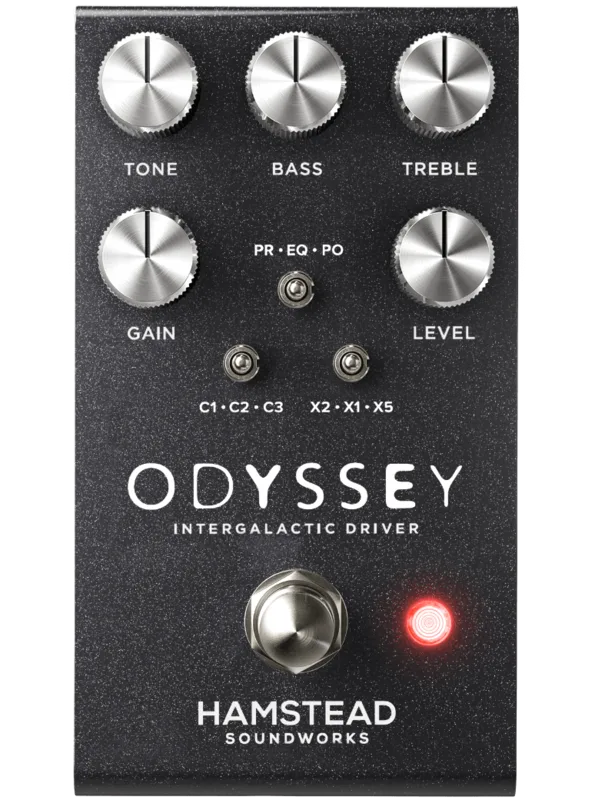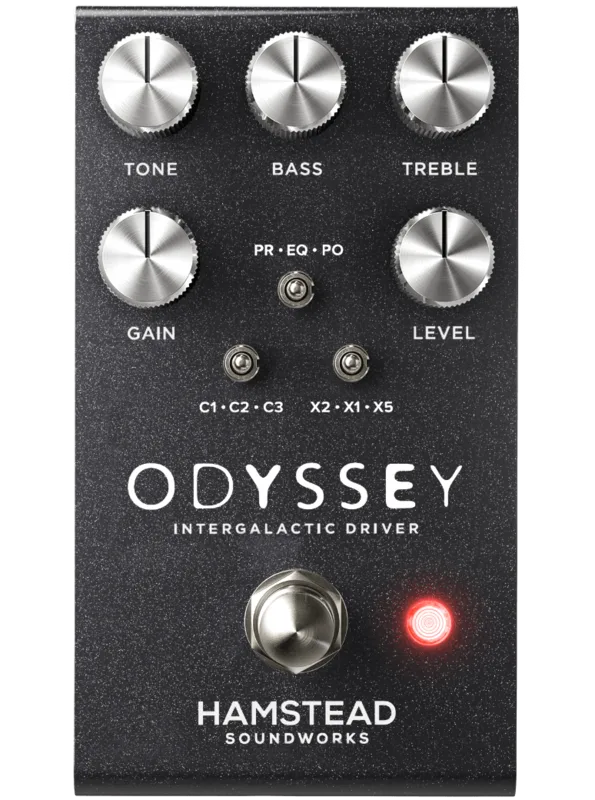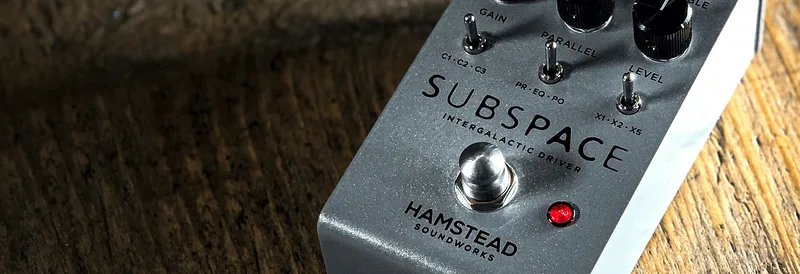


The Hamstead Soundworks Subspace is an all-analog drive pedal designed and built in Great Britain by Peter Hamstead. It takes the circuit of Hamstead's Odyssey drive pedal and re-voices it for low frequencies, adding a Parallel Dry control that blends your clean signal back in with the driven one1. Like the Odyssey, it is a do-it-all gain pedal: Hamstead says it takes you from clean boost with tone shaping, through warm vintage valve style overdrive and defined high gain distortion, all the way to glitchy oversaturated fuzz1.
The Subspace was launched in 2019 as an evolution of the Odyssey, and it occupies the same role on a pedalboard: one drive pedal that can cover many gain jobs2. Delicious Audio described it as "optimized for low frequencies (still within the guitar realm, shining on baritone guitar, but it works well with bass)"3.
An Odyssey re-voiced for low end, with a parallel dry blend
The Subspace is essentially the Odyssey circuit with two changes: a specially enhanced low end response, and a Parallel Dry Function that the Odyssey does not have2. MusicRadar's review put it this way:
"The Subspace will occupy a same role on your pedalboard, i.e. a do-it-all drive pedal, but comes with a re-tooled low-end response to keep those bass-heavier frequencies in the mix, and it comes with a parallel blend control for dialing in a mix of your overdriven and clean signals"4
The Parallel knob is the heart of the difference. It works as a volume control for your unprocessed signal, so you can keep clean low end under driven mids, which is what makes the pedal useful for bass and baritone guitar4. The control is unity at noon and can provide a 2x boost at maximum2. Delicious Audio described it as acting "as a Mix control to reintegrate some of the clean signal"3.
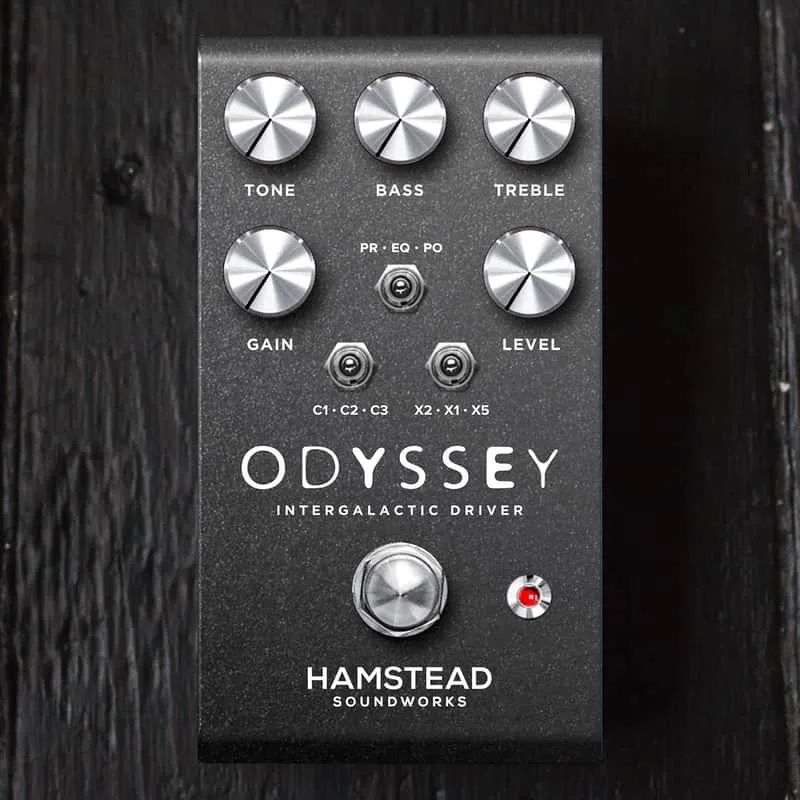
The Odyssey itself covers a similar gain range, from clean boost with tone shaping through classic rock and heavy metal to oversaturated fuzz1, so the Subspace is best understood as that same pedal aimed at players who need the low end to survive the drive.
The controls
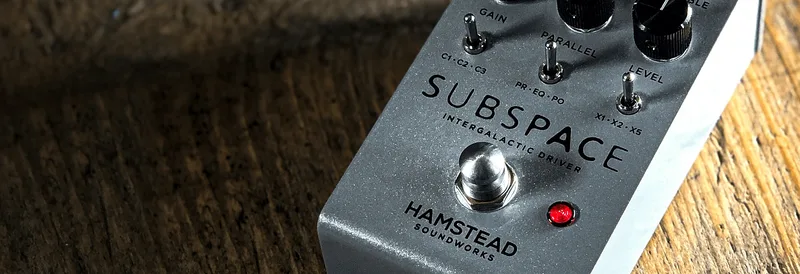
The Subspace carries six knobs and three three-way toggle switches3.
| Control | What it does |
|---|---|
| Gain | Sets the amount of drive |
| Level | Sets the output volume |
| Tone | A low pass filter controlling the high frequencies in the drive circuit, usable with Treble to fine-tune the high end5 |
| Bass | Bass boost and cut, +/-18dB1 |
| Treble | Treble boost and cut, +/-18dB1 |
| Parallel | Volume control for the unprocessed signal; unity at noon, 2x boost at max24 |
| Clipping switch (C1/C2/C3) | Selects between three clipping circuits1 |
| EQ switch (PR/EQ/PO) | Places the EQ before or after the drive circuit2 |
| Gain Multiplier switch (x1/x2/x5) | Input gain multiplier, offering total control of the guitar's input36 |
There is also a -10dB input gain switch for padding down hot inputs1, and an internal dip-switch for power up mode4. Bypass is handled by the optical OptoKick footswitch from TheGigRig, which Hamstead fits for silent and reliable switching1.
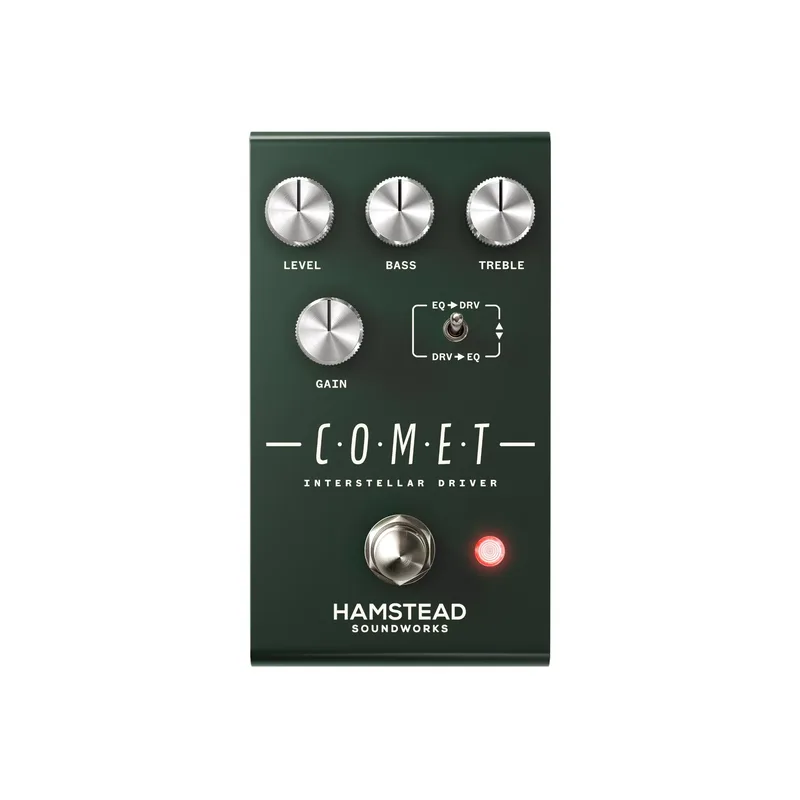
There is no mids control. MusicRadar notes that if you set the EQ to arrive before the drive circuit, the bass and treble controls can be used to enhance the midrange instead4.
The EQ pre/post switch is worth understanding before you dial anything else in. In Post mode the EQ works as studio-style tone sculpting after the drive circuit; in Pre mode it can drastically alter the response and character of the breakup5.
The three clipping modes
The clipping switch selects between three clipping circuits1, which Guitar World described as "symmetrical, asymmetrical and multiple clipping circuits - giving the user everything from heavily processed to fully transparent drive sounds"6.
- C1: symmetrical clipping, for classic drive sounds47
- C2: asymmetrical, affecting only half of your signal. MusicRadar calls it "excellent for low-gain bluesy drives, adding a little definition to more saturated tones and for fun fuzz tones"4
- C3: a multiple clipping circuit, the most heavily processed of the three6
Power: 9V DC, 60mA, center negative
The Subspace runs on 9V DC only, drawing 60mA, with a center negative plug1. Reviews confirm the same figures: Guitar World lists "9V DC adaptor (not supplied) 60mA"8, and MusicRadar the same4.
There is no battery option. The pedal takes 9V DC only, so you need a pedalboard power supply or a 9V adapter with a center negative barrel.
For comparison, the Odyssey up to serial number 680 ran on 9V DC center negative at 55mA9, so the Subspace draws slightly more current.
The Subspace GE limited edition
In 2022 Hamstead released the Subspace GE Edition, a limited run of only 25 pedals52. It adds a rare Mullard GEX35 germanium clipping diode to the drive circuit, which Guitar Pedal X reported "generates more warmth and dynamics"2. All three clipping modes in the GE use the GEX35 in tandem with other specially selected components5.
The GE also differs visually: its colourway follows the original Odyssey colourway rather than the silver of the standard Subspace2.
Videos
Nate Navarro
Eirik Stordrange
Guitarist
Questions
What is the difference between the Hamstead Subspace and the Odyssey?
The Subspace is a re-voiced version of the Odyssey circuit, optimised for low frequencies, with an added Parallel Dry control that blends your clean signal back in. Both are do-it-all drive pedals covering clean boost to fuzz, but the Subspace keeps bass-heavier frequencies in the mix.
Does the Hamstead Subspace work on bass guitar?
Yes. The Subspace is optimised for low frequencies and works well with bass, and it also shines on baritone guitar. The parallel blend control lets you mix clean low end back in with the driven signal.
Can the Hamstead Subspace run on a battery?
No. The Subspace requires a 9V DC power supply only, drawing 60mA, with a centre negative plug. There is no battery option, so you need a pedalboard power supply or a 9V adapter.
What is the Subspace GE limited edition?
A run of only 25 pedals that adds a rare Mullard GEX35 germanium clipping diode to the drive circuit, which Hamstead says generates more warmth and dynamics. It shipped from 21 July 2022 at £299 and follows the original Odyssey colourway rather than the silver standard version.
What do the three clipping modes on the Subspace do?
C1 offers symmetrical clipping for classic drive sounds. C2 is asymmetrical, affecting only half of your signal, which suits low-gain bluesy drives and fuzz tones. C3 is a multiple clipping circuit, giving everything from heavily processed to fully transparent drive sounds.
Sources (9)
- Subspace, Hamstead Soundworks
- Guitar Pedal X, Guitar Pedal X, 2022-07-11
- Hamstead Soundworks Subspace Drive, Delicious Audio, 2021-05-25
- Hamstead Soundworks Subspace Intergalactic Driver review, MusicRadar, 2020-05-01
- Subspace GE, Hamstead Soundworks
- NAMM 2020: Explore the cosmos with Hamstead Soundworks' Subspace Intergalactic Driver, Guitar World, 2020-01-07
- Hamstead Soundworks Odyssey review, MusicRadar, 2018-08-14
- Hamstead Soundworks Subspace Intergalactic Driver review, Guitar World, 2020-07-10
- Odyssey | Hamstead Soundworks, Hamstead Soundworks