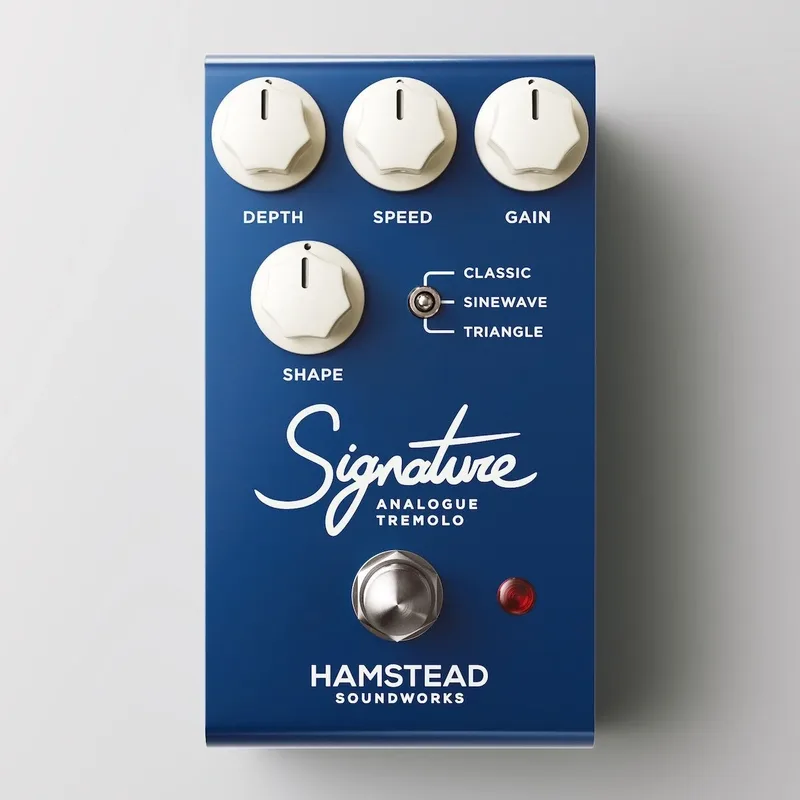


The Hamstead Soundworks Signature Analog Tremolo is an all-analog tremolo pedal that takes the "Sinewave" tremolo circuit from Hamstead's Artist +RT series amplifiers and puts it in a stompbox, adding a clean boost of up to 10dB1. The circuit is an all-analog design by Peter Hamstead, including the waveform creation, where many tremolo pedals generate their waveforms digitally12. Hamstead Soundworks is based in Cambridgeshire, England, and the pedal is designed and built in Great Britain13.
The current version is the MKII, released in 2026, which trims the footprint, adds a third waveform and a Shape control, and drops the original's separate boost footswitch2. The original Signature Tremolo/Boost pedal first appeared in 20162.
What it does: amp-style tremolo with a clean boost
The pedal's core is the Signature "Sinewave" mode, which Hamstead describes as "a true sinusoidal waveform for the cleanest, smoothest and most musical sounding tremolo"1. MusicRadar's reviewer Trevor Curwen called it "Hamstead's own true sine wave tremolo and it sounds gorgeous: smooth in its undulation with plenty of musical" capability4. A second mode, Classic, is an "Output Bias" tremolo that Hamstead says gives "a more vintage feel, replicating the familiar tremolo sounds found in vintage amplifiers and thousands of seminal records from the 1950s to the present day"1. The MKII adds a third waveform, Triangle, which Hamstead says is "far more natural sounding than the angular name suggests"1.
Alongside the tremolo there is a boost. On the original pedal, tremolo and boost each had their own footswitch, so the boost could be used independently4. On the MKII the separate boost footswitch is gone; the Gain knob provides up to 10dB of transparent boost that Hamstead says can accentuate the tremolo or "naturally push the front-end of your amp"2.
"This is one of the best-sounding tremolos we've heard, and having the boost facility reinforces the fact that this is money well spent."
Guitar World's verdict on the MKII was that it is "a solid choice for impeccably built, vintage-inspired tremolo," noting its trio of waveforms and 10dB of boost in a more compact format2. MusicRadar listed "tremolo and boost in one pedal independently switchable; two tremolo types; excellent quality of sound" among its reasons to buy4.
The controls
The MKII carries five knobs, a mode switch and an internal dipswitch2:
| Control | What it does |
|---|---|
| Speed | Sets tremolo speed, from 0.4 to 15Hz; can also be placed under an expression pedal12 |
| Depth | Sets the level of the effect, from subtle modulation through to aggressive side-chain style pumping volume1 |
| Gain | Up to 10dB of transparent boost, to accentuate the tremolo or push an amplifier's front end12 |
| Shape | New for the MKII; tilts any waveform left or right, with no effect at its notched central position12 |
| Modulation Mode switch | Selects the waveform: Classic, Sinewave or Triangle12 |
| Internal Power Up mode dipswitch | Sets the pedal's power-up state2 |
Guitar World found that "from a slow deep throb to a fast shimmer, the Depth and Speed knobs give you a great range"2. The Shape control does different things in different modes: in Triangle mode it creates up and down sawtooth waveforms, and in Classic mode it can accentuate the thump of output bias style tremolo1. Guitar World noted that "the Triangle waveform is capable of sawtooth and reverse sawtooth patterns with the Shape knob in play"2.
Switching is handled by an optical OptoKick footswitch from TheGigRig, which Hamstead fits "for silent and reliable switching"1. As shipped the pedal uses buffered bypass, which Hamstead recommends because it provides silent switching, but an internal DIP switch converts it to true bypass4.
Power and connections
The MKII runs on a 9V to 18V DC adaptor, which is not supplied, drawing 250mA at 9V2. That current draw is high for a tremolo pedal and rules out a battery; it is also worth checking against a small isolated power supply's per-output limit. Connections are a standard input, a standard output and a standard Control input for external speed control via an expression pedal2. Input impedance is 500K Ohms1.
History and versions: from the Artist +RT amps to the MKII
The circuit's lineage goes back to Hamstead's Artist +RT series amplifiers, where the RT denotes reverb and tremolo4. Hamstead Soundworks first put the tremolo circuitry from those amps into a pedal in 2016 with the Signature Analog Tremolo2. The original pedal was an all-analog design by Peter Hamstead, built around the Signature "Sinewave" circuit taken straight from the Artist +RT series amplifiers1.
| Original | MKII | |
|---|---|---|
| Price | £255 on the maker's page1 | £2192 |
| Dimensions | 70w x 130d x 65h mm1 | 70 (w) x 130 (d) x 65 mm2 |
| Footswitch | Optical OptoKick footswitch from TheGigRig1 | OptoKick footswitch2 |
| Shape knob | Not part of the original design | Yes; skews the waveform left or right of its notched center2 |
The MKII also adds buffered bypass and an external speed control input2, and its Triangle waveform is capable of sawtooth and reverse sawtooth patterns with the Shape knob in play2.
Delicious Audio, featuring the MKII, described a pedal with the company's original "Sinewave" circuit, which already existed embedded in the Artist +RT series amplifiers3.
Videos
Eirik Stordrange
HarryAndAGuitar
Do Noise
Questions
Is the Hamstead Signature Analogue Tremolo true bypass?
No, not as it ships. The pedal comes set to buffered bypass, which Hamstead recommends because it gives silent switching, but there is an internal DIP switch that lets you change it to true bypass if you prefer. Switching is handled by an optical OptoKick footswitch from TheGigRig.
Can you control the Hamstead tremolo speed with an expression pedal?
Yes. The MKII has a standard Control input, and the speed can be placed under an expression pedal for changes on the fly. Speed ranges from 0.4 to 15Hz, set either by the Speed knob, an external expression pedal, or a high/low speed switch arrangement.
What is the difference between the original Hamstead Signature Tremolo and the MKII?
The MKII has a smaller footprint, a control input for expression speed control, a third waveform (Triangle) and a Shape control that tilts any waveform left or right. It loses the original's extra footswitch for the boost circuit, so the boost is no longer independently switchable.
Can you use the boost on the Hamstead tremolo without the tremolo on?
On the original Signature Tremolo, yes: it had independent footswitches for tremolo and boost, so the boost could be used on its own. On the MKII the separate boost footswitch is gone, with the Gain knob providing up to 10dB of transparent boost alongside the effect.
Is the Hamstead Signature Tremolo analog?
Yes. It is an all-analogue design, including the waveform creation, where many tremolo pedals use digital waveform circuitry. The core is the Signature Sinewave circuit taken from Hamstead's Artist +RT series amplifiers, designed by Peter Hamstead.
Sources (4)
- Signature Tremolo, Hamstead Soundworks
- Hamstead Soundworks Signature Analogue Tremolo MKII review, Guitar World, 2021-02-10
- Hamstead MKII Signature Analogue Tremolo, Delicious Audio, 2021-04-15
- Hamstead Soundworks Signature Analogue Tremolo review, MusicRadar, 2016-10-13