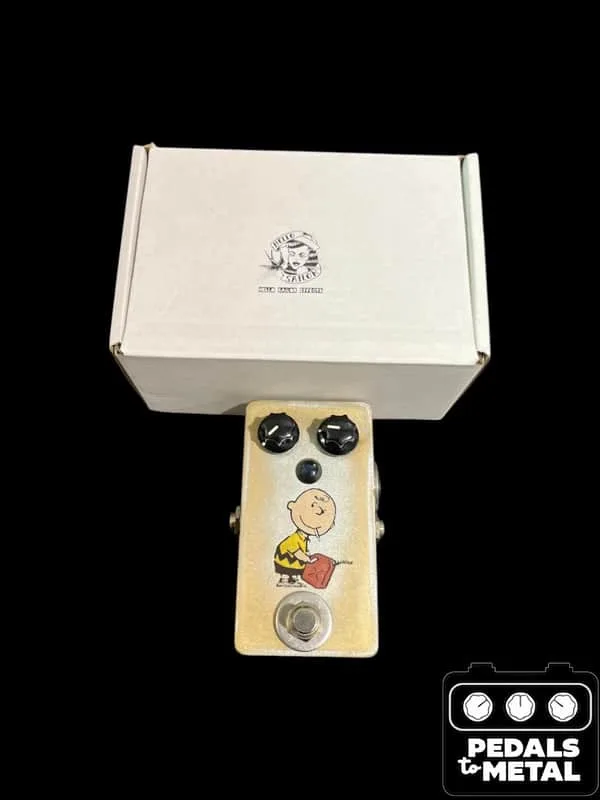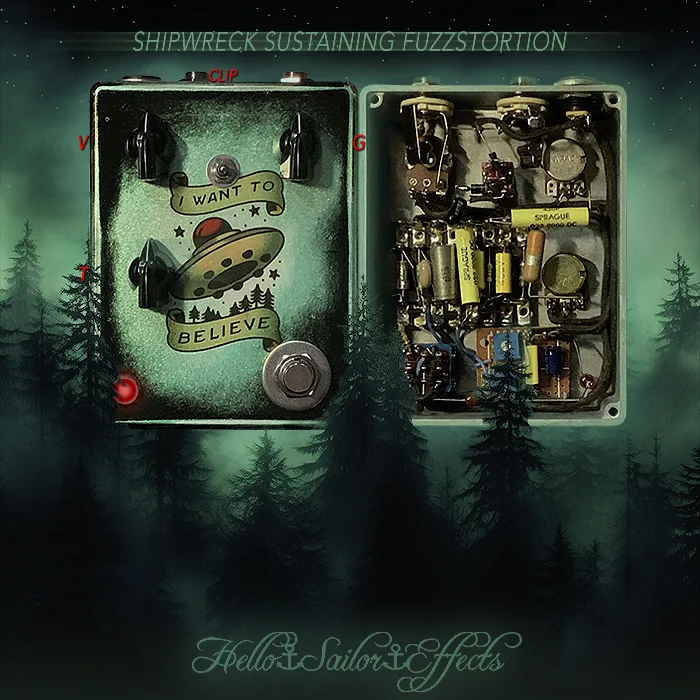
The ShipWreck Fuzzstortion is a hand-built fuzz and distortion pedal from Hello Sailor Effects, the small British builder run by designer Joe Halliday. Launched in March 2024, it is what Guitar Pedal X's Stefan Karlsson calls "a very distinctly Fuzzstortion - or Fuzzy Distortion - being relatively high gain in nature", and elsewhere he described it as "a super-sustaining high gain Fuzz Face based distortion." In his year-end roundup he summed it up as "a beautiful singing sustaining distortion!"12
Inside the circuit
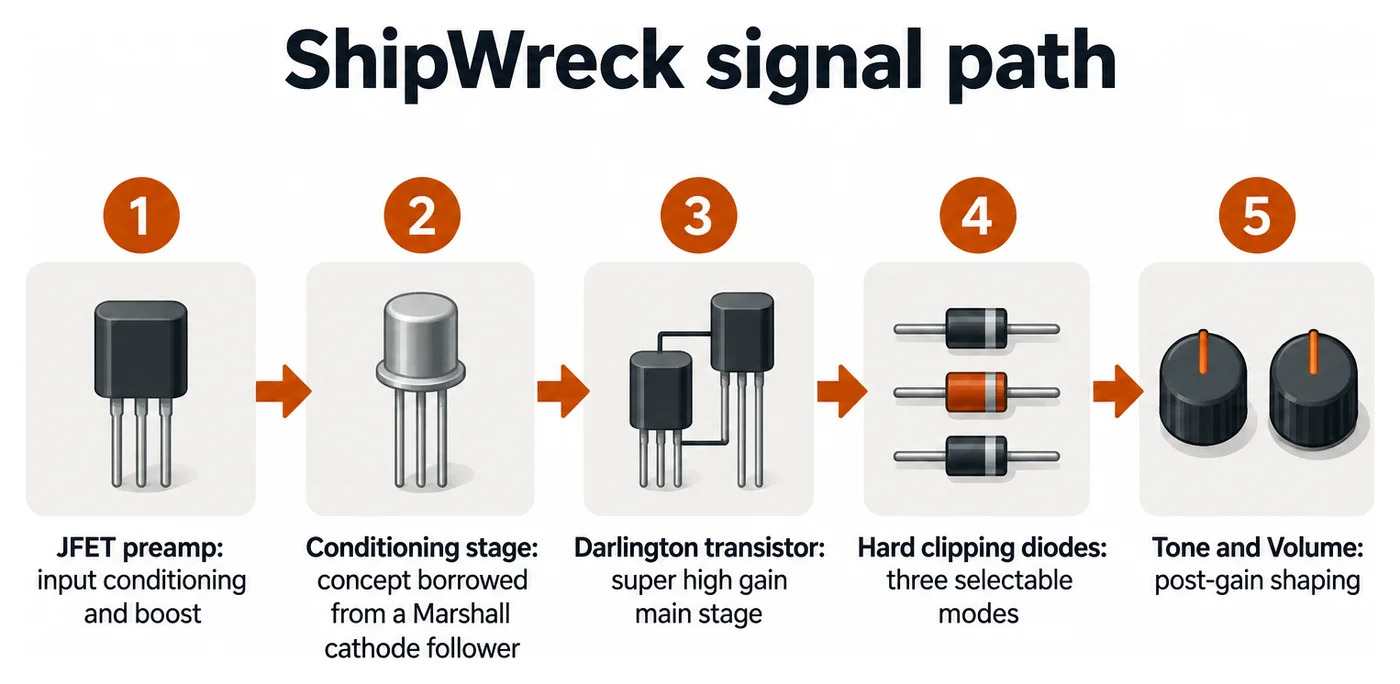
The ShipWreck stacks several stages in series: a JFET preamp, a conditioning stage, a high-gain Darlington transistor feeding a hard-clipping diode stage, and then post-gain tone and master volume controls1. Halliday has said the idea for the conditioning stage came from a Marshall amplifier cathode follower stage, though as he put it, "Obviously the circuit has no relation to it but the concept"1.
The clipping switch is the pedal's main voicing control. In the center position you get silicon asymmetrical clipping, up is silicon/germanium asymmetrical, and down is silicon symmetrical1. Alongside the panel controls there are two internal trim-pots for fine-tuning the voltage bias on the two main gain stages; these are factory optimized during the build1.
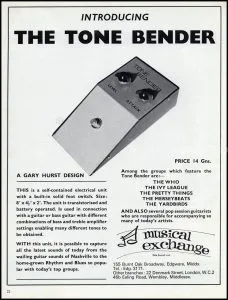
ShipWreck and the Tone Bender connection
The pedal went through a revision before reaching its final form. An earlier version of the circuit was more compressed and Tone Bender-like, but Halliday decided he preferred his very original, higher-gain take and recalled those early pedals1. Guitar Pedal X also noted the possibility of a later DLX version with a circuit-bending switch that would offer both the Tone Bender style first-edition profile and the final Fuzz Face style profile in one box1.
Hello Sailor Effects has built other takes on classic fuzz circuits, including the Leia Rebel-Rebel, a version of the Vox Tone Bender, and the Monmouth Octave Fuzz1.
Price and availability
Guitar Pedal X listed the ShipWreck Fuzzstortion at £250 / $315 in December 20242. Like most Hello Sailor Effects pedals, it is sold through the maker's Reverb.com store, where pedal drops occur every week or two and each pedal is unique, so a given release may not repeat1.
Hello Sailor Effects builds in small, one-off batches. If you are after a specific circuit such as the ShipWreck, watching the Reverb.com store for the next drop is the way these pedals reach players1.
Videos
Leigh Fuge
Questions
Who designed the Hello Sailor Effects ShipWreck Fuzzstortion?
The ShipWreck Fuzzstortion was designed by Joe Halliday of Hello Sailor Effects. Guitar Pedal X, which reviewed the pedal at its launch, credits Halliday with combining a JFET preamp, a conditioning stage, a high-gain Darlington transistor, a hard-clipping diode stage and post-gain tone and volume controls into the single circuit.
What does the clipping switch do on the ShipWreck?
The Clipping switch selects between three diode arrangements: up is silicon/germanium asymmetrical, centre is silicon asymmetrical, and down is silicon symmetrical. Each mode changes how the hard-clipping stage shapes the gain, giving three distinct flavors of fuzz-edged distortion from one pedal.
What are the internal trim-pots on the ShipWreck for?
The ShipWreck has two internal trim-pots that fine-tune the voltage bias on its two main gain stages. They are factory optimised during the build, so players normally leave them alone, but they allow the bias of each stage to be adjusted if needed.
How much does the ShipWreck Fuzzstortion cost?
Guitar Pedal X listed the ShipWreck Fuzzstortion at £250 / $315 as of December 2024. Because each pedal is built individually and sold through drops, availability can vary.
Where can you buy a Hello Sailor Effects pedal?
Hello Sailor Effects pedals are sold through the maker's Reverb.com store. Guitar Pedal X reports that pedal drops occur every week or two, and that each pedal is unique, so players need to watch the store for the next release.
How does the ShipWreck differ from a Tone Bender?
An earlier version of the ShipWreck circuit was more compressed and Tone Bender-like, but designer Joe Halliday preferred his original higher-gain take and recalled those early pedals. The final version is a Fuzz Face based design, described as a super-sustaining high-gain distortion with clean-to-scream dynamics rather than a compressed Tone Bender profile.
Sources (2)
- Guitar Pedal X, Guitar Pedal X, 2024-03-13
- Guitar Pedal X, Guitar Pedal X, 2024-12-18