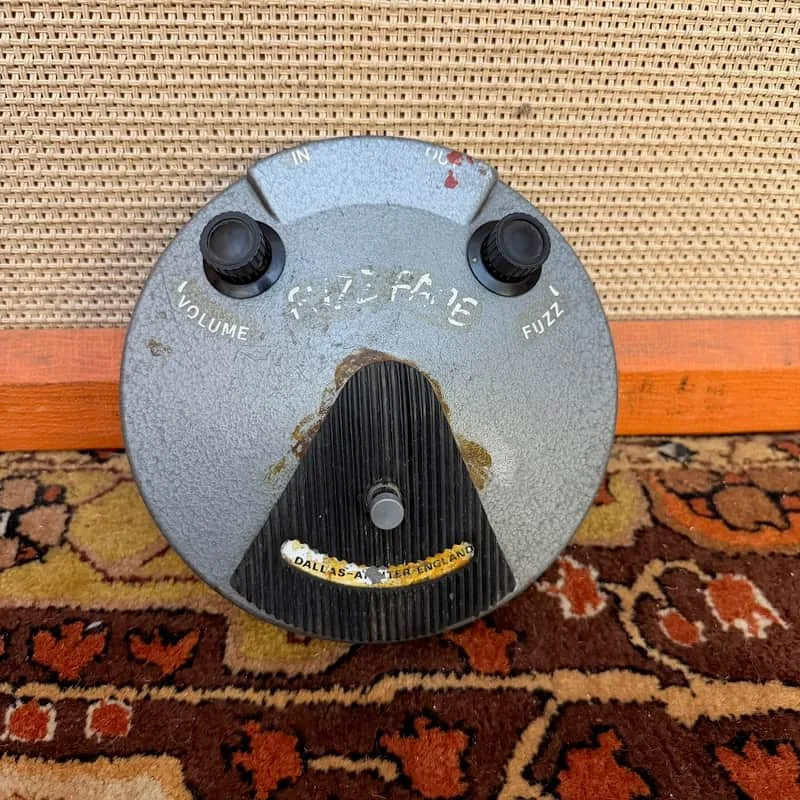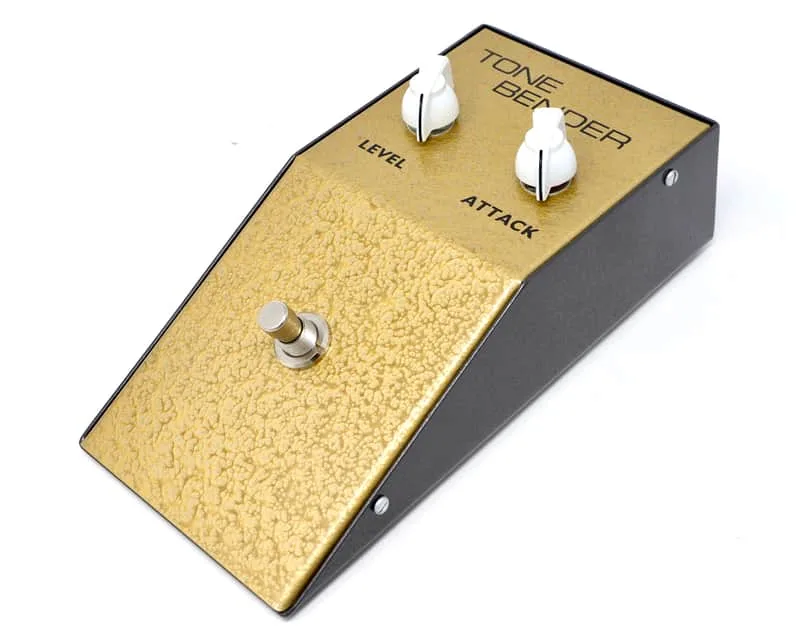


The Vox Tone Bender is a fuzz pedal sold by Vox from 1966 into the 1970s, and it had the longest production run of any Tone Bender variant. Originally made in 1966, it was still being made in some form into the mid to late 1970s1. Most examples were built in Italy, and the two-transistor circuit inside them is the same design family that inspired the Dallas Arbiter Fuzz Face2.
For a player, the classic Italian Vox Tone Bender delivers a rather nasal and raspy fuzz sound without a lot of lower end, with treble content quite high for a fuzz pedal. Stompboxes.co.uk's history describes it as "a very unique sounding effect and an excellent pedal to use with dark sounding British valve amplifiers"1. It also cleans up nicely with either the guitar's volume knob or the attack knob3.
What the Vox Tone Bender does
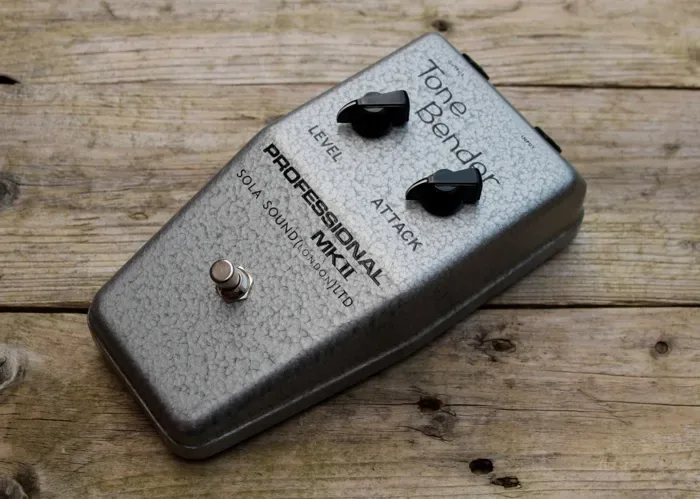
The pedal takes the guitar signal and clips it through a pair of transistors to produce a saturated fuzz tone. TONEHOME's page on the V8281 notes that "you can achieve plenty of output thanks to two germanium SFT transistors inside this pedal," and that the resulting sound is "rather nasal and raspy... without a lot of lower end"3. That bright, cutting character is the pedal's signature: compared with the Sola Sound Mk1.5, the Vox version featured a couple of minor circuit changes that resulted in "a slightly brighter, more cutting tone with less low end"56.
The high treble content is what makes it pair well with darker amps, and the responsive cleanup from the guitar's volume knob is a trait it shares with other germanium fuzzes of the era31.
The circuit: a two-transistor fuzz close to the MK1.5
The Vox Tone Bender is very closely related to the two-transistor Tone Bender Mk1.5, an unofficial name given to the transitional circuit that Sola Sound built in the mid-1960s27. That circuit matters in fuzz history because it inspired the Fuzz Face: Red Witch Pedals calls the Mk1.5 the "Father of the Fuzz Face," noting it used different germanium transistors and had a much less tight bottom end5, and RockBoard's PedalPedia likewise lists it as an inspiration for the Dallas Arbiter Fuzz Face7.
Aion FX's analysis goes further, describing the earlier Tone Bender version as "essentially the same circuit as the Fuzz Face," with one capacitor carrying a different value in the 1.5 circuit that "has very little impact on the sound"8. A Georgia Institute of Technology circuit analysis frames the Vox pedal as Vox Amplification's "own take on the Fuzz Face," listing the changes that distinguish the Vox circuit: NPN silicon transistors instead of PNP germanium, reduced coupling capacitor values, a resistance in series with the pot at the emitter of Q2, and a resistance in parallel with the output pot4.
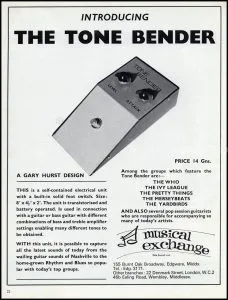
The lineage runs the other way too. Stompboxes.co.uk's history says the Mk1.5's two-transistor circuit "is said to have been leaked/loaned to Arbiter who went on to release the legendary Fuzz Face later that same year," and that the same circuit was also used by Vox in their Italian production1. BSM's page adds that Sola Sound built Gary Hurst's circuit, slightly modified and in large production numbers, as an OEM product for Vox9.
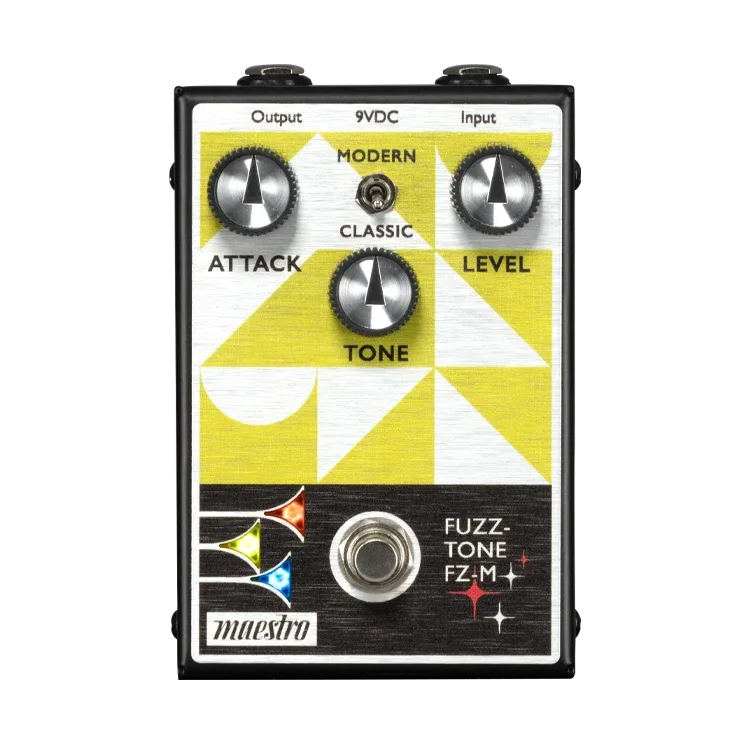
For context, the Mk1.5 sits between two larger designs: the original three-transistor Sola Sound Tone Bender MKI, based on Gibson's 1962 Maestro Fuzz-Tone510, and the three-transistor MKII circuit11.
Versions: the Italian units, the v828 and the V829
The Vox Tone Bender name covers several distinct pedals built over more than a decade.
| Version | Built | Circuit | Notes |
|---|---|---|---|
| Earliest Italian units | from 1966 | SFT337 and OC76 transistors, input capacitor under the board | Possibly made in England, though without direct proof1 |
| Later 1967 units | approx. 1967 | SFT337 and SFT363E, top-mounted input capacitor | 1 |
| v828 | 1967 to early 1970s | Two-transistor, easily mistaken for the MK1.5 | Made by EME, later Jen; intended for the American market212 |
| Professional MKII | 1967 to 1968 | Three-transistor, largely unchanged from the Sola Sound MKII | Built by Sola Sound via Macari's; discontinued in 196813 |
| MKIII | 1968 to mid-1970s | Germanium or silicon, at least three different circuits | Supplied by Sola Sound; also built in Hastings14 |
| V829 | 1994 to 1997 | Based on the late-'60s MkI.5, smaller enclosure | Reissue with modern germaniums156 |
The v828 was apparently intended for the American market: the model appears in Thomas Organ catalogs, and surviving examples overwhelmingly resurface in the United States. It was initially made by EME (Elettronica Musicale Europea), with production later taken over by the newly founded Jen company2. British Pedal Company's history dates the move to the Italian Jen factory to 1967, resulting in the release of the V828 Tone Bender12. Premier Guitar's Tom Hughes notes that by 1967 Vox had begun making the Tone Bender themselves in Italy, and that "the Italian-made Vox became the most widely available and recognized of all vintage Tone Benders"15.
The Vox Tone Bender Professional MKII was a different animal: a Sola Sound-built three-transistor fuzz supplied via Macari's Musical Exchange. Early Vox-branded units simply had the "Sola Sound" name obscured by a black bar and replaced with "Vox," before the graphics were redesigned with a much more prominent Vox logo. Earlier examples of the later version featured a triplet of Mullard OC75 transistors and slightly larger value input and output capacitors13. The MKII was discontinued in 1968, and its demise led to Sola Sound's development of the Vox Tone Bender MKIII13.
The MKIII, introduced in 1968, is its own tangle: pedals formally labeled "Vox Tone Bender MKIII" could have been built with any one of at least three entirely different fuzz circuits. The germanium version came with adjustable controls for volume, fuzz amount, and tone, and was built from the late 1960s to approximately the mid-1970s. The earliest "with treble 'n' bass boost" units used a silicon transistor circuit with just two controls, volume and tone, and were in production by August 1968; these were identical to Sola Sound's own Colorsound Jumbo Tone Bender pedals. A later "Hastings" edition was built into a cast aluminum enclosure and was likely manufactured in-house by Vox Sound Limited in Hastings, Sussex, based on Sola Sound's design14.
The V829 brought the design back in the 1990s. Premier Guitar's history records that between 1994 and 1997 Vox issued the V829 Tone Bender, based on the late-'60s MkI.5 but housed in a smaller enclosure615. Tom Hughes, writing in Premier Guitar's Stompbox Classics series, says it appeared "announcing itself as 'Germanium Charged'" and that "it did indeed use a pair of modern generic germaniums," though "it's still not what we consider a real Tone Bender"15.
The Vox Tone Bender name spans more than one circuit. A "Vox Tone Bender" from 1966, a v828, a Professional MKII and a MKIII are all different pedals, and the MKIII label alone covers at least three distinct circuits14211. When comparing vintage units or modern clones, check which version is being referenced.
What builders and reviewers said
The DIY community has studied the circuit closely. IvIark's Guitar FX Layouts blog published layouts for the circuit in both PNP and NPN versions, and builders reported verified builds using an OC75 (73hfe) for Q1 and an OC76 (98hfe) for Q2, with the Q2 collector biased at 6.5V16. Builders also flagged practical tweaks: the 8K2 bias resistor may need adjusting if Q2 does not bias correctly, and the 4n7 output cap traps the lows at Q2's collector, with builders swapping in 150n, 10n or 22n values16.
Two builder verdicts from the comments on that page:
"Sounds just amazing. Kicks the living daylights out of most other '60 fuzz circuits."
mirosol, Guitar FX Layouts16
"Just built this jammy last night. Balls indeed. Cleans up very nicely as well."
Gristlepig, Guitar FX Layouts16
On the germanium-versus-silicon question, Guitar Pedal X's Stefan Karlsson noted that "Germanium Tone Benders can be a little difficult on the dial-in, sometimes temperamental even," reviewing a silicon MKII take17. Wren and Cuff's page for its UB-Stone recreation notes that most 1967 Vox Tone Bender examples the owner had heard differed in tone from Shinichi Ubukata's unit, which had a spongy, gated, sizzling character18.
The design also spread beyond a single brand: the Tone Bender MkII became so popular that Sola Sound agreed to build it under other monikers for such companies as Marshall, Vox, and Rotosound6, and the Vox Tone Bender itself appeared in both PNP and NPN circuit layouts.
Who used it
The Tone Bender family has a long artist roster, with a distinction between the Sola Sound originals and the Vox-branded pedal:
- The Beatles used Tone Benders, though the first one they used was the Sola Sound MKI, which first featured on the album "Rubber Soul"1. Gary Hurst personally gave that pedal to George Harrison, but Paul McCartney was the one who ended up using it19. GuitarPlayer notes the Beatles were among those who used the Vox pedal20.
- Paul McCartney and Mick Ronson used MKI versions21.
- Jimmy Page famously used a Tone Bender MkII22, and Jimmy Page, Jeff Beck and Mick Ronson are all named as Tone Bender users23.
Videos
Johan Segeborn
Coolpapabear
Vintage Stompboxes
Questions
Is the Vox Tone Bender germanium or silicon?
It depends on the version. The Italian-made two-transistor units used germanium SFT transistors, with the earliest examples pairing an SFT337 with an OC76. The Vox Tone Bender MKIII came in both a germanium version and a silicon version, and some Italian-built two-transistor units were fitted with silicon transistors instead of germanium.
Is the Vox Tone Bender the same as a Fuzz Face?
Not the same, but closely related. The Vox Tone Bender is built on the two-transistor Tone Bender Mk1.5 circuit, which inspired the Dallas Arbiter Fuzz Face, and one analysis describes the circuit as essentially the same with only a different capacitor value that has little impact on the sound. The Vox version had a slightly brighter, more cutting tone with less low end.
Where was the Vox Tone Bender made?
Most were made in Italy. Production moved there by 1967, initially by EME (Elettronica Musicale Europea) and later by the Jen company, and continued until the early 1970s. The earliest units may have been made in England, and a later MKIII edition was likely built in-house by Vox Sound Limited in Hastings, Sussex.
Did the Beatles use a Vox Tone Bender?
The Beatles used Tone Benders, though the first one they used was the Sola Sound MKI, which first featured on the album Rubber Soul. Gary Hurst personally gave that pedal to George Harrison, but Paul McCartney was the one who ended up using it. GuitarPlayer notes the Beatles were among those who used the Vox pedal.
Sources (23)
- A Little History, www.stompboxes.co.uk, 2017
- Sola Sound Tone Bender 'MK1.5' • Fuzzboxes, Fuzzboxes.org, 2021-05-18
- TONEHOME, TONEHOME (tonehome.de)
- Microsoft Word, Georgia Institute of Technology (hosted at guitarpcb.com), 2006-05
- Delilah - Ultra Rare Fuzz - Red Witch Pedals, Red Witch Pedals
- The Mighty Tone Bender Fuzz: A 50-Year Legacy, Premier Guitar, 2018-12-13
- Taras Bulba V2 by Drunk Beaver, RockBoard PedalPedia, 2026
- Deimos Germanium Fuzz / Tone Bender Mk. II, Aion FX, 2020-07-03
- FuzzBender Fuzz Machine, BSM - Finest Treble Booster (treblebooster.net), 2025
- Gary Hurst Tone Bender 'MKI' • Fuzzboxes, fuzzboxes.org, 2021-05-20
- Sola Sound Tone Bender Professional MKII • Fuzzboxes, Fuzzboxes.org, 2021-05-18
- Tone Bender History, British Pedal Company
- Vox Tone Bender Professional MKII • Fuzzboxes, Fuzzboxes.org, 2021-05-20
- Vox Tone Bender MKIII • Fuzzboxes, Fuzzboxes.org, 2021-05-30
- Stompbox Classics: Tone Bender, Part 2, Premier Guitar, 2009-10-21
- Guitar FX Layouts: Vox Tone Bender, Guitar FX Layouts (tagboardeffects.blogspot.com), 2012-09-29
- Guitar Pedal X, Guitar Pedal X, 2025-03-07
- UB-Stone Shinichi Ubukata Signature Fuzz, Wren and Cuff
- Ultimate tone research, sounding like the Beatles, Aclam Guitars, 2021-04-27
- The Sola Sound Tone Bender and the Early Evolution of the Fuzz Pedal, GuitarPlayer (www.guitarplayer.com), 2020-07-27
- SkinPimp MKIII Pedal Review, Premier Guitar, 2010-01-14
- SolidGoldFX Communication Breakdown review, Guitar World, 2020-10-07
- New Pedal: Drunk Beaver Taras Bulba V2 Fuzz, Delicious Audio, 2023-05-19