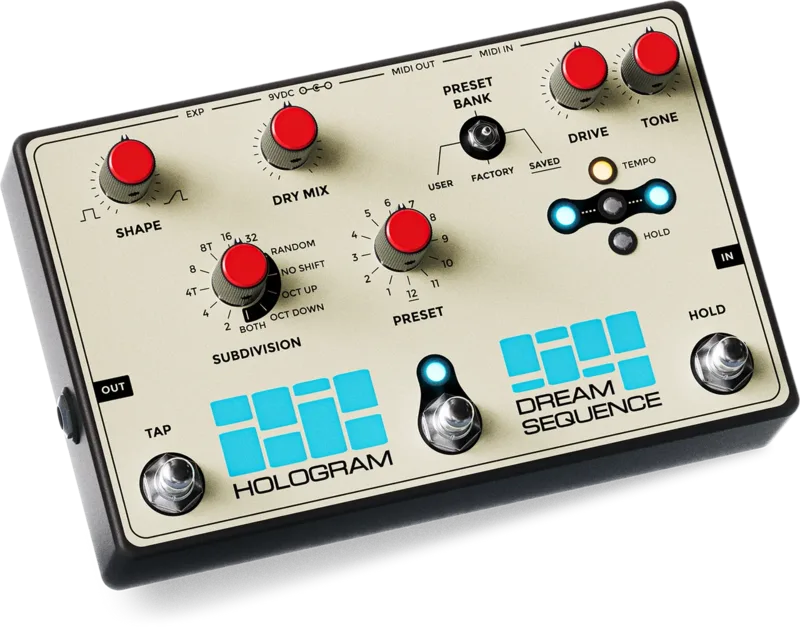


The Hologram Electronics Dream Sequence is a programmable rhythm and octave pedal that combines a step sequencer, envelope shaping and octave up and down pitch shifting. Where a conventional octave pedal shifts your pitch and leaves it there, the Dream Sequence runs that shifting in repeating rhythmic patterns, so a single sustained note comes out as a moving sequence of octaves, pulses and shaped attacks1.
Hologram Electronics describes the result as a tool for creating "synth-like arpeggios, pulsating sheets of sub-octave distortion, shimmering, ethereal chord washes, and a limitless number of other new sounds"2. Delicious Audio, reporting on the company, called it "a sequencer, an envelope shaper, a pitch shifter, a sampler, and more"3. It arrived in 2016 and was, in Delicious Audio's words, "probably the most critically acclaimed pedal of 2016"3.
The maker's page lists the US, EU and AU variants of the Dream Sequence as sold out or unavailable, and states that no returns are accepted on this product1. Players looking for a new unit may need to check the used market.
What it does: a rhythmic octave sequencer
The core idea is a step sequencer that drives pitch shifting and envelope shaping in sync. Instead of a static octave, the pedal repeats a pattern of octave up and octave down shifts over a musical subdivision you choose, with the envelope of each step shaped by a selectable waveform. Hologram Electronics says the Shape knob "controls the contour of the waveform used by the step sequencer, smoothly morphing from short, percussive, square-wave sounds to backwards-guitar-like ramp waves"2. That is what gives the pedal its synth-like character: short square-wave steps sound percussive and staccato, while ramp waves soften the attack into something closer to a reversed guitar.
The pedal also works as a plain pitch shifter. The maker states that "the octave up and octave down section can also be used independently of the sequencer to replace a traditional pitch shifter"2, so a player who wants a straightforward octave up or octave down effect, in the vein of a traditional octave pedal, can have one without engaging the patterns at all.
The circuit is a hybrid: digitally controlled, with analog Drive and Tone sections and an analog dry path5. RockBoard's PedalPedia classifies the circuit type as hybrid and lists the effect among envelope filter, octaver and pitch shifter types4. The Drive and Tone controls shape the wet signal at the output, with Drive varying the amount of distortion and Tone varying the high-frequency rolloff5, which places part of the pedal's voice in distortion territory.
The controls and footswitches
The Dream Sequence has three footswitches, and one of its distinctive features is that you can build your own patterns by tapping the three footswitches in sequence2. The Hold footswitch plays three different roles: Toggle, which samples a note or chord and sustains it; Latch, which samples, then clears and re-samples; and Momentary, which holds a note or chord until you release the switch5.
| Control or switch | What it does |
|---|---|
| Shape knob | Controls the contour of the sequencer's waveform, morphing from short, percussive square waves to backwards-guitar-like ramp waves2 |
| Subdivision switch | Selects the musical subdivision of the pattern sequencer, and also selects from 5 auxiliary modes: Random, No Shift, Octave Up, Octave Down and Both5 |
| Drive | Varies the amount of distortion at the output5 |
| Tone | Varies high-frequency rolloff at the output5 |
| Dry Mix | Blends the wet and dry signals5 |
| Preset switch | Works with the Preset Banks to access 35 internal presets5 |
| 3 footswitches | Used for tapping custom patterns in sequence2 |
| Hold footswitch | Toggle, Latch and Momentary sample-and-hold roles5 |
The Subdivision switch is worth a closer look for a player deciding how this compares to a standard octave pedal. Beyond the rhythmic subdivisions, its five auxiliary modes include No Shift, which leaves pitch alone and lets the envelope shaping and sequencing do the work, plus Octave Up, Octave Down and Both for conventional shifting5.
Presets and the User Bank
The pedal ships with 24 built-in presets1, and the Preset switch works with the preset banks to access 35 internal presets in total5. The banks are organized as User, Factory and Saved2. The User Bank contains 12 building-block patterns and lets you customize them with the Subdivision and Shape controls2, which is where a player can take a simple pattern and push it toward their own rhythmic and tonal territory.
Pedal of the Day's reviewer found the preset system one of the pedal's practical strengths5:
"The Dream Sequence is an excellent tool for saving and recalling the odd sounds you find as well, via the Preset Bank toggle"5
For players integrating the pedal into a larger rig, the Dream Sequence has MIDI In and Out1 and is listed as a supported device by Disaster Area Designs6, whose MIDI pedals can control it. The expression pedal input is mappable to many of the controls1, so parameters such as mix or shape can be moved in real time from an expression pedal.
Where it came from and what reviewers said
The Dream Sequence was Hologram Electronics' first pedal, released in 2016. Delicious Audio later described it as "the undeniable success of their first pedal, the Dream Sequence" when reviewing the company's follow-up, the Infinite Jets73. Pedal of the Day, reviewing it in July 2016, wrote that "a pedal came onto the market that was unlike any we had all seen before" and called it "one of the hottest pedals out at the moment" with "a huge range of sonic options"58. The pedal sits in the same experimental territory as synth pedals, using a guitar's input to generate sounds a conventional overdrive or fuzz pedal cannot.
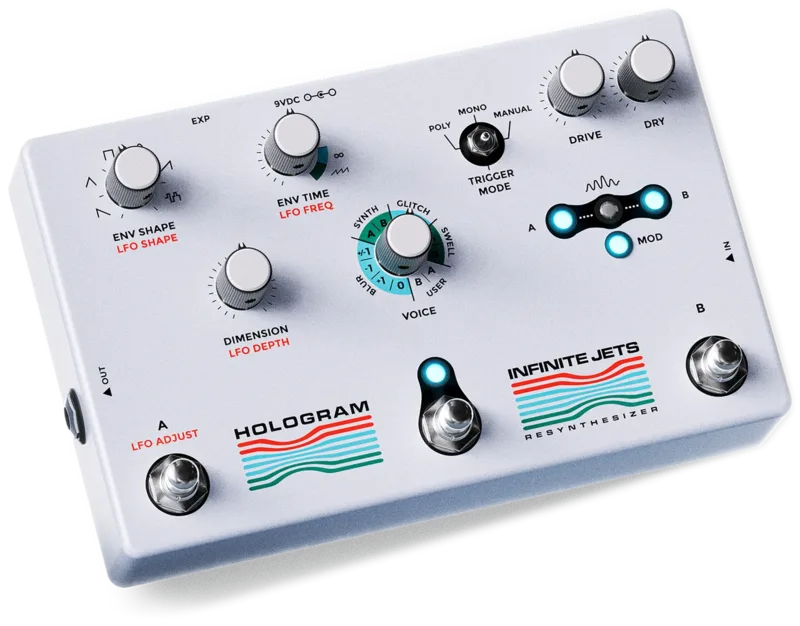
The pedal's place in Hologram's line was cemented by its reception. Delicious Audio called it "probably the most critically acclaimed pedal of 2016"3, and the company went on to release the Infinite Jets, a sampling pedal with four sampling effects and two channels of infinite sustain38, building on the reputation the Dream Sequence established.
Videos
Knobs
ProGuitarShopDemos
Hologram Electronics
Questions
Is the Hologram Dream Sequence analog or digital?
It is a hybrid design. The pedal is digitally controlled, with analog Drive and Tone sections and an analog dry path. The pitch shifting, sequencing and envelope shaping that define its sound are handled digitally, while the distortion and tone shaping at the output stay analog.
Can the Dream Sequence be used as a plain octave pedal?
Yes. The octave up and octave down section can be used independently of the sequencer, so the pedal can replace a traditional pitch shifter when you do not want the rhythmic patterns. The Subdivision switch also offers Octave Up, Octave Down and Both modes alongside the sequencer subdivisions.
Is the Dream Sequence true bypass?
Yes. It uses true bypass switching with an electromechanical relay, so when the pedal is off your signal passes through without processing.
Does the Dream Sequence have MIDI?
Yes. The pedal has MIDI In and Out, and it is listed as a supported device by Disaster Area Designs, whose MIDI controllers can integrate it into a larger MIDI rig.
Is the Hologram Dream Sequence discontinued?
The maker's product page currently lists the US, EU and AU variants as sold out or unavailable, so new units are not being sold directly at the time of writing. The pedal was released in 2016 and remains widely discussed on the used market.
Sources (8)
- Dream Sequence, Hologram Electronics
- Dream Sequence, Hologram Electronics
- Hologram Infinite Jets, Delicious Audio, 2022-10-30
- Dream Sequence by Hologram Electronics, RockBoard PedalPedia, 2026
- Hologram Electronics Dream Sequence, Pedal of the Day, 2016-07-11
- Supported Devices, Disaster Area Designs, 2021-10-11
- Hologram Infinite Jets Review, Delicious Audio, 2018-01-10
- Hologram Electronics Infinite Jets Resynthesizer, Pedal of the Day, 2019-09-14