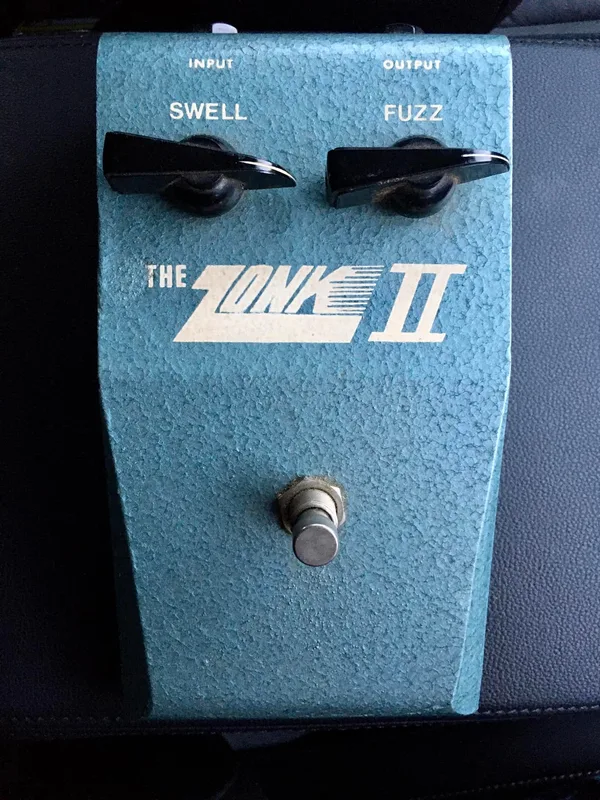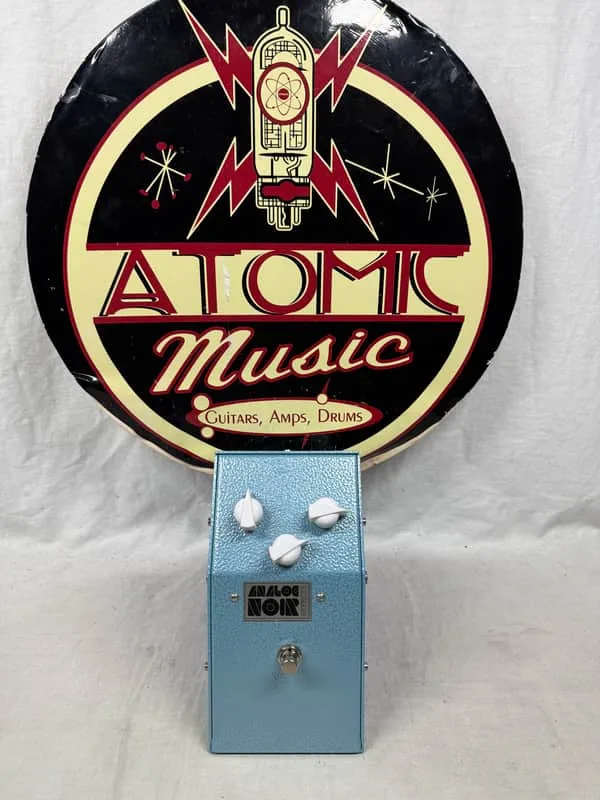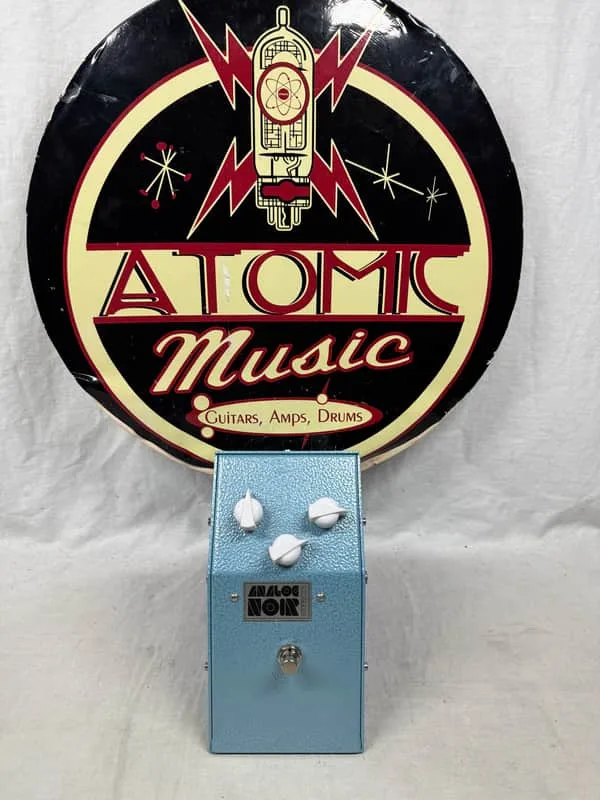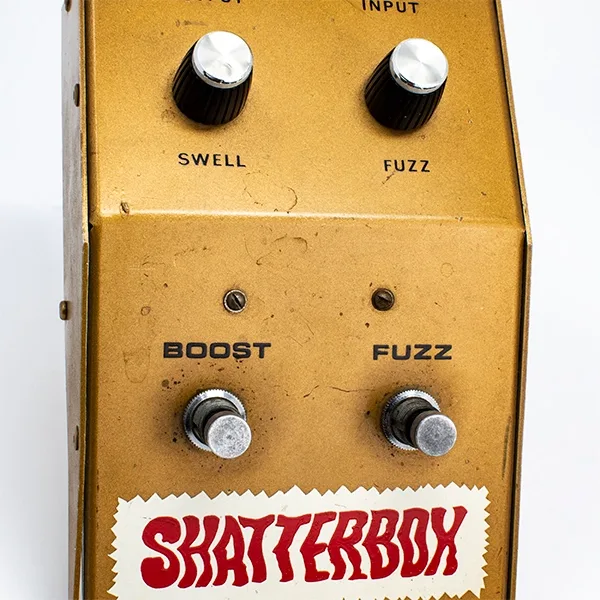

The Hornby Skewes Shatterbox is a 1960s British fuzz pedal that puts two effects in one box: the Zonk II fuzz and the Hornby Skewes Treble Booster. Fuzzboxes.org calls it "an early 'multi-effects' fuzz box that combined the Hornby Skewes Treble Booster with the Zonk II"12. Two separate footswitches let a player run the boost alone, the fuzz alone, or both together, which in its day was an unusual amount of flexibility from a single box.
It was designed in 1966 by Wilsic Sound for John Hornby Skewes of Leeds3, and was reportedly shown for the first time at the Frankfurt Musikmesse trade fair in the spring of 19691. It was produced in exceptionally limited numbers2 and originals are rare enough that most players who want the sound today build it from published layouts.
A Zonk fuzz and treble booster in one box
The Shatterbox is really two Hornby Skewes circuits sharing a chassis. Guitar FX Layouts describes it plainly: "the unit combines two effects; The JHS Zonk fuzz and a Treble Booster circuit"2. Vintage Guitar gives the same account from the history side: Wilsic combined the Zonk circuitry with the Treble Boost to create the Shatterbox4. The fuzz side traces directly to the Zonk Machine family, specifically the Zonk Machine II, and the boost side to the Hornby Skewes Treble Booster, which started with a germanium transistor that was soon replaced by a silicon one5.
Fuzzboxes.org notes the Shatterbox used the same construction style as the Wilsic Sound Fuzz, and that it is likely Charlie Ramskir, the Wilsic man behind the original Zonk Machine I, was involved in its development too, though this is probable rather than confirmed1.
Controls and switches
The control set is minimal, as was normal for the era:
| Control or switch | What it does |
|---|---|
| Boost footswitch | Switches the treble booster on its own14 |
| Fuzz footswitch | Switches the Zonk fuzz on its own14 |
| Both footswitches | Runs boost and fuzz together1 |
| Swell control | The fuzz volume control, wired as shown in the Zonk schematics2 |
An owner who opened an original 1960s unit found a few details that differ from the commonly circulated schematic: a 4k7 trimpot between the fuzz control pin 3 and chassis ground, an input resistor of 470k rather than the 27k shown in the layout, and two 125uF capacitors inside. The fuzz switch is a DPDT type but only one side is used, so it functions as SPDT2.
The Shatterbox ran only off a 9-volt battery4. There is no DC input on an original unit, so it cannot be powered from a modern pedalboard supply without modification.
History and versions
The design dates to 1966, credited to Wilsic Sound for John Hornby Skewes of Leeds3, though it was reportedly first shown publicly at the Frankfurt Musikmesse in spring 19691. Production appears to have continued into the 1970s: Fuzzboxes.org notes that date codes on the potentiometers of surviving Shatterboxes show the model was still in production by the early 1970s1. The printed graphics on the enclosures were updated slightly between the stripboard and PCB eras1.
The circuit existed in both PNP and NPN forms. Guitar FX Layouts published four stripboard layouts in April 2017: the original PNP version, an NPN version, and LED-equipped versions of each2. Builders should note one caution from the same source: one builder reported he could not get the layout to work, writing "I could not get this to work (built the regular zonk ii today without incident). This one just motorboats"2.
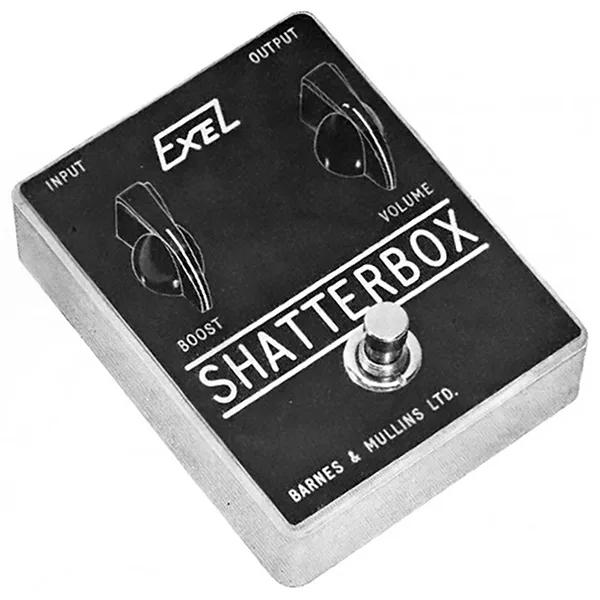
There was also a related pedal sold under another name. The Exel Shatterbox, sold by Barnes & Mullins, used the same idea in a compact die-cast aluminum enclosure rather than the original's bare-bones folded-steel box46.
Where it was sold and how rare it is
The Shatterbox was advertised in the British press and clearly sold in Britain, where many of the originals remain. Surviving units have also been sighted in Canada, Finland (two units) and Belgium (one unit)1. Guitar FX Layouts calls it "another stupid rare fuzz/booster made in the 60's" and says the original unit was produced in exceptionally limited numbers2. For most players, a clone built from the published PNP or NPN layouts is the realistic way to hear what it does.
Videos
jermsfuzz
Questions
Is the Hornby Skewes Shatterbox a PNP or NPN fuzz?
The original Shatterbox used a PNP transistor circuit, the same germanium-style topology as the Zonk Machine fuzz it was built from. Builders cloning the pedal have also produced NPN versions, and Guitar FX Layouts published stripboard layouts for both the original PNP circuit and an NPN alternative.
Does the Shatterbox run on a battery only?
Yes. Vintage Guitar reports that the original Shatterbox ran only off a 9-volt battery, with no external power option. That was normal for British effects of the 1960s, and anyone using an original unit today needs a fresh 9-volt battery to power it.
How is the Shatterbox related to the Zonk Machine?
The Shatterbox is essentially the Zonk II fuzz and the Hornby Skewes Treble Booster built into one enclosure. Wilsic Sound, the company behind the Zonk Machine, combined the Zonk circuitry with the Treble Boost to create it, so it shares its fuzz lineage with the Zonk family.
Where was the Hornby Skewes Shatterbox made?
It was made in Leeds, England. The design is credited to Wilsic Sound in 1966 for John Hornby Skewes, a Leeds firm. The pedal was advertised in the British press and sold in Britain, with surviving units also sighted in Canada, Finland and Belgium.
How rare is the Hornby Skewes Shatterbox?
Very rare. Guitar FX Layouts describes the original unit as produced in exceptionally limited numbers, and it is often called one of the rarest 1960s British fuzzes. Originals occasionally surface, but most players who want the sound build a clone from published layouts.
Sources (6)
- John Hornby Skewes Shatterbox • Fuzzboxes, Fuzzboxes.org, 2021-05-28
- Guitar FX Layouts: Hornby Skewes Shatterbox, Guitar FX Layouts (tagboardeffects.blogspot.com), 2017-04-30
- BPC-Product-Manual-2021-V1.pdf, British Pedal Company, 2021
- Hornby Skewes Zonk Machines, Vintage Guitar magazine, 2016-02-12
- The Dallas Rangemaster, Vintage Guitar magazine, 2015-01-26
- Exel Shatterbox • Fuzzboxes, Fuzzboxes.org, 2022-02-15