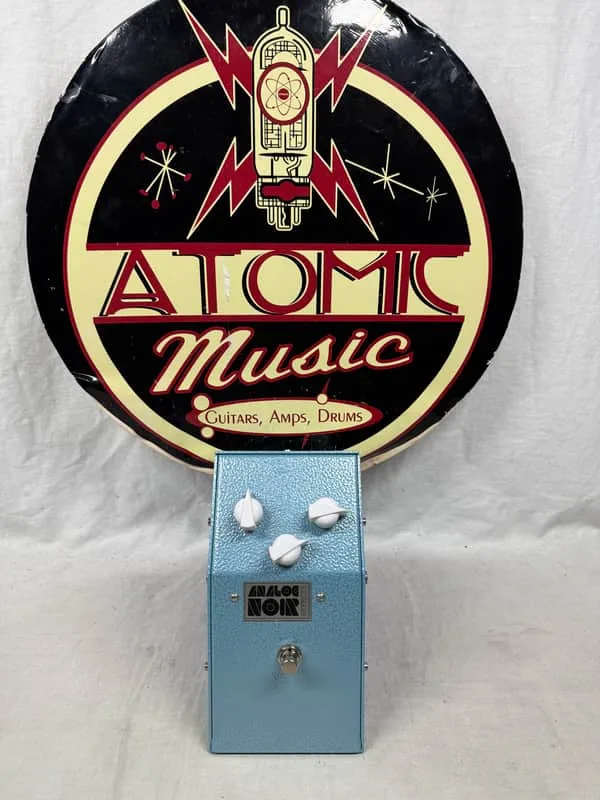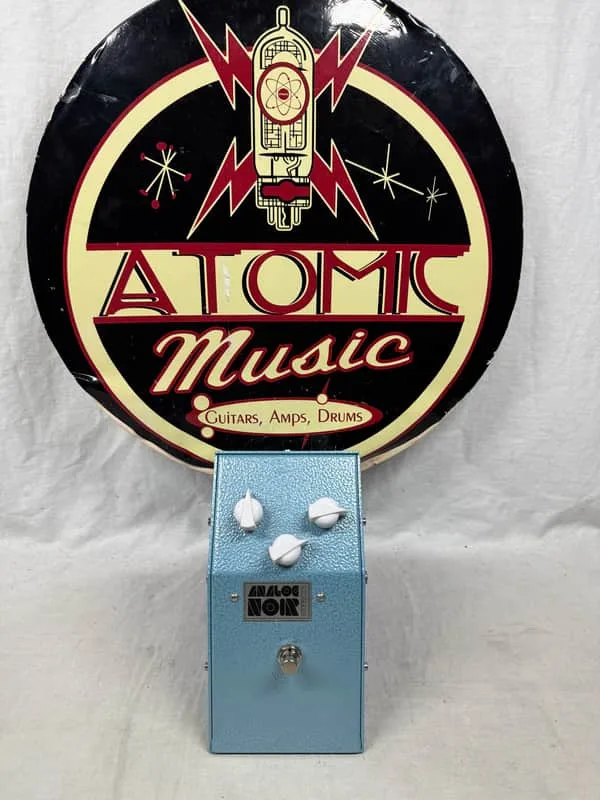


The Hornby Skewes Zonk Machine I is a germanium fuzz pedal made in Leeds, England, between 1965 and 19661. John Hornby Skewes, a Leeds firm, developed it to meet the demand created by the mid-1960s fuzz boom2, and the pedal was built by Charlie Ramskirr of Wilsic Electronics2. Its circuit is almost identical to the Tone Bender MKI345, and it is remembered for a famously bright, searing fuzz4. Very few were made, and originals are highly sought-after by collectors and fuzz enthusiasts2.
A bright, early British fuzz
The Zonk Machine arrived at the end of 1965, when British makers were racing to build fuzz boxes after the Maestro FZ-1 inspired the Great British fuzz pedal boom289. John Hornby Skewes of Leeds wanted in on this growing market and decided to develop his own fuzz box to meet demand2. The result was housed in a simple steel box with two controls2, and Zonk Machines were housed in enclosures made of folded aluminum, painted a teal hammered finish7.
The pedal's place in the fuzz family tree is clear from several angles:
- The British Pedal Company's history calls the circuit similar to the MKI Tone Bender2, and stompboxes.co.uk describes it as almost identical in its circuitry4
- Fuzzboxes.org found the circuit resembled Gibson's Maestro Fuzz-Tone but was much more similar to the Tone Bender MKI, likely its true inspiration7
- Guitar FX Layouts describes it as topographically identical to the MKI apart from a 33K resistor3
- stompboxes.co.uk calls it "the freakier, weirder looking cousin to the Tone Bender MKI"5
The sound is where the Zonk Machine I earned its reputation. MusicRadar notes the original became something of a legend in the world of fuzzboxes, with a famously bright fuzz10. Builders agree: Guitar FX Layouts calls the Zonk very bright, and suggests input cap values between .001uF and .01uF to tame it3. One verified PNP build found a 1nf cap on the input to ground removed sizzling bacon noise artifacts without killing the highs, while the original 1nf input cap sounded tinny and a 10nf cap gave a beefier sound with stronger midrange3.
The brightness can also be unpredictable. Comparing Zonk fuzz controls with another vintage unit, David Main noted on Guitar FX Layouts that "Zonk's can be either all on nothing at times in this regard"11.
"So it's actually the Zonk Machine for me."
The fuzz control
The Zonk Machine I has two controls, and their names are misleading to a modern player. The Fuzz control controls the volume, while the switched Swell control controls the amount of fuzz2.
Under the hood, the Fuzz pot essentially adjusts the bias of Q2, the second transistor3. Guitar FX Layouts recommends a log/audio taper pot, and notes some units came with a 25k Log Fuzz pot and a 220k resistor instead of 470k3. For builders chasing the pedal's wilder side, the site suggests an SPST switch to bypass the 2.2M resistor for what it calls "nasty, all-out craziness"3.
Transistors and versions
The Zonk Machine I uses three germanium transistors12, though the maker advertised it as featuring a highly developed circuit using expensive American transistors2. Fuzzboxes.org documents the production changes across the pedal's short life7:
| Version | Period | Transistors |
|---|---|---|
| PCB version | c. 1966 to 1967 | TI 2G309 or TI AO2 in Q1, Mullard black glass OC44, OC71 or OC75 in Q2 and Q3; early examples used a triplet of Mullards7 |
| Stripboard version | c. 1967 to 1968 | AO2, OC75, OC71 set; late units replaced Q2 with a silicon 2N4061 and a bias trimpot7 |
Guitar FX Layouts measured an original unit with Q1 as a TI AO2 at 180 hfe, Q2 as a Mullard OC75 at 78 hfe and Q3 as an OC44 at 58 hfe3. A verified PNP build by commenter OcularDawn used Q1 OC75, Q2 NKT275 reissue and Q3 OC753.
Originals came in both PNP and NPN ground schemes, and the PNP version is positive ground, which matters to anyone powering a reissue or clone on a modern pedalboard: a positive ground unit cannot be daisy chained with negative ground devices13.
The Zonk Machine I and II
In 1967 Hornby Skewes replaced the original with the Zonk Machine II, a re-engineered Zonk Machine I13. The II used two PNP silicon transistors instead of the earlier three germaniums13, and builders describe it as more stable, smoother and less dark sounding than the I13. Like the MKI, the Zonk Machine I was only made in small numbers before being updated with a more modern, easier to produce unit1.
Where it went
The Zonk Machine was discontinued in 19687. The British Pedal Company's history attributes the end of the product to the death of designer Charlie Ramskirr in 19682, while Fuzzboxes.org reports the same account from Skewes in 2015 but calls it unreliable7. Either way, very few original units were produced between 1965 and 19682, and originals now overwhelmingly resurface in Canada, where the company was exporting fuzz boxes as early as 19667.
The pedal's later life has been busy. The British Pedal Company released a reissue made in England in 20131, and MusicRadar reported in 2024 that JHS has two of its own versions out, a Vintage Series with the larger wedge-style enclosure and one in its Compact Series10.
Videos
British Pedal Company
Acid Fuzz Pedals
Blackstrap Electrik Co.
Questions
Is the Zonk Machine I a Tone Bender MKI clone?
Not a clone, but very close. The circuit is almost identical to the Tone Bender MKI, and one technical analysis describes it as topographically identical apart from a 33K resistor. Fuzzboxes.org notes it resembled Gibson's Maestro Fuzz-Tone but was much more similar to the Tone Bender MKI, which was likely its true inspiration.
Where was the Hornby Skewes Zonk Machine made?
In Leeds, England, by John Hornby Skewes, a Leeds company that wanted a share of the growing 1960s fuzz market. The pedal itself was built by Charlie Ramskirr of Wilsic Electronics. By 1966 the company was reported in Melody Maker to have been exporting its fuzz boxes.
What transistors did the Zonk Machine I use?
Germanium transistors, three of them. Early PCB examples typically used a Texas Instruments 2G309 or TI AO2 in the first position with Mullard OC44, OC71 or OC75 in the second and third. Later stripboard units used an AO2/OC75/OC71 set, and near the end of production the second position was replaced with a silicon 2N4061 and a bias trimpot.
What is the difference between the Zonk Machine I and II?
The Zonk Machine II of 1967 was a re-engineered Zonk Machine I. It used two PNP silicon transistors instead of three germaniums, and builders describe it as more stable, smoother and less dark sounding than the original. The original I was also known for a very bright, sometimes unstable fuzz character.
When was the Zonk Machine discontinued?
The original Zonk Machine was discontinued in 1968. Very few units were produced between 1965 and 1968, and the British Pedal Company's history attributes the end of the product to the death of designer Charlie Ramskirr in 1968, an account Fuzzboxes.org disputes.
Sources (13)
- TONEHOME, TONEHOME - the World of Vintage Guitar Effect Pedals
- Zonk Machine History, britishpedalcompany.com, 1968
- Guitar FX Layouts: Hornby Skewes Zonk Machine I, Guitar FX Layouts (tagboardeffects.blogspot.com), 2017-05-01
- A Little History, www.stompboxes.co.uk, 2017
- 1965, stompboxes.co.uk, 2025
- Zonk Machine History, British Pedal Company
- John Hornby Skewes Zonk Machine • Fuzzboxes, Fuzzboxes.org, 2021-05-14
- Skronk Machine, BLAMMO! Electronics
- That Pedal Show's Dan Steinhardt & Mick Taylor rate legendary pedals, Guitar World, 2022-10-31
- Bored of your 'board? Stomp this way for the must-have new guitar effects pedals of 2024, MusicRadar, 2024-03-28
- Guitar FX Layouts: DAM FZ-673, tagboardeffects.blogspot.com, 2014-07-29
- Creation of Zonk Machine Fuzz, tru-fi.com
- Guitar FX Layouts: Hornby Skewes Zonk Machine II, Guitar FX Layouts (tagboardeffects.blogspot.com), 2017-05-01