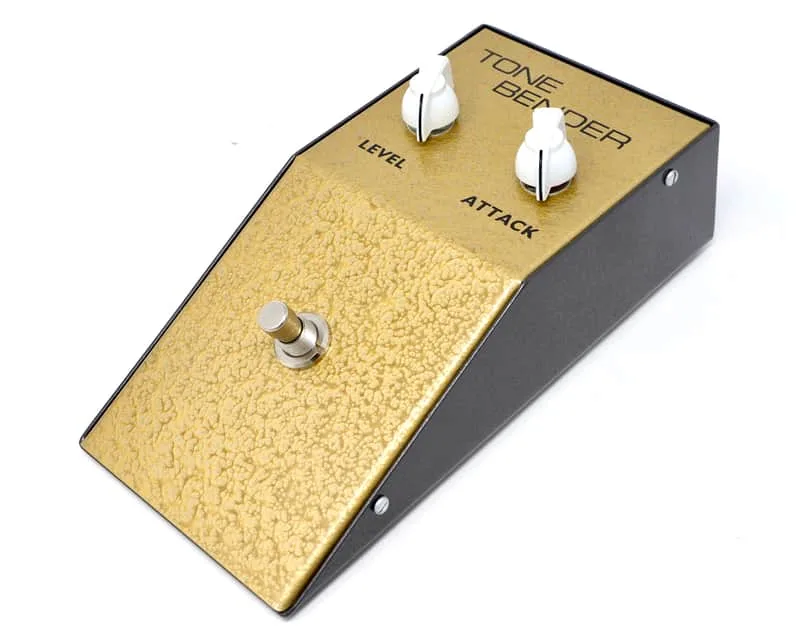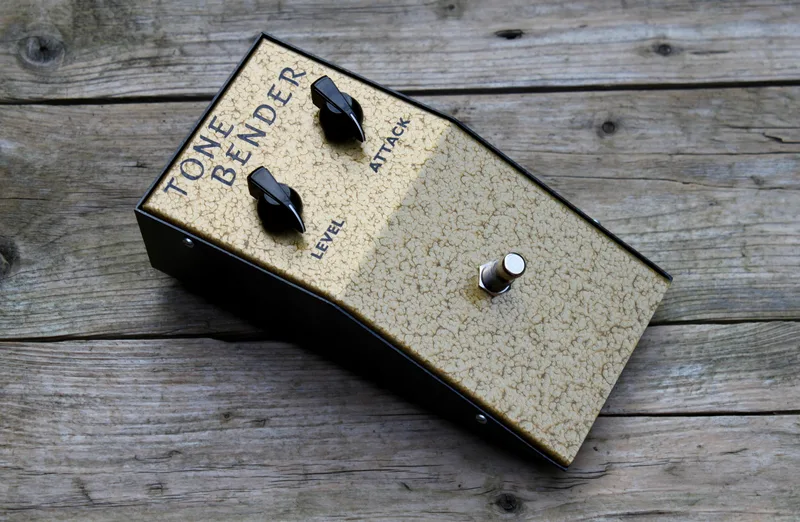


The Hornby Skewes Zonk Machine is a British fuzz box launched by the end of 1965 by John Hornby Skewes, a Leeds company that wanted a share of the mid-60s fuzz boom. It is one of the more famous Tone Bender MKI-influenced fuzzes: a three-transistor germanium circuit that was almost identical in its circuitry to the Sola Sound Tone Bender MKI, housed in a simple folded-steel box with a basic footswitch123.
Very few were made between 1965 and 1968, and the pedal has since become something of a legend among fuzz enthusiasts, with originals highly sought-after by collectors13. MusicRadar's Jonathan Horsley described its character plainly:
"The Zonk Machine was a notoriously bright-sounding fuzz, which is part of its charm. It had a more puckish treble than the Tone Bender, and as Blammo says,"4
A fuzz box close to the MKI Tone Bender
The Zonk Machine's circuit resembled Gibson's Maestro Fuzz-Tone, but it was much more similar to the Tone Bender MKI, which is likely its true inspiration3. On the Guitar FX Layouts blog, Zach's technical analysis puts it more precisely: the circuit is topographically identical to the MKI sans a 33K resistor6. Blammo! Electronics describes the lineage the same way, saying the Tone Bender "was later taken by John Hornby Skewes and further tweaked into the Zonk Machine"7.
For a player, that means the Zonk Machine sits in the same family as the D*A*M System Tone Bender MKI: a vintage-voiced germanium fuzz rather than a modern high-gain distortion. Vintage Guitar reported that Ramskirr's design provided more boost and a slight but pleasing oscillation compared with what came before it, and the ZZ.1 was advertised at the time as featuring a "Highly developed circuit, using expensive American transistors"8.
The circuit gradually evolved over the two-to-three year production run. Early Zonk Machines were built on printed circuit boards, with later stripboard and tag board versions following around 1967 to 19683.
The controls
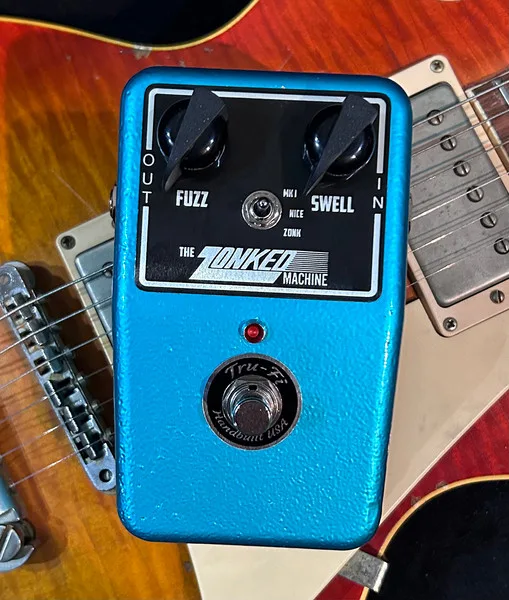
The Zonk Machine had only two controls, and their names do the opposite of what a modern player expects1:
So the knob labeled Fuzz is a volume control, and the switched control labeled Swell sets the fuzz amount. Under the hood, the Fuzz pot essentially adjusts the bias of Q2, and a log/audio taper pot is recommended; some units came with a 25k log Fuzz pot and a 220k resistor instead of 470k6.
History and versions
John Hornby Skewes of Leeds wanted in on the growing fuzz market of 1965 and developed his own fuzz box to meet demand, with the build credited to Charlie Ramskirr of Wilsic Electronics. Skewes recalled in 2015 that Ramskirr, known for his work with Miles Platting amplifiers, designed the pedal, though that recollection is considered unreliable13. By August 1966 the company was reported in Melody Maker to have been exporting fuzz boxes3.
The pedal's construction details shifted across the run3:
- PCB version, c. 1966 to 1967, with brown carbon composite resistors in earlier examples and yellow, likely Iskra, types later
- Stripboard version, c. 1967 to 1968
- Tag board version
- Early examples had a battery clasp fastened to the main chassis; later units moved it to the removable cover behind the controls
A verified PNP build documented on Guitar FX Layouts used Q1: OC75 (around 80 hfe), Q2: NKT275 reissue (around 100 hfe) and Q3: OC75 (around 80 hfe), confirming the germanium transistor complement6.
The Zonk Machine II
In 1967 Hornby Skewes released the Zonk Machine II, the result of a re-engineered Zonk Machine I, after Skewes asked Wilsic Electronics to develop a less-expensive option98. It retailed at just £810.
| Zonk Machine I | Zonk Machine II | |
|---|---|---|
| Year | 1965 to 196669 | 19679 |
| Transistors | Three germanium9 | Two PNP M2N 4403 silicon9 |
| Enclosure | Folded steel box10 | Rolled steel, blue Hammerite finish9 |
| Price | £141 | £810 |
| Character | Notoriously bright4 | More stable, smoother, less dark9 |
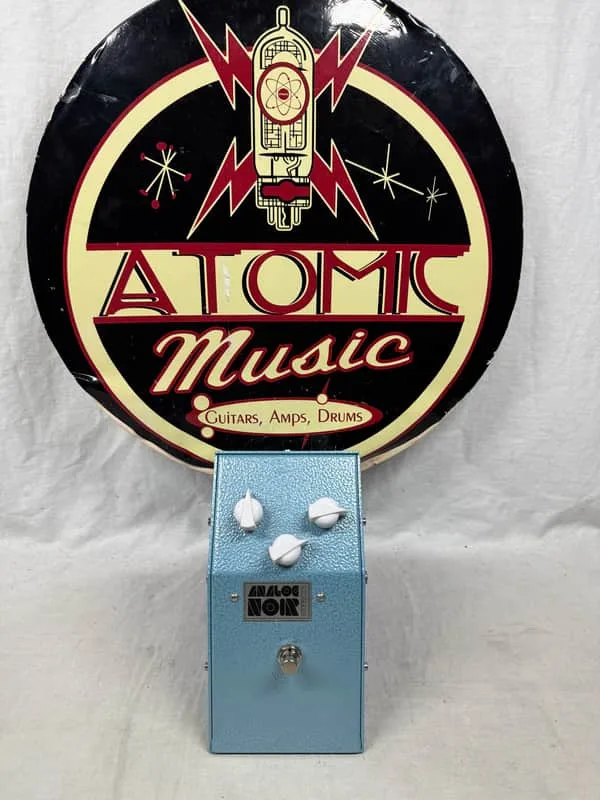
The II kept two basic controls on top with the input and output next to one another on the back, and it is an extremely rare vintage pedal that enthusiasts have long coveted9.
Why it ended
Production of the first-generation Zonks ended in 1968. Skewes attributed the discontinuation to Ramskirr's death that year, an account Fuzzboxes.org disputes, and Vintage Guitar also points to competition from more sophisticated products ending the first generation of Hornby Skewes effects3810.
Later versions and modern takes
The Zonk Machine's rarity has kept it alive through reissues and tributes:
- The British Pedal Company released a reissue made in England in 20132
- The Tru-Fi Zonked Machine is built on the John Hornby Skewes Germanium Zonk Machine circuit, and Guitar Pedal X called it a favorite take on the original11
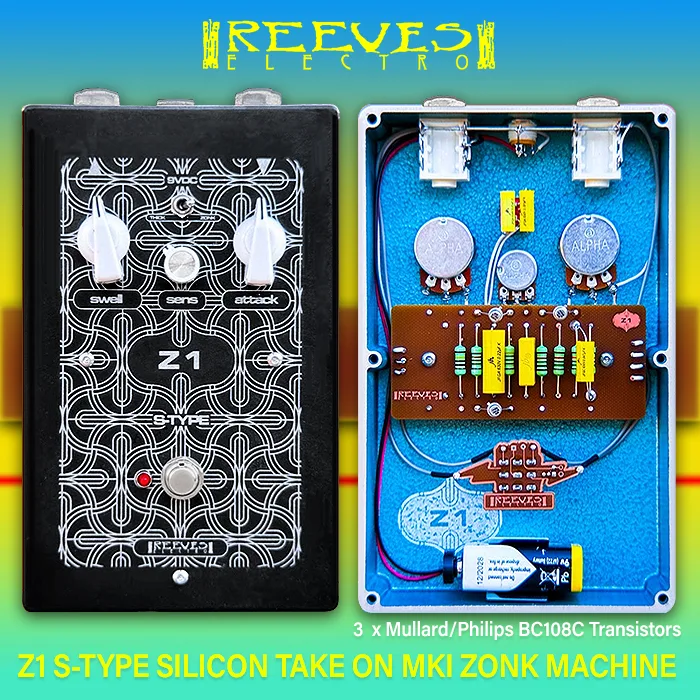
- The Reeves Electro Z1 S-Type Silicon-style MKI Zonk Machine carries the circuit forward with Swell (Volume), Sensitivity and Attack (Fuzz) controls, at £47512
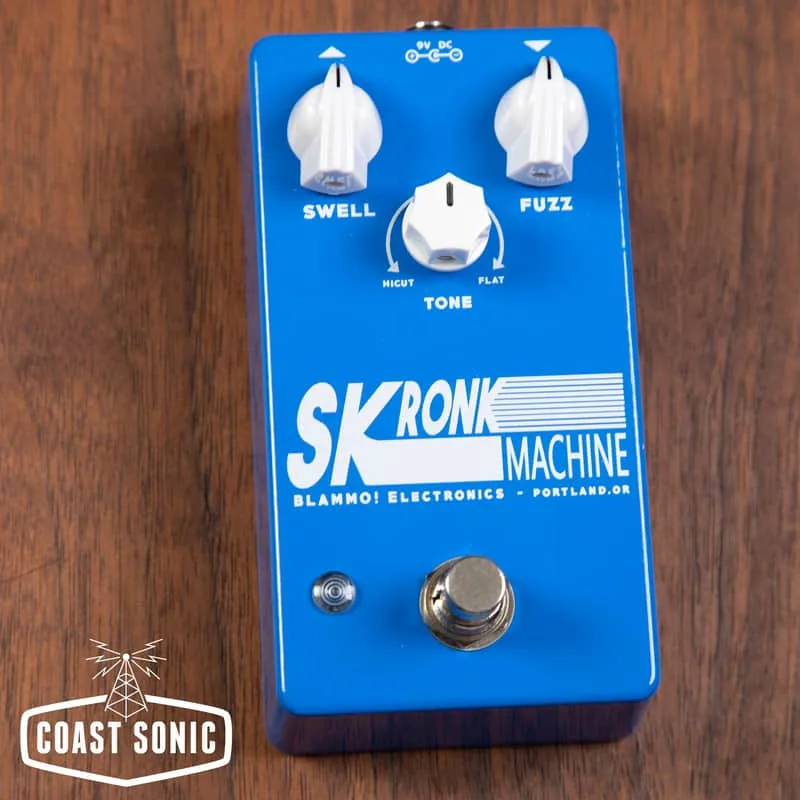
- Blammo! Electronics' Skronk Machine is a modern pedal drawing on the same lineage47
For players who want the circuit in a current pedal, those pages cover each maker's version in detail.
Videos
Acid Fuzz Pedals
British Pedal Company
Acid Fuzz Pedals
Questions
Who made the Hornby Skewes Zonk Machine?
The Zonk Machine was made by John Hornby Skewes, a company based in Leeds, England, and launched by the end of 1965. The build work is credited to Charlie Ramskirr of Wilsic Electronics, working from Skewes' own take on the Tone Bender circuit. The company was already exporting fuzz boxes by August 1966.
What circuit is the Zonk Machine similar to?
It is almost identical in circuitry to the Sola Sound Tone Bender MKI, a three-transistor germanium fuzz. Its lineage also resembles Gibson's Maestro Fuzz-Tone, but the Tone Bender MKI is generally considered the true inspiration. The main circuit difference from the MKI is a single 33K resistor.
How much did the Zonk Machine cost when new?
It launched in 1965 with a UK retail price of £14, which made it a costly purchase for the time. The later Zonk Machine II, introduced as a less expensive option, sold for just £8.
How many original Zonk Machines were made?
Very few. Production ran from 1965 to 1968 in small numbers before the pedal was updated with a more modern, easier to produce unit. Original units overwhelmingly resurface in Canada today, and the pedal is highly sought-after by collectors and fuzz enthusiasts.
What is the difference between the Zonk Machine and the Zonk Machine II?
The original Zonk Machine I used three germanium transistors in a folded-steel box. The 1967 Zonk Machine II was a re-engineered version using two PNP silicon transistors in a rolled steel casing with a blue Hammerite finish, described as more stable, smoother and less dark sounding, and sold as a less expensive option.
Why was the Zonk Machine discontinued?
Production ended in 1968. Skewes recalled in 2015 that the pedal was discontinued because designer Charlie Ramskirr died that year, though the account is considered unreliable, and competition from more sophisticated products also played a part in ending the first generation of Hornby Skewes effects.
Sources (12)
- Zonk Machine History, British Pedal Company, 1965
- TONEHOME, TONEHOME - the World of Vintage Guitar Effect Pedals
- John Hornby Skewes Zonk Machine • Fuzzboxes, Fuzzboxes.org, 2021-05-14
- Blammo Electronics' new Skronk Machine is a more user-friendly Zonk Machine for a new generation of vintage fuzz freaks, MusicRadar, 2024-02-09
- Zonk Machine History, britishpedalcompany.com, 1965
- Guitar FX Layouts: Hornby Skewes Zonk Machine I, Guitar FX Layouts (tagboardeffects.blogspot.com), 2017-05-01
- Skronk Machine, BLAMMO! Electronics
- Hornby Skewes Zonk Machines, Vintage Guitar magazine, 2016-02-12
- Guitar FX Layouts: Hornby Skewes Zonk Machine II, Guitar FX Layouts (tagboardeffects.blogspot.com), 2017-05-01
- features, Vintage Guitar magazine, 2026
- Guitar Pedal X, Guitar Pedal X, 2024-12-18
- Guitar Pedal X, Guitar Pedal X, 2026-10-09