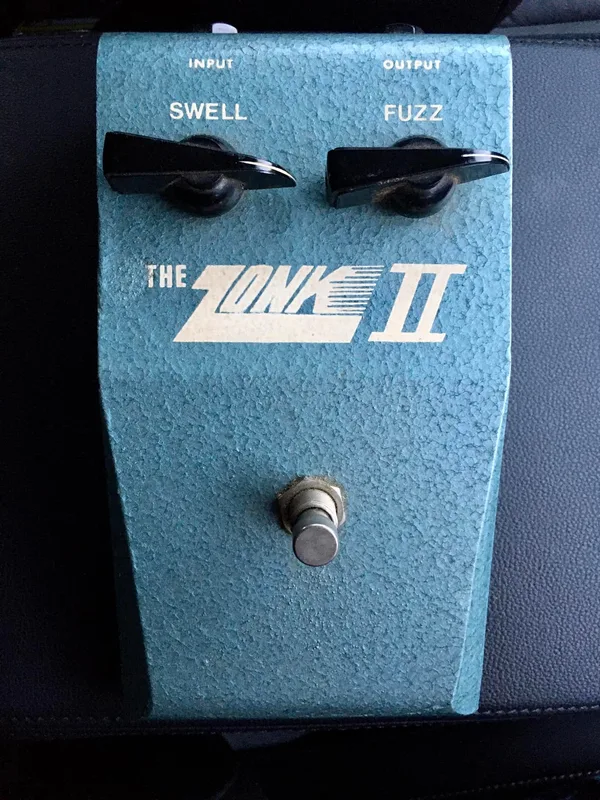


The John Hornby Skewes Zonk II is a British fuzz box that Hornby Skewes of Leeds offered alongside its ZZ.1 Zonk Machine, from approximately 1967 through to the early 1970s1. It was positioned as the budget option in the company's line: a 1967 advertisement describes the Zonk II as a "good quality Fuzz Box at a reasonable price", and it was priced considerably lower than the Zonk Machine1. Vintage Guitar reports that Skewes asked Wilsic Electronics to develop a less-expensive option2.
The reason there are so many different versions of the same model is that Hornby Skewes outsourced production to several different builders1. Some early cast-enclosure units came from Sola Sound, later folded-enclosure pedals came from Charlie Ramskir's Wilsic Sound, and the circuits changed along the way, from germanium to silicon transistors.
A budget fuzz box from Hornby Skewes
John Hornby Skewes of Leeds wanted in on the growing 1960s fuzz market and decided to develop his own fuzz box to meet demand; by the end of 1965 the Hornby Skewes Zonk Machine was launched, housed in a simple steel box with two controls31. The Zonk II followed as a second, cheaper fuzz sold alongside the ZZ.1 Zonk Machine1.
The Zonk II was the result of a re-engineered Zonk Machine I, and according to the Guitar FX Layouts technical analysis it was based upon the Sola Sound MK I Tone Bender circuit4. The Zonk Machine II is described there as more stable, smoother, and less dark sounding than the Zonk Machine I4.
"The 1967 John Hornby Skewes Zonk Machine II is an extremely rare, and vintage pedal enthusiasts have long coveted both"
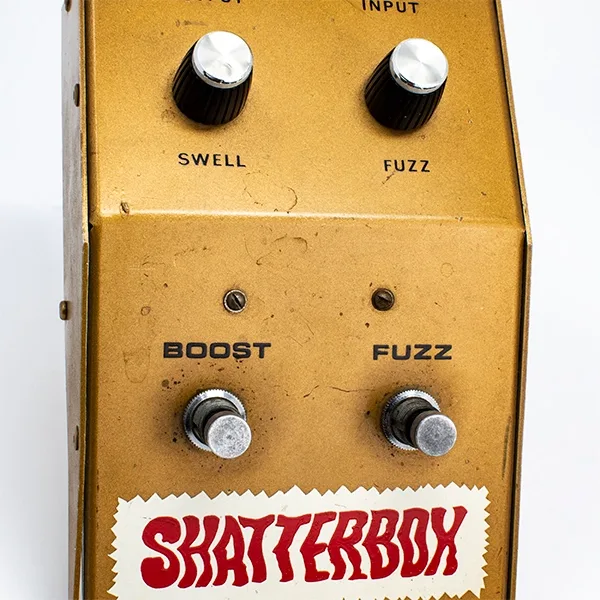
The Zonk II's circuit also lived on inside another Hornby Skewes product: its two-transistor circuit featured as part of the more sophisticated Hornby Skewes Shatterbox, which combined the Zonk Machine and JHS Treble Booster in one box and was built and sold concurrently from the late 1960s through the early 1970s15. Vintage Guitar notes the Shatterbox's fuzz side used the silicon transistors of the Zonk II2.
Who made the Zonk II for Hornby Skewes
Production was outsourced, and the builders changed over the pedal's life1:
- Early cast-enclosure versions: some early Zonk II fuzz boxes were supplied to Hornby Skewes by Sola Sound as the OEM1.
- "Professional MKII" versions, c. 1968: other early Zonk IIs were built by Sola Sound with identical sets of Tone Bender MKII electronics to the fuzz boxes Sola Sound offered to Marshall, Vox and Rotosound1.
- PCB-era folded-enclosure versions: branding on the track side of the printed circuit boards reveals that these pedals were built for Hornby Skewes by Charlie Ramskir's Wilsic Sound1.
The same silicon-transistor Zonk II was also offered under Ramskir's own Wilsic Sound brand during the early 1970s5.
From cast germanium to folded silicon versions
The Zonk II's hardware and circuit both evolved across its production run, which is why collectors treat the versions as distinct1.
| Version | Enclosure | Circuit | Notes |
|---|---|---|---|
| Early, c. 1967 | Heavy-duty cast aluminum with tapered sides | Various two- and three-transistor germanium circuits | One known cast unit uses a three-transistor circuit that may be derivative of the Zonk Machine; another uses a germanium two-transistor circuit1 |
| "Professional MKII", c. 1968 | Cast aluminum | Tone Bender MKII electronics | Not built before 1968; built by Sola Sound1 |
| c. 1969 silicon version | Cast, then folded aluminum | Two 2N4061 silicon transistors on stripboard | Silicon circuit used until discontinuation1 |
| Folded-enclosure PCB era | Folded aluminum, flimsier than the cast type | Two-transistor silicon circuit on a dedicated PCB | Built by Wilsic Sound1 |
Early versions were housed in heavy-duty cast aluminum enclosures with tapered sides; around 1969 the Zonk II transitioned to a flimsier type of folded aluminum enclosure1. Construction on stripboard eventually changed over to a dedicated printed circuit board1. The Guitar FX Layouts analysis of the Zonk Machine II lists two 2N4061-family parts as PNP M2N 4403 silicon transistors, replacing the earlier three-germanium-transistor Zonk Machine I, and notes the pedal came in a rolled steel casing with a blue Hammerite finish4.
Two c. 1967 cast-enclosure pedals, one with a three-transistor circuit possibly derived from the Zonk Machine and one with a germanium two-transistor circuit, are, at time of writing, the only known surviving examples of their circuit type1. Transitional Zonk IIs, built with silicon transistors but housed in the earlier cast aluminum enclosures, have only resurfaced in Italy1.
Power and polarity
The original Zonk Machine II circuit was positive ground (PNP), which could not be daisy-chained with negative ground (NPN) devices, while an NPN layout version could be daisy-chained without issues4. That distinction matters to players running vintage-style fuzzes on modern power supplies, though it comes from the DIY layout analysis rather than a maker specification for the stock pedal.
Is the Zonk II still made?
No. The Zonk II was finally discontinued at some point in the early-to-mid-1970s1. Surviving examples are extremely rare and have long been coveted by vintage pedal enthusiasts4, so players wanting the circuit today generally encounter it through DIY layouts or modern reproductions rather than original units.
Videos
GearVidsChannel
Pedal Pawn
R2R Electric
Questions
When was the Zonk II made?
The Zonk II was sold from approximately 1967 through to the early 1970s. The handful of known surviving Zonk II MKII fuzz boxes with Sola Sound Tone Bender MKII electronics were not built before 1968, and the model was finally discontinued at some point in the early-to-mid-1970s.
Is the Hornby Skewes Zonk II still made?
No. The Zonk II was discontinued at some point in the early-to-mid-1970s. Surviving examples are now extremely rare vintage pedals that enthusiasts have long coveted, and the two earliest known cast-enclosure units are, at time of writing, the only known surviving examples of their circuit type.
Is the Zonk II a Tone Bender copy?
Partly. Some early Zonk II fuzz boxes were supplied to Hornby Skewes by Sola Sound as the OEM, and those early MKII versions were built with identical sets of Tone Bender MKII electronics to the fuzz boxes Sola Sound offered to Marshall, Vox and Rotosound. Other versions used different circuits, including one that may be derivative of Hornby Skewes' own Zonk Machine.
What is the difference between the Zonk II and the Zonk Machine?
The Zonk II was priced considerably lower than the Zonk Machine and was positioned as a less-expensive option. The Zonk II was the result of a re-engineered Zonk Machine I, and the Zonk Machine II is described as more stable, smoother, and less dark sounding than the Zonk Machine I.
Who made the Zonk II for Hornby Skewes?
Hornby Skewes outsourced the pedal to several different builders. Some early cast-enclosure versions were supplied by Sola Sound as the OEM, while the later PCB-era folded-enclosure pedals were built for Hornby Skewes by Charlie Ramskir's Wilsic Sound.
Did the Zonk II use germanium or silicon transistors?
Both, depending on the version. Early Zonk II pedals from around 1967 were built with various two- and three-transistor circuits using germanium transistors. Around 1969 the circuit moved to silicon, featuring two 2N4061 silicon transistors, and that silicon-transistor circuit was used until the model was discontinued.
Sources (5)
- John Hornby Skewes Zonk II • Fuzzboxes, Fuzzboxes.org, 2021-05-26
- Hornby Skewes Zonk Machines, Vintage Guitar magazine, 2016-02-12
- Zonk Machine History, britishpedalcompany.com, 1965
- Guitar FX Layouts: Hornby Skewes Zonk Machine II, Guitar FX Layouts (tagboardeffects.blogspot.com), 2017-05-01
- John Hornby Skewes Zonk Machine • Fuzzboxes, Fuzzboxes.org, 2021-05-14