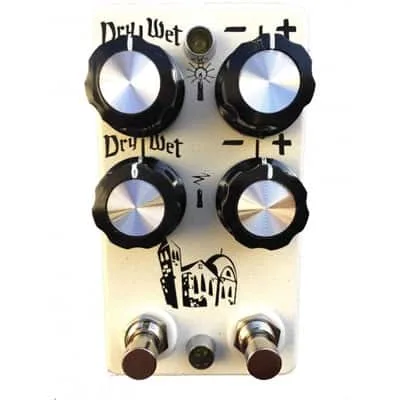


The Monastery is a dual-preset, polyphonic octave generator from Hungry Robot, a pedal that produces octave up and octave down at the same time. The maker describes it as inspired by the rich, multi-layered timbre of vintage organs, with a subtle Leslie warble1. It was announced in July 2017 and launched officially on 1st August 2017, and it was shown to the public at the 7th Brooklyn Stompbox Exhibit on September 9-10, 201723.
Controls and the dual preset design
The Monastery's panel is arranged as two horizontal rows, one for each channel or preset. Each row carries a mix knob on the left and a knob for the ratio between octave up and octave down on the right2. The left knobs are the "Dry/Wet" controls: they adjust the ratio of wet and dry signal and can go from 100% wet to 100% dry, with an even split at twelve o'clock at unity gain. The right knobs are the "+/-" knobs, which work in a similar way but control the ratio of octave up and octave down1.
| Control | What it does |
|---|---|
| Dry/Wet knob (top) | Crossfades between dry and octave signal for the top channel1 |
| +/- knob (each row) | Sets the ratio of octave up to octave down1 |
| Left footswitch | Turns the pedal on and off1 |
| Right footswitch | Toggles between the top and bottom channels1 |
The two footswitches split the work: one toggles the effect on and off, while the other switches between the two sides of the octave effect3. Hungry Robot calls the dual preset function the pedal's most compelling aspect, letting you seamlessly cycle between two presets with the right footswitch1.
Delicious Audio's Paolo De Gregorio noted that Hungry Robot's designer deviated from the standard three-knob "Dry, Up, Down" layout used in many octave pedals and went for a crossfade/pan arrangement instead2.
Power
The Monastery runs on 9V DC with a negative center 2.1mm barrel connector and draws 74 mA1. That draw is higher than many compact pedals, so it is worth keeping in mind on a shared or daisy-chained power supply. It sits among other octave and pitch pedals as a dedicated polyphonic octave unit rather than a multi-effect.
Background and reception
The pedal was announced in July 2017 with an official launch set for 1st August, at an RRP of USD 197.10 plus shipping and taxes3. It was then presented at the 7th Brooklyn Stompbox Exhibit in September 2017, where visitors could try it in person2. Gearnews described it as "billed as a dual preset, polyphonic octave generator"3.
Videos
Premier Guitar
Eirik Stordrange
aBunchOfPedals
Questions
What power does The Monastery need?
The Monastery runs on 9V DC with a negative center 2.1mm barrel connector, the standard supply used by most pedalboard power supplies. It draws 74 mA of current, so a typical isolated supply output handles it, but it is worth checking your supply's per-output budget before sharing or daisy-chaining.
How do you switch between the two sides on The Monastery?
The right footswitch toggles between the top and bottom channels, each of which has its own row of controls. The maker describes this as the pedal's dual preset function, letting you cycle seamlessly between two octave settings during a song. The left footswitch turns the pedal on and off.
How much current does The Monastery draw?
Hungry Robot lists the current draw at 74 mA at 9V DC. That is higher than many simple pedals, so on a shared or daisy-chained supply you should make sure the output can supply it.
What does The Monastery sound like?
Hungry Robot describes The Monastery as inspired by the rich, multi-layered timbre of vintage organs, with a subtle Leslie warble. It generates octave up and octave down simultaneously, and the mix and octave ratio controls let you blend the effect from fully dry to fully wet.
Sources (3)
- The Monastery, Hungry Robot Pedals
- Hungry Robot The Monastery, Delicious Audio, 2017-09-06
- Hungry Robot's The Monastery: A polyphonic octave generator guitar pedal, gearnews.com, 2017-07-28