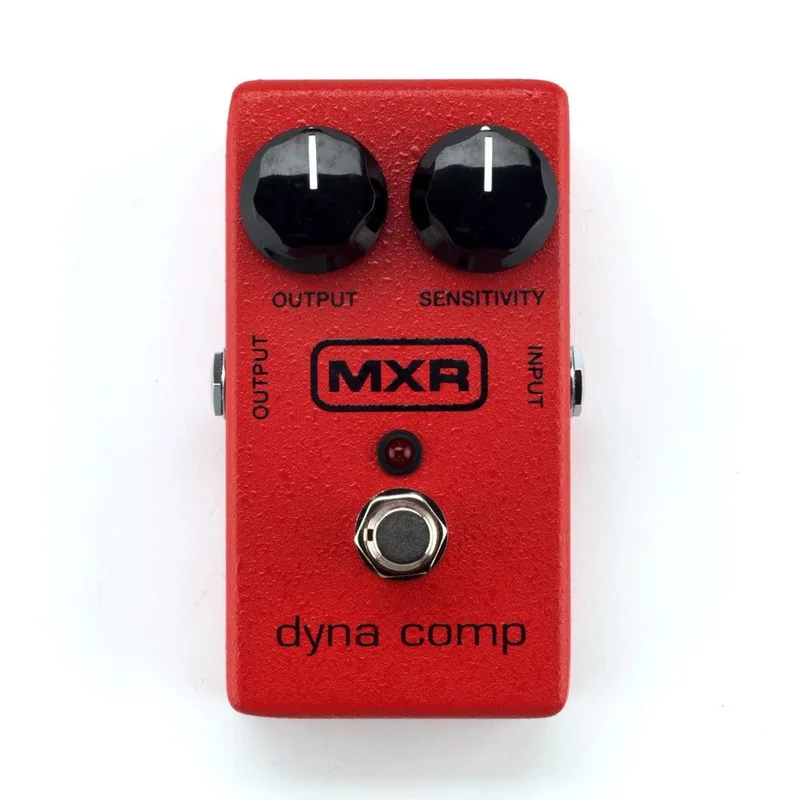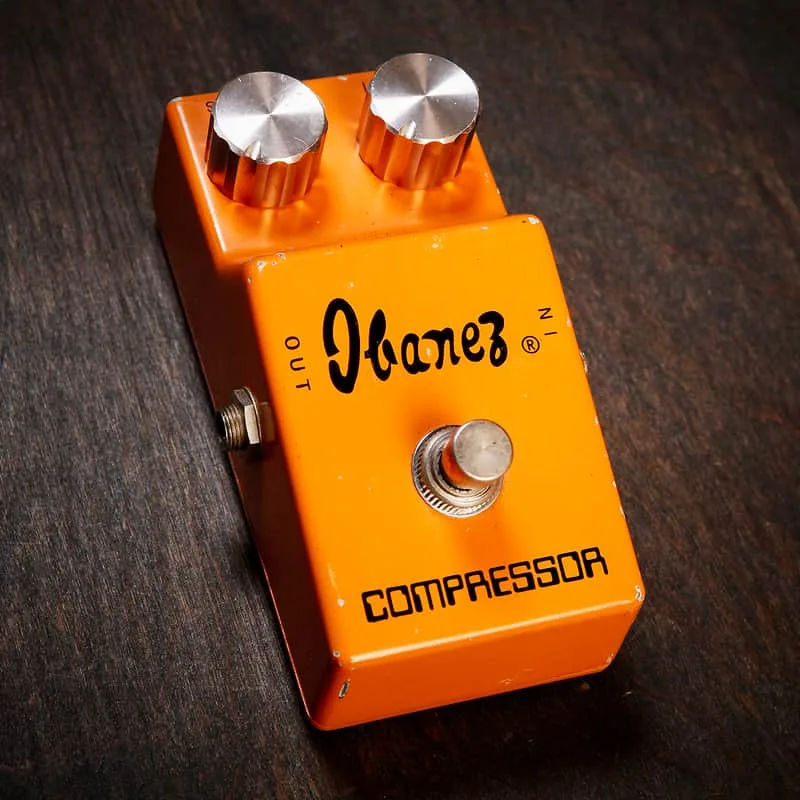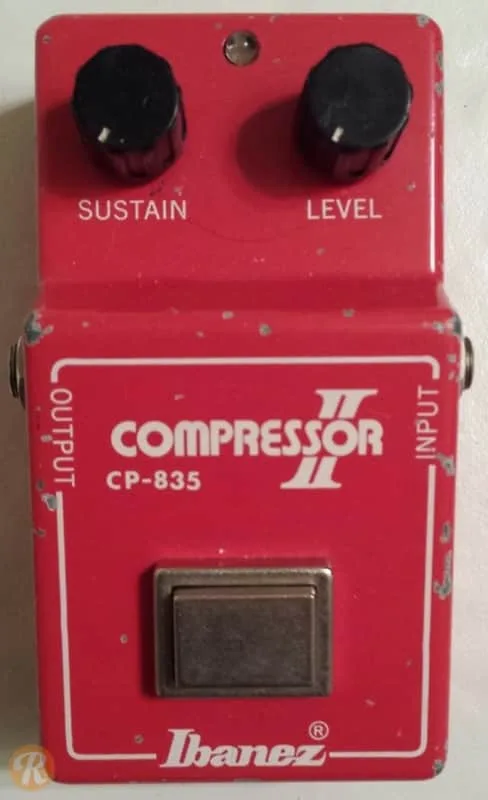

The Ibanez CP-835 Compressor II is a vintage compressor pedal made in Japan, with the standard box versions built from 1980 to 1981 and the earliest examples dating to 197912. It belongs to the first wave of Ibanez compact pedals, and it was never reissued, so every CP-835 you will find today is an original1. TONEHOME describes its sound as "classic, warm vintage compression similar to an MXR Dyna Comp, delivering great sustain and a distinct colored tone, though a bit less transparent than modern units"2.
If you are shopping vintage, the CP-835 is a pedal where the exact version matters. Ibanez revised it several times in a short period, and the differences are visible without opening the pedal up.
Versions from v1 to v7
TONEHOME documents seven versions of the CP-83512:
| Version | Enclosure | Flying fingers graphics | Power jack | Years |
|---|---|---|---|---|
| v1 | standard box | yes | no | 19792 |
| v2 | standard box | yes | yes | 1979 to 19802 |
| v3 | standard box | no | yes | 1979 to 19802 |
| v4 | narrow box with square switch | no | yes | 19802 |
| v5 | standard box, knurled nut on power jack | no | yes | 1980 to 19811 |
| v6 | standard box, plain power jack | no | yes | 1980 to 19811 |
| v7 | standard box, plain power jack | no | yes | with level markers1 |
The practical way to tell them apart is to look at three things in order: the side graphics, the power jack, and the box shape. The flying fingers graphics only appear on v1 and v2, and v1 has no power jack at all, meaning it runs on battery only2. Version 4 is the odd one out, a narrow box with a square footswitch that Ibanez also used for other pedals in that series2. From v5 onward the pedals are standard boxes again, and the last differences are small: v5 has a knurled nut on the power jack, v6 has a plain one, and v7 adds level markers1.
A v1 CP-835 has no power jack, so it can only be powered by battery. If you plan to put one on a pedalboard with a power supply, that version is not a candidate.
The flying fingers
The flying fingers are the side graphics that mark the earliest CP-835s. They appear on v1 and v2 only, covering the 1979 to 1980 period, and were dropped when version 3 arrived2. Among vintage Ibanez collectors these graphics are a recognized marker of the first-issue pedals, and ToneHome has separately sought other first-issue narrow box Ibanez pedals with flying finger side graphics for its collection2.
Circuit and sound
TONEHOME describes the CP-835's circuit as similar to an MXR Dyna Comp2. In plain terms, that places it in the family of simple vintage optical-style compressors: one or two controls, strong sustain, and a colored tone rather than a transparent one. TONEHOME's description is explicit about that trade, calling the compression classic and warm but "a bit less transparent than modern units"2. Players used to modern compressor pedals should expect a more colored character.
The Compressor II was built in Japan and sold from 1980 to 1981 in its standard-box version, with a German list price of 148 DM in 1980 and 179 DM in 198112. Ibanez has not re-issued it1. For context on what a compressor does to a signal, see Compressor Pedals.
Collectibility
TONEHOME rates the CP-835's collectibility as high and its availability as good1. That combination tells you something useful: the pedal is sought after as a vintage Ibanez, but examples come onto the market often enough that finding one is realistic. The original German list prices, 148 DM in 1980 and 179 DM in 1981, are recorded by TONEHOME12. Because the pedal was never reissued, condition and version are the main things that separate one example from another, with the flying fingers versions and the narrow box v4 standing apart from the later standard boxes2.
Videos
akallons
akallons
Questions
Is the Ibanez CP-835 based on the MXR Dyna Comp?
TONEHOME describes the CP-835's circuit as similar to an MXR Dyna Comp, and its sound the same way: classic, warm vintage compression with great sustain and a distinct colored tone, though a bit less transparent than modern units. It is a close relative in character rather than a documented clone, so players who know the Dyna Comp will find familiar territory.
Has the Ibanez CP-835 Compressor II been reissued?
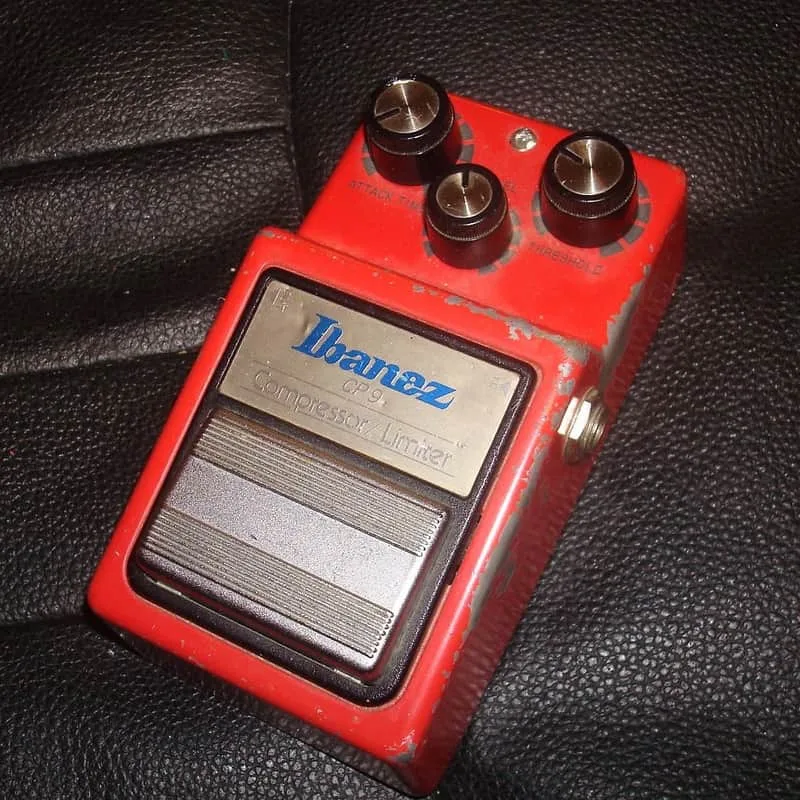
No. TONEHOME lists the CP-835 as not re-issued, so every example on the used market is an original from the production period around 1979 to 1981. Ibanez later offered other compressors, such as the CP9 Compressor/Limiter and the CP10 Compressor/Sustainer, but those are different designs.
Where was the Ibanez CP-835 made?
The CP-835 was made in Japan. TONEHOME dates the standard box versions to 1980 to 1981, with the earliest versions appearing in 1979. Japanese manufacture is typical of Ibanez pedals of that era.
What are the flying fingers on the CP-835?
The flying fingers are side graphics found on the first two versions of the CP-835. Version 1 from 1979 has the flying fingers and no power jack, and version 2 from 1979 to 1980 keeps the graphics and adds a power jack. From version 3 onward the graphics were dropped.
How can you tell the CP-835 versions apart?
Check three things: the side graphics, the power jack, and the enclosure. Versions 1 and 2 carry the flying fingers graphics, version 1 with no power jack and version 2 with one. Version 3 has a power jack but no graphics. Version 4 is a narrow box with a square switch from 1980, and versions 5 to 7 are standard boxes, distinguished by the power jack hardware and the presence or absence of level markers.
Is the CP-835 collectible?
TONEHOME rates the CP-835's collectibility as high and its availability as good, meaning examples do turn up for sale regularly despite the pedal's collector appeal. Original examples have not been reissued, which supports their standing among vintage Ibanez pedal collectors.