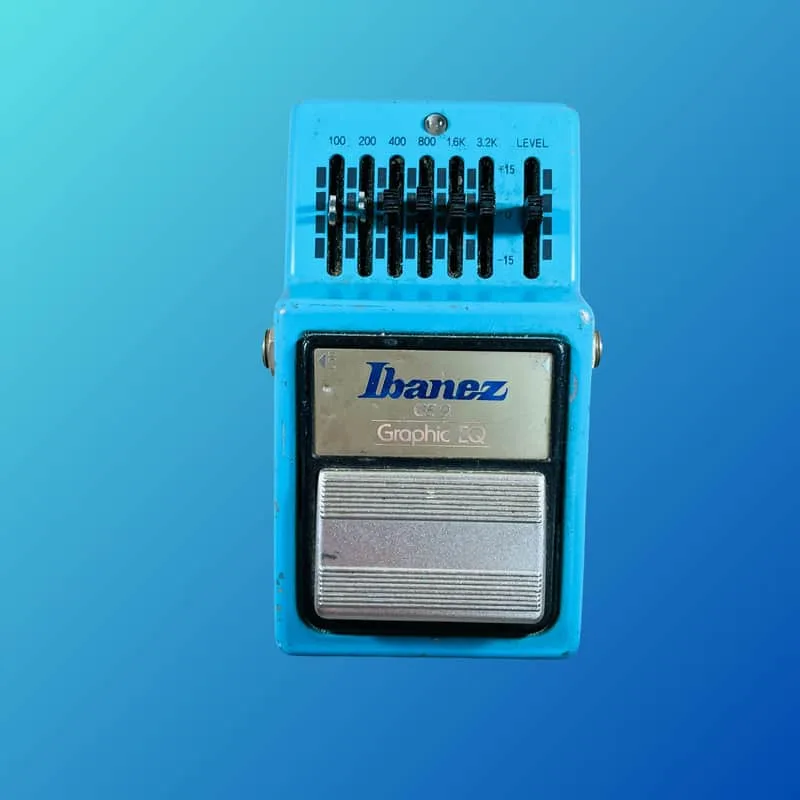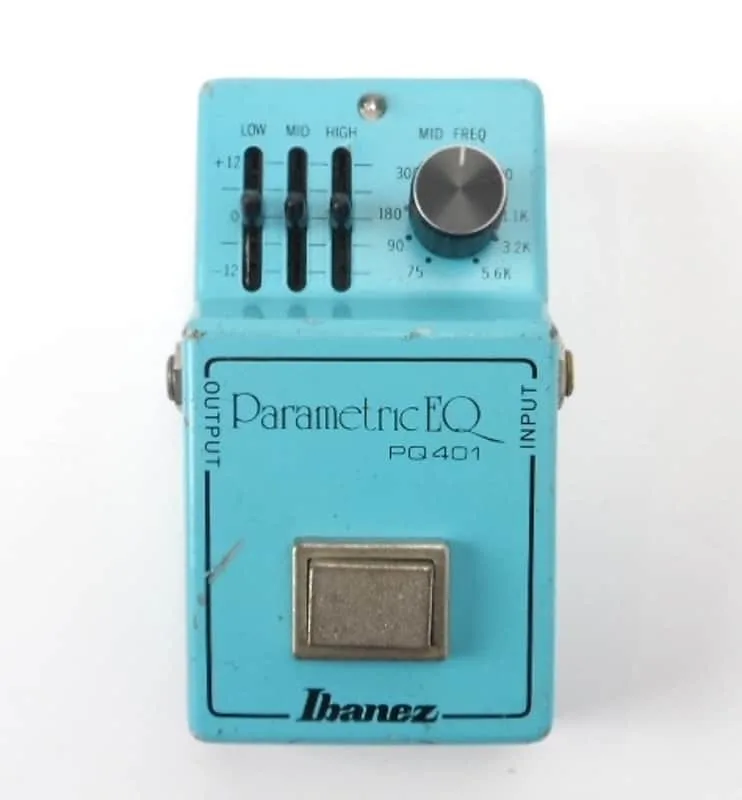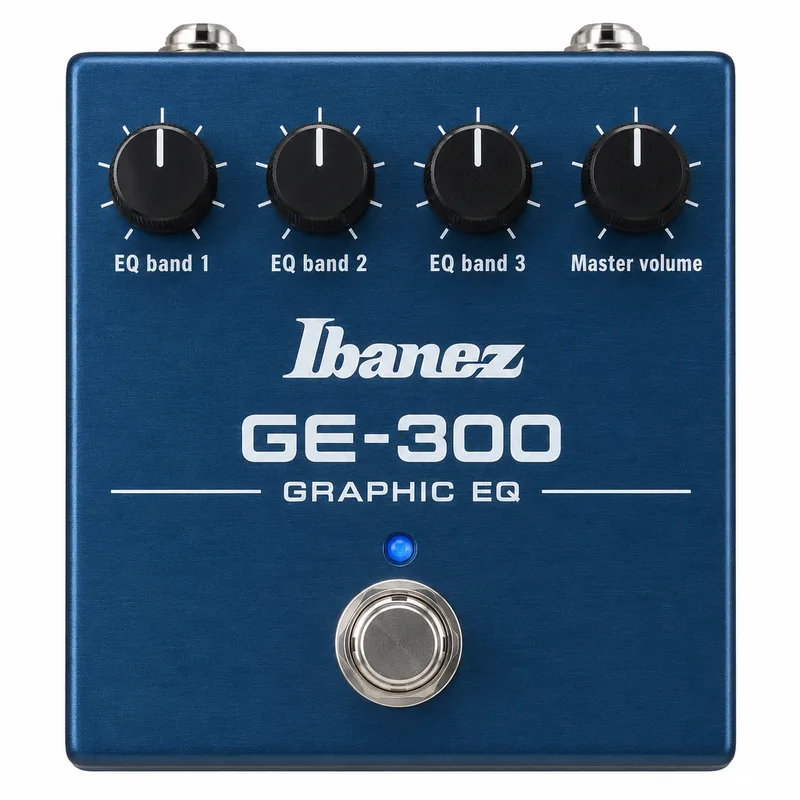
The Ibanez GE-300 Graphic EQ is a vintage graphic equalizer pedal from Ibanez's Wide Box series, produced from 1979 to 19801. It gives a player 12 dB of boost or cut across three frequency bands, which TONEHOME describes as tastefully chosen, and its master volume can add a further 20 dB of gain on top1. That makes it usable both as a tone-shaping EQ and as a clean level boost into an amp.
Controls and what they do
The GE-300's front panel is simple: three EQ bands plus a master volume. Each band gives the player 12 dB of boost or cut at its center frequency, and the master volume sits after the EQ, able to add up to 20 dB of gain on top of whatever the bands are set to1.
| Control | Function |
|---|---|
| EQ band 1 | 12 dB of boost or cut1 |
| EQ band 2 | 12 dB of boost or cut1 |
| EQ band 3 | 12 dB of boost or cut1 |
| Master volume | Up to 20 dB of additional gain1 |
Power and headroom
The GE-300 runs on 18 volts rather than the 9 volts common to most floor pedals. TONEHOME explains the reasoning: "Running at 18 volts gives the GE-300 more headroom than conventional 9 volt floor based EQ pedals, resulting in a much clearer sound with more dynamic range"1. For a player, that headroom matters most when the pedal is pushed hard, either by a hot guitar signal or by the higher levels some amps send down an effects loop. TONEHOME notes this makes the GE-300 particularly well suited to the higher signal levels present in some effects loops1.
The GE-300's 18 volt requirement means it will not run from a standard 9V daisy-chain output or a battery in the usual way. Check any power arrangement before slotting one into a board.
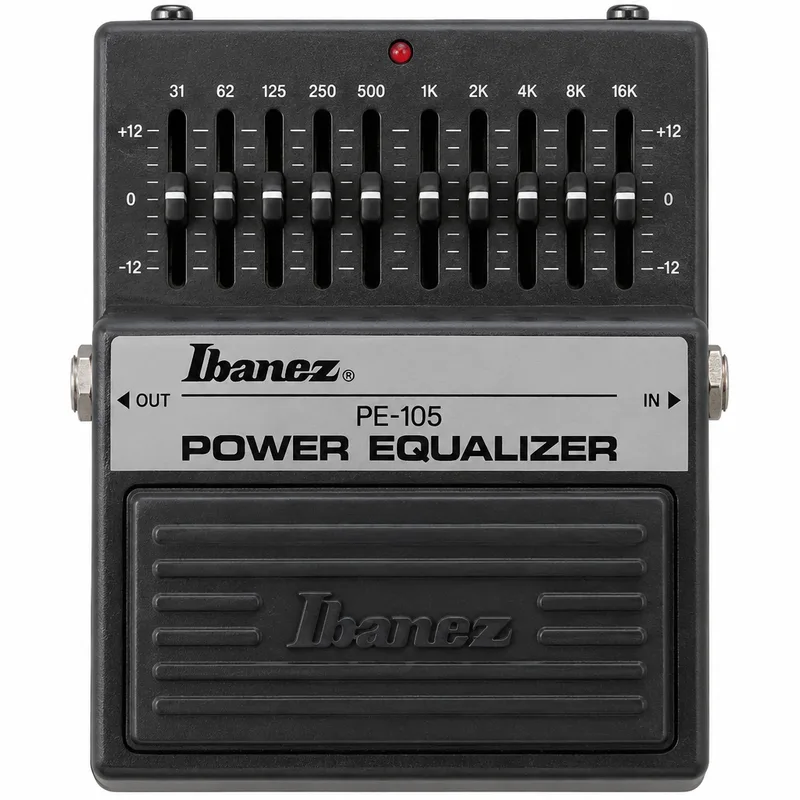
A successor to the PE-105 Power Equalizer
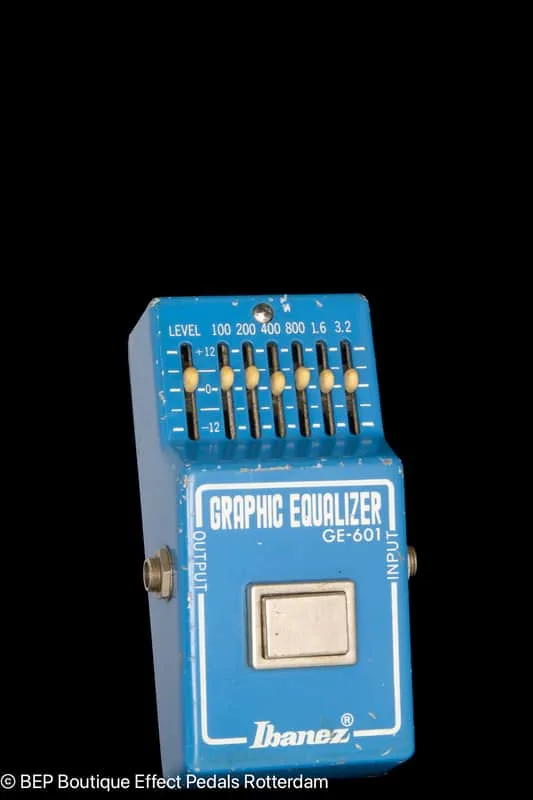
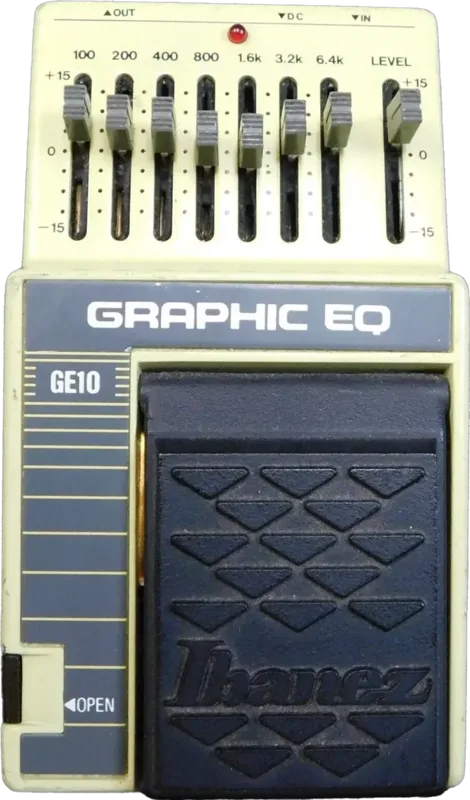
Within Ibanez's own line, the GE-300 followed the PE-105 Power Equalizer, which TONEHOME describes as short-lived1. The GE-300 carried the idea forward as a graphic EQ, and Ibanez continued the graphic EQ concept in later pedals such as the GE-601 Graphic Equalizer and the GE-10 Graphic EQ. For more on the effect type itself, see Equalization Pedals.
| Pedal | Years | Type |
|---|---|---|
| PE-105 Power Equalizer | not given1 | Power Equalizer1 |
| GE-300 Graphic EQ | 1979 to 19801 | Graphic Equalizer1 |
| GE-601 Graphic Equalizer | later Ibanez graphic EQ1 | Graphic Equalizer |
| GE-10 Graphic EQ | later Ibanez graphic EQ1 | Graphic EQ |
Rarity and collectibility
TONEHOME lists the GE-300's availability as rare and its collectibility as high1. The short two-year production run and the absence of any re-issue are the main reasons. The pedal's original list price was 185 DM on Ibanez's 1980 German retail price list1.
For a collector or player hunting one today, the practical picture is:
- Production lasted only from 1979 to 19801
- TONEHOME lists it as not re-issued1
- Availability is listed as rare, with high collectibility1
- Its 18 volt power requirement sets it apart from typical 9 volt floor pedals1
Questions
Does the Ibanez GE-300 run on 9V?
No. The GE-300 runs on 18 volts, not the 9 volts that conventional floor EQ pedals use. TONEHOME notes that running at 18 volts gives the pedal more headroom than a 9 volt design, which it says results in a clearer sound with more dynamic range. That higher requirement is worth knowing before putting one on a pedalboard power supply.
Why does the GE-300 run on 18 volts?
The higher voltage gives the circuit more headroom than conventional 9 volt floor based EQ pedals. According to TONEHOME, that extra headroom produces a much clearer sound with more dynamic range, and it also suits the higher signal levels found in some amp effects loops.
Has the Ibanez GE-300 been reissued?
No. TONEHOME lists the GE-300 as not re-issued. The pedal was produced from 1979 to 1980 only, so any example on the used market is an original from that short production run.
Is the GE-300 good in an amp's effects loop?
TONEHOME says the GE-300 is particularly well suited to the higher signal levels present in some effects loops, a benefit of its 18 volt design and the headroom that comes with it. Players whose amps have a loop-level send may find it a natural home for the pedal.
How rare is the Ibanez GE-300?
TONEHOME lists the GE-300's availability as rare and its collectibility as high. Production lasted only from 1979 to 1980, and the pedal has never been re-issued, so examples do not come up often.
Sources (1)
- TONEHOME, TONEHOME, 1980