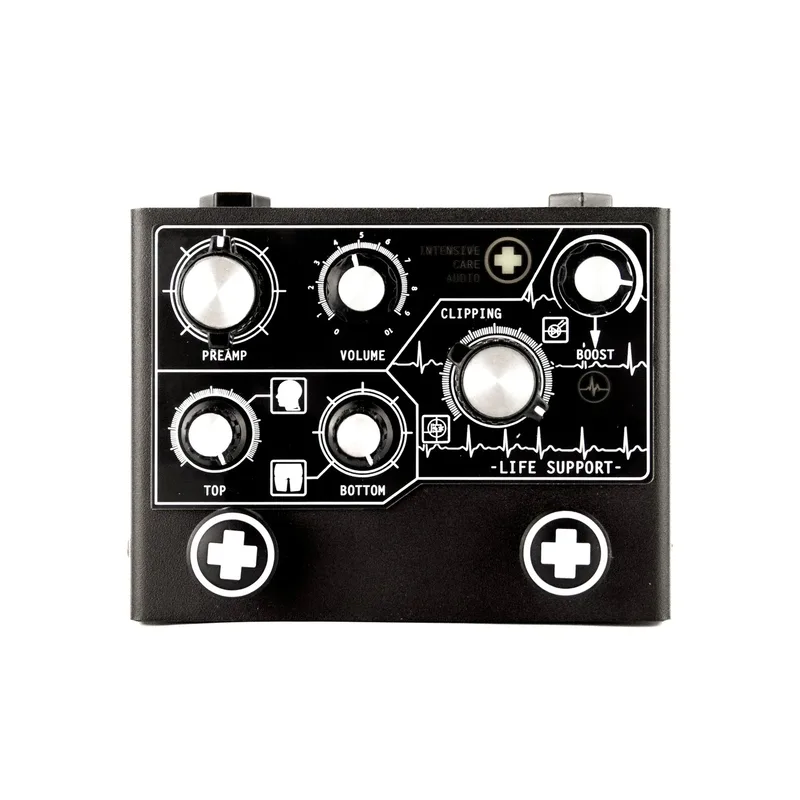


The Intensive Care Audio Life Support is an all-analog overdrive and distortion pedal with a built-in JFET boost stage that drives the front end of the overdrive circuit. The maker describes it as "a high-fidelity, all-analogue overdrive and distortion pedal" with six controls, and positions its gain range from clean, chiming tones through tube-like edge-of-breakup into grittier distortion territory1.
What sets it apart from most overdrives is its clipping control: instead of one fixed diode arrangement, you blend between a parallel MOSFET/JFET pair and LED clipping with a single knob. Guitar Pedal X reviewed it at launch in December 2023 and called it "one of those rare pretty distinct sounding overdrives," giving it its own informal category, Spanky BritPop Overdrive2.
The boost and the overdrive
The Life Support is really two gain stages in series. The BOOST knob controls the gain of a boost circuit that feeds the front end of the overdrive circuit. Intensive Care Audio is explicit that this stage "cannot be used independently of the overdrive": its job is to push the overdrive harder, increasing gain and compression, and to serve as a boost for lead and solo situations1.
Guitar Pedal X's reviewer, Stefan Karlsson, characterized the JFET boost as slightly dirty, so turning it clockwise raises both volume and gain rather than acting as a clean volume lift. He also noted the pedal "was actually mostly engineered for the lower-gain voicings," with the boost included to get the most out of its subtler settings2.
The PREAMP knob sets the gain of the overdrive itself. In the maker's words, it ranges "from sparkly, chiming clean tones to natural, tube-like edge-of-breakup, and on into grittier distortion territory," and it interacts with the CLIPPING control in ways worth exploring1.
The clipping control: MOSFET/JFET to LED
The CLIPPING knob is the pedal's distinguishing feature. It blends between two clipping arrangements1:
- Fully counter-clockwise: a parallel arrangement of a MOSFET and a JFET, which the maker says produces "harder, compressed, saturated clipping"1
- Fully clockwise: LED clipping, for "a softer, more transparent breakup"1
- In between: a continuous blend of the two1
Karlsson described the sweep in practical terms: the dial "goes from its dirtiest / gainiest fully CCW, and then increasingly opens up with LED clarity as you rotate" it, with the fully clockwise LED setting rendering a little louder2. For a player, that means one knob moves you from a compressed, saturated feel toward a more open, transparent one, and the PREAMP control's character changes as you move it.
All six controls
| Control | What it does |
|---|---|
| PREAMP | Sets overdrive gain, from clean chime through edge-of-breakup to distortion1 |
| CLIPPING | Blends between MOSFET/JFET clipping (counter-clockwise) and LED clipping (clockwise)1 |
| BOOST | Sets the gain of the boost circuit driving the overdrive's front end; not usable on its own1 |
| VOLUME | Sets overall output volume, including when boost is engaged1 |
| TOP | Passive subtractive treble filter after the last gain stage, for taming highs that grow with gain or clipping changes1 |
| BOTTOM | Subtractive bass filter after the last gain stage, variably bypassing the output capacitor before the output transformer1 |
One quirk worth knowing: because the BOTTOM control sits in parallel with the output capacitor, the maker warns that "some crackle may be present when adjusted at lower gain settings"1.
The BOTTOM control can crackle when adjusted at lower gain settings. This is a characteristic of its parallel placement with the output capacitor, not a fault, according to the maker1.
What reviewers said
Guitar Pedal X covered the Life Support twice in December 2023. At launch, Karlsson described its voicing as "a bright, spanky, articulate British Pop voicing, spanning 60's psychedelia and 90's Britpop, with note clarity, bell-like strings and smooth vintage fuzz at higher gain"2. In the site's year-end round-up of the best new boost and overdrive pedals, he called it "a very uniquely voiced classic British 60's and 90's pop voiced overdrive with a psychedelic edge, and exceptional note clarity," while adding one criticism: it "could do with more output volume overall"3.
The same round-up listed it at £184 / £2203, and the maker's webstore price as of 25 October 2026 is £220.001.
Where it came from and where to find it
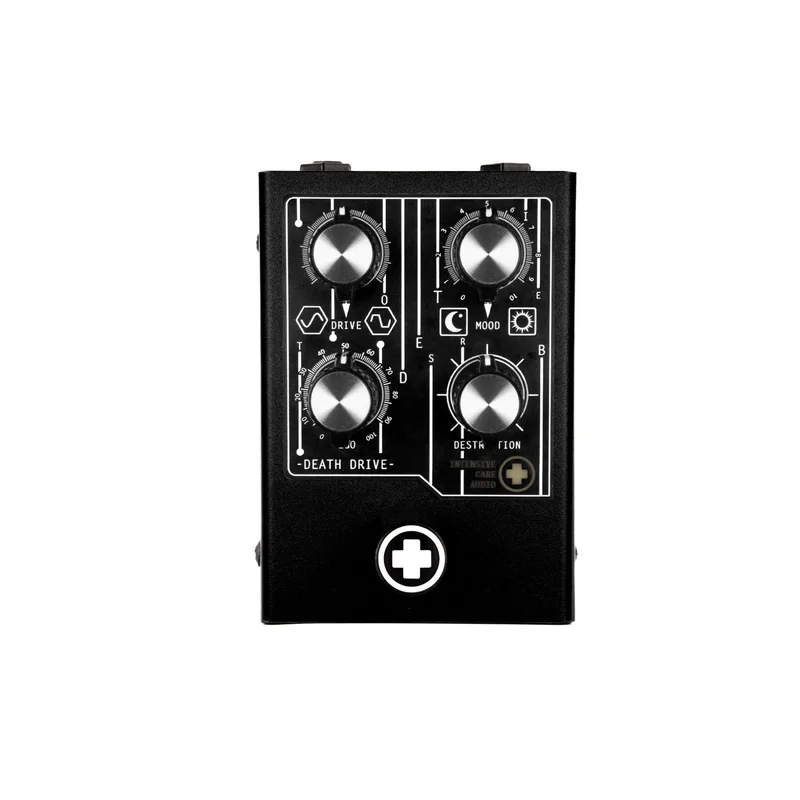
Intensive Care Audio launched the Life Support Overdrive + Boost in December 20232, priced at £220.00 GBP1. The company also makes the Death Drive, and all of its pedals are built in London, England1.
For players comparing circuits, the Life Support's blendable clipping and series boost put it in different territory from a fixed-diode overdrive like the Boss SD-1 vs Ibanez TS9 pair, and its boost stage is a gain-stage design rather than a standalone boost pedal.
Videos
INTENSIVE CARE AUDIO
The Pedal Zone
collector//emitter
Questions
Can the boost on the Life Support be used on its own?
No. The boost circuit drives the front end of the overdrive circuit and cannot be used independently of it. Its purpose is to push the overdrive harder, adding gain and compression, and to act as a boost for lead and solo situations. Guitar Pedal X notes the JFET boost is slightly dirty, so it raises both volume and gain as you turn it up.
Is the Intensive Care Audio Life Support true bypass?
Yes. The maker specifies soft-touch, relay-based true bypass switching, so with the pedal off your signal passes through without buffering or coloration, and the switch action itself is the quiet, momentary type rather than a mechanical latch.
Is the Life Support analog?
Yes. Intensive Care Audio describes the Life Support as a high-fidelity, all-analogue overdrive and distortion pedal, and all of the company's pedals are built in London, England, using what it calls high-quality components.
Does the Life Support have enough output volume?
It depends on what you need. The Volume control sets the overall output, including when the boost is engaged, and the boost itself raises volume as well as gain. However, Guitar Pedal X's 2023 round-up praised the pedal's voicing and note clarity while adding that it could do with more output volume overall.
Sources (3)
- LIFE SUPPORT, Intensive Care Audio
- Guitar Pedal X, Guitar Pedal X, 2023-12-06
- Guitar Pedal X, Guitar Pedal X, 2023-12-16