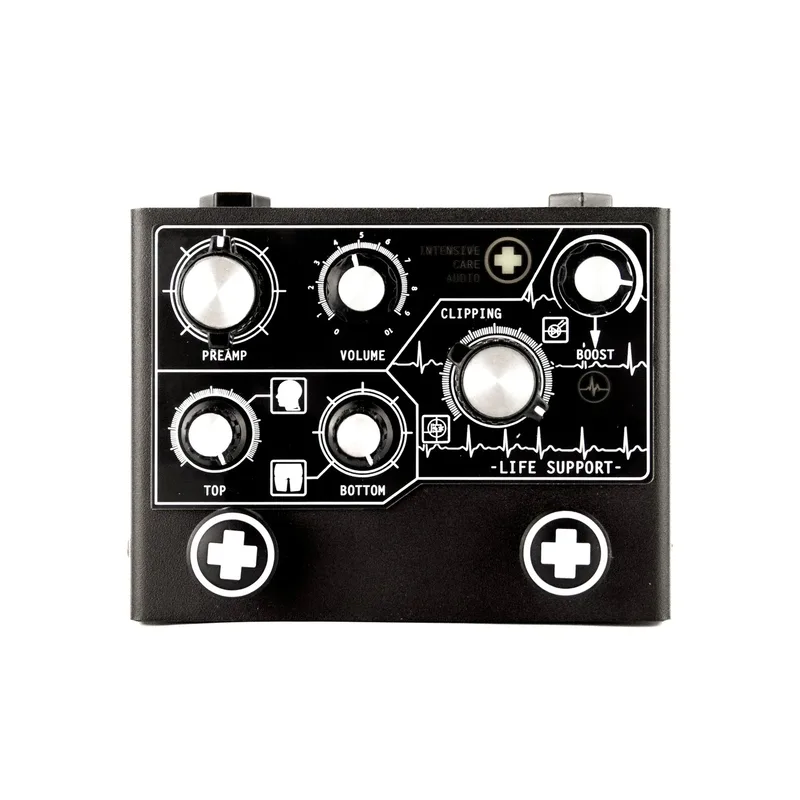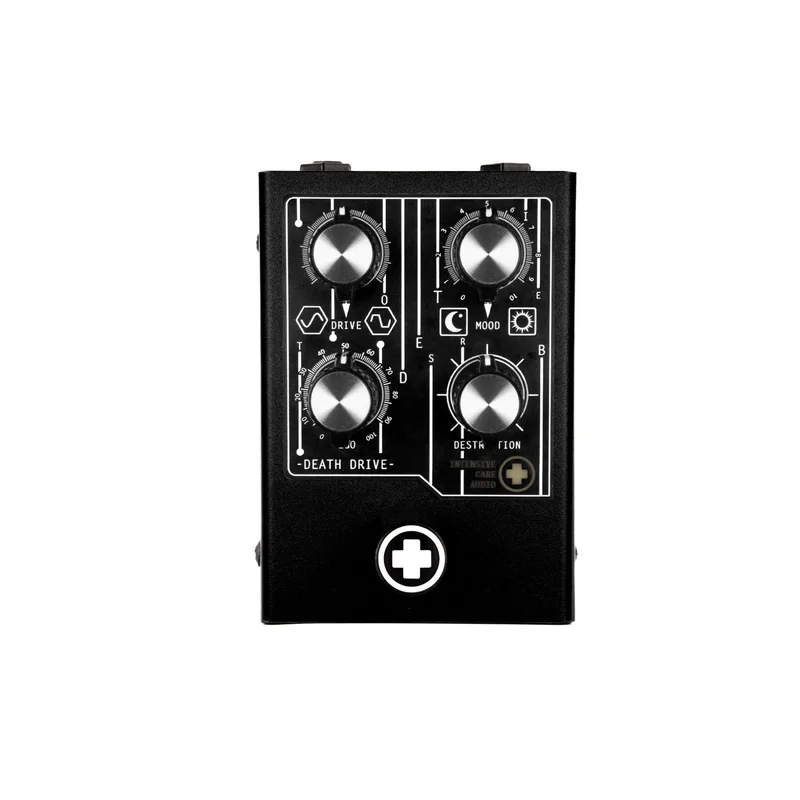


The Intensive Care Audio Death Drive is an original, all-analog overdrive and distortion pedal, one of three black pedals in the London maker's roster with names borrowed from hospital jargon1. Delicious Audio described it as "sludgy and dark, the Intensive Care Audio Death Drive is a high-gain pedal with its own voice that can cover a lot of ground from overdrive to distortion"1. It is built in London, England, and as of late October 2026 it is listed as sold out on the maker's own page2.
What the Death Drive does
The Death Drive sits in the gain-pedal space between a conventional overdrive and a full distortion. Intensive Care Audio calls it a high-output device, and that output level is a feature in itself: the maker says it is "suitable for pushing tube amplifiers further into breakup"2. In practice that means the pedal can be used the way many players use a boost, driving the front end of an amp harder, while also supplying its own distortion character.
The maker describes the range of that character through its Destruction control: at lower settings it "provides natural, tube-like distortion full of vintage character," while at higher settings "the distortion becomes pleasantly compressed and saturated while still retaining clarity and individual note definition"2. Delicious Audio's take on the pedal's overall voice was sludgy and dark, with enough range to cover ground from overdrive to distortion1.
The controls: Ego, Destruction and Drive
The Death Drive has three knobs, and the two gain controls are designed to work together rather than independently2.
| Control | What it does |
|---|---|
| Ego | Sets the overall volume of the effect. Because the pedal is high output, this is also what pushes a tube amp further into breakup. |
| Destruction | The main distortion control, ranging from subtle to extreme. Low settings give natural, tube-like distortion with vintage character; high settings give compressed, saturated distortion that the maker says retains clarity and note definition. |
| Drive | A secondary gain control. Used with Destruction, it fine-tunes the exact saturation of the signal. |
The interactivity of the two gain controls is the pedal's core idea: Intensive Care Audio says Destruction and Drive together "provide a wide range of tonal remedies," so the same pedal can be dialed from a light edge to a saturated wall2. Players who like to set a base character on one knob and sweep the other for different sections will find that layout familiar.
Power and build
The Death Drive runs on a 9V DC center-negative supply, and the maker specifically advises using only high-quality supplies of that type2. Delicious Audio lists its current draw at 95mA1, which is higher than many simple analog drives (Death By Audio's all-analog pedals, for comparison, draw between 1 and 5.8 mA), so it is worth accounting for on a shared power supply.
Build details from the maker's page2:
- Built in London, England, with high-quality components
- Soft-touch, relay-based true bypass on all Intensive Care Audio pedals
- Enclosure measuring 126 mm long by 88 mm wide (5.0 in by 3.5 in), with a height that tapers from 45 mm to 27 mm (1.8 in to 1.1 in)
- Weight of 323g
The relay-based true bypass is worth noting for players comparing switching types: the signal path is bypassed entirely when the pedal is off, and the relay does the switching rather than a mechanical footswitch contact, which is what the "soft-touch" description refers to2.
Origins and the Death Muff connection
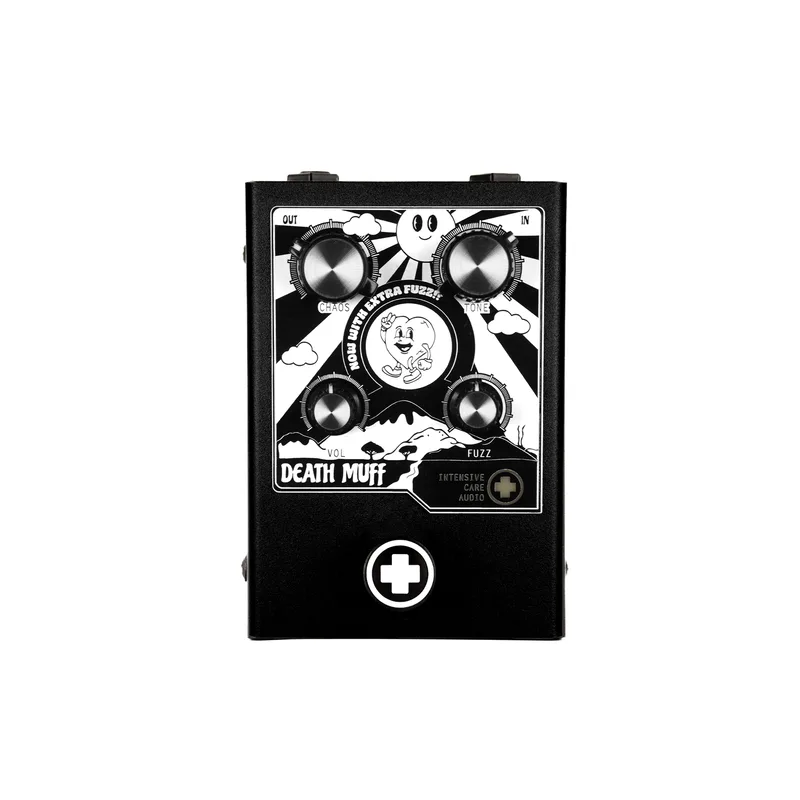
Intensive Care Audio builds its pedals in London, England, and the Death Drive sits in a small roster of hospital-jargon-named pedals that includes the Death Muff, a high-gain, expressive Big Muff style fuzz1. The Death Muff takes its circuit beyond the higher gain even of the original 1969 Triangle Edition Big Muff, and one reviewer called it a superbly textured next level evolution of a Muff3.
The circuit link to the Death Muff is concrete. Guitar Pedal X reports that the Death Muff uses a mix of BC337 and BC547 transistors, "which are the same as are used in the Intensive Care Death Drive pedal too"3. The Death Muff itself is a high-gain take on a Big Muff style circuit: Guitar Pedal X called it "a high-gain, expressive Big Muff Style Fuzz" and "the angrier version of the circuit, beyond the higher gain even of the original 1969 Triangle Edition"3. So the two pedals share silicon, while the Death Drive points that hardware at overdrive and distortion rather than fuzz.
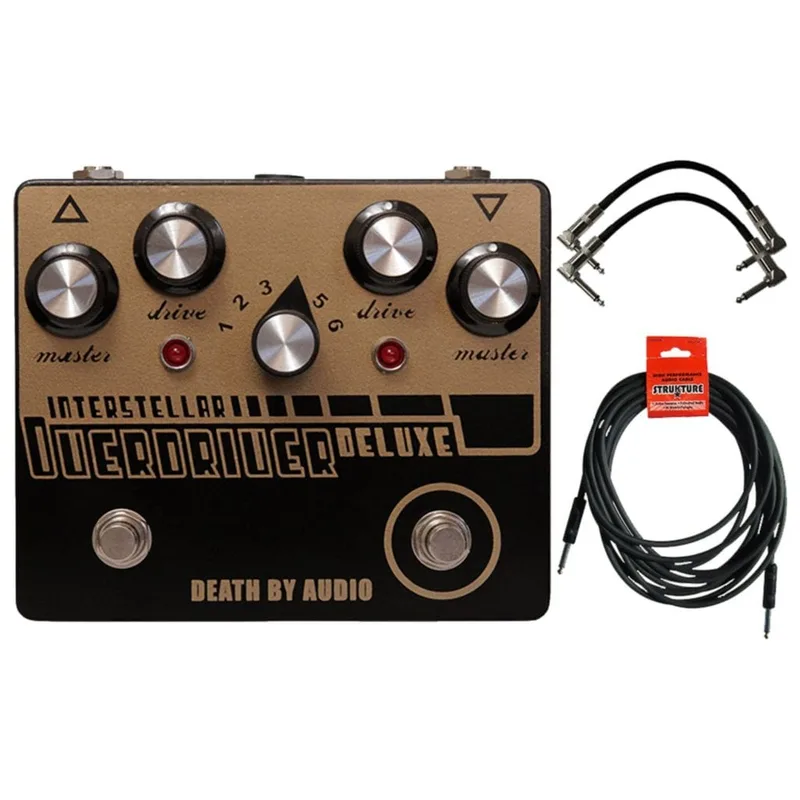
For context on where the Death Drive sits among gain pedals more broadly, Death By Audio's Interstellar Overdriver covers similar ground from the opposite direction, described by its maker as sounding like a cranked 50s tube amp with drive from a slight boost to harmonically rich overdrive4.
Both the Death Drive and the Death Muff are listed as sold out on Intensive Care Audio's site as of October 202625. The company's pages remain live, but no stock is shown for either pedal.
Videos
The Pedal Zone
Jackson Brooksby
Break the Machine
Questions
Is the Intensive Care Audio Death Drive true bypass?
Yes. Intensive Care Audio says all of its pedals, the Death Drive included, use soft-touch, relay-based true bypass switching. That means the signal passes through no active circuitry when the pedal is off, and the switch itself is a quiet relay rather than a mechanical click.
How much current does the Death Drive draw?
Delicious Audio lists the Death Drive's current draw at 95mA. That is modest by digital standards but higher than many simple analogue drives, so it is worth checking the headroom on a small daisy-chain supply if you run several pedals from one output.
Is the Death Drive still available?
As of late October 2026 the Death Drive is listed as sold out on Intensive Care Audio's own product page, and the Death Muff is sold out too. The company itself remains active, so a restock or a follow-up release is possible, but nothing is listed as in stock right now.
What transistors are in the Death Drive?
Guitar Pedal X reports that the Death Drive uses a mix of BC337 and BC547 transistors, the same types used in the company's Death Muff fuzz. Both are common, inexpensive bipolar transistors, which fits the pedal's all-analogue design.
Can the Death Drive push a tube amp into breakup?
Yes, that is part of the design. Intensive Care Audio describes the Death Drive as a high-output device suitable for pushing tube amplifiers further into breakup, with the Ego control setting the overall volume of the effect.
Sources (5)
- Intensive Care Audio Death Drive, Delicious Audio, 2023-07-11
- DEATH DRIVE, Intensive Care Audio
- Guitar Pedal X, Guitar Pedal X, 2025-11-21
- INTERSTELLAR OVERDRIVER - Death By Audio, Death By Audio
- DEATH MUFF, Intensive Care Audio